Vera Delivers the Best of Both Worlds: Highest Throughput and Fastest Agents
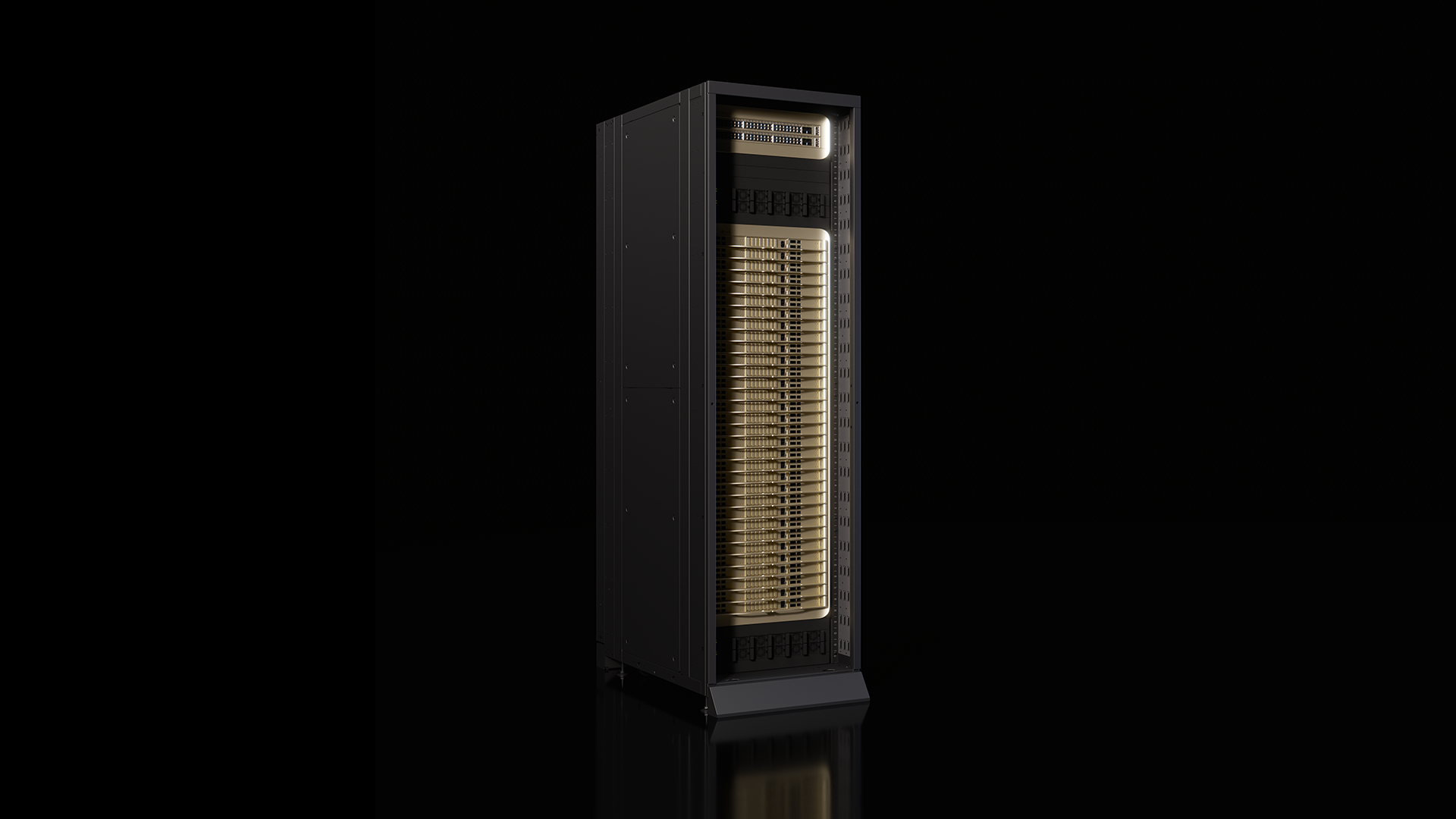
NVIDIA published benchmark claims positioning its Vera CPU as a single part that serves both speed-sensitive and capacity-sensitive agent workloads, rather than forcing operators to choose between fast and dense x86 chips. The comparison NVIDIA describes is a 100-megawatt data center scenario, a framing that reflects the company's argument that AI factories are power constrained and operators must maximize work done per watt. Against the fastest x86 CPU tested, NVIDIA says Vera enables 1.6x more agents per watt; against the most energy-efficient x86 CPU, it claims 2x faster agent speed while retaining leading energy efficiency.
The context NVIDIA offers for the CPU's role is worth spelling out. An AI agent does not only generate text: it searches for information, queries databases, writes and tests code, and takes actions. Each of those steps runs on a CPU, and a task bounces repeatedly between GPU-side reasoning and CPU-side execution. That makes per-core speed and aggregate capacity matter at the same time, because a slow CPU step stalls the whole agent loop while insufficient core counts cap how many agents can run concurrently. This is NVIDIA's own framing of the workload, and it explains why the company is pitching one CPU rather than a mix of x86 parts tuned for different ends of the speed-versus-density spectrum.
NVIDIA also cited results from several early partners running production-style tests. Perplexity reported agentic coding tasks running 1.5x faster on Vera than on traditional CPUs and plans to deploy Vera in an upcoming production system. DeepInfra reported up to 2.2x the speed of the best x86 processor on agentic orchestration for its production agent workload, which NVIDIA says was the fastest of four architectures tested. ClickHouse reported that its standard binary, without any Vera-specific tuning, scaled near-linearly across 176 cores and topped the ClickBench hardware leaderboard. DuckLabs reported roughly 1.5x the median TPC-H SF1000 performance of an Intel Xeon 6 baseline. Daytona said it brought 1,000 agent sandboxes online in 10.8 seconds on Vera, against 88.4 seconds on x86, and reached 12.7 completed jobs per second at 2,000 concurrent sandboxes. Modal reported up to 2x sandbox throughput per core versus comparable x86 hardware, with the gains widening under heavy load.
Those partner numbers cluster into two themes. Several are sandbox or orchestration measurements, where the CPU is largely spawning, scheduling and isolating short-lived environments; Daytona's startup time and Modal's per-core throughput fall into this bucket, and both point at provisioning overhead rather than raw compute. The ClickHouse and DuckLabs results are database-oriented, and the notable detail in ClickHouse's case is that near-linear scaling came from an unmodified binary, which suggests the gains stem from core count and memory behavior rather than a bespoke software build. This is my reading of the figures, not something NVIDIA states.
A few caveats are worth flagging for anyone weighing these numbers. All benchmarks come from NVIDIA or from partners NVIDIA selected for the announcement, and the x86 comparisons do not specify exact SKUs, core counts, memory configurations or power envelopes, so the 1.6x and 2x ratios are hard to reproduce independently. The 100-megawatt framing is a modeled data center comparison rather than a single-system test, and per-watt claims are sensitive to assumptions about utilization and cooling. The workloads described are agent-centric, so the results say less about conventional throughput-bound services. Treat the partner figures as directional pointers to where Vera helps most: high-concurrency sandbox orchestration and CPU-bound database execution.
Why it matters: Teams building agent platforms have usually scaled by buying more x86 cores and accepting slower per-step latency, or by buying faster cores and accepting lower density; NVIDIA is arguing Vera removes that trade-off within a fixed power budget. If the claims hold up under independent testing, infrastructure providers could standardize on one CPU family for a wider range of agent workloads, which in practice may simplify fleet planning and procurement. Inference: the sandbox-related numbers from Daytona and Modal suggest the most immediate beneficiaries are platforms that spin up and tear down many short-lived execution environments, where provisioning time directly bounds agent throughput.
Based on reporting from the original publisher. Visit the source for full context and later updates.
Publisher excerpt
AI agents do more than generate answers. They search for information, query databases, write and test code and take action. Each of those steps relies on a CPU, with agents moving between GPU reasoning and CPU execution throughout a task. As businesses put more agents to work, AI factories need CPUs that can execute those […]