Our newest AI Quest: Mapping the human brain
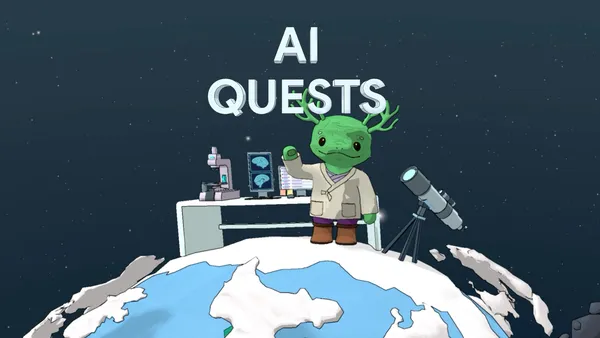
Google Research and the Stanford Accelerator for Learning have released "Polar Peaks," the third lesson in the AI Quests series, aimed at students ages 11 to 14. The announcement comes from Ronit Levavi Morad, a Senior Director at Google Research. In the new quest, students take on the role of researchers mapping neurons in the brain to understand why a game character is experiencing memory loss, and they work through tasks such as data cleaning and model testing along the way.
The design puts AI literacy alongside neuroscience. The stated aim is for students to see how AI helps scientists study the brain and accelerates research, while also learning that the technology needs careful human oversight and critical thinking. Mentors inside the game guide students through the scanning and mapping exercises, and on finishing the quest students hear from two researchers involved in Google's real-world work, including the recent mapping of the complete fruit fly brain, which the announcement describes as the largest brain map by number of neurons to date.
The series now spans three quests, each drawn from an area of Google Research. The first two covered flood forecasting, inspired by the company's Flood Forecasting initiative, and eye disease detection, based on its AI model for diabetic retinopathy screening. Across the program, Google says more than 400,000 quests have been completed to date, and the material has been localized into 10 languages.
Polar Peaks draws on more than a decade of Google research in connectomics, the science of mapping the neural networks in the brain. That background helps explain the choice of subject. Connectomics produces large, dense datasets in which individual neurons and their connections must be traced and labeled, often with the help of machine learning models that propose reconstructions for human reviewers to check. This is my own reading of why the topic suits an AI literacy lesson: the workflow is a natural fit for teaching data cleaning, model testing and human review, because the model output is only as good as the labeled data behind it and the corrections people make.
For teachers, Google is rolling out dedicated training modules designed to help educators reinforce key AI literacy concepts and use the quests for classroom learning and discussion. The modules sit within the Google AI Educator Series. Those for Quest #1 and Quest #2 are accessible now, while the module for Quest #3 is scheduled to follow next month. Teachers who want to bring the lessons into an existing curriculum can use these as a bridge between the game and regular coursework.
Google also points to recognition the program has received. Earlier this year, AI Quests won a 2026 Webby Award for AI Education, Learning and Training, and was named Best Global K-12 Learning Solution at the ETIH Innovation Awards. The company says it will keep working with educators and partners to bring more quests to more classrooms during the school year.
In practice, this is an education product rather than a research release or a developer tool. Its relevance to product teams is mostly as a reference for how to teach AI concepts to a young audience: framing the work around a concrete scientific problem, making data preparation and evaluation part of the exercise, and treating human oversight as a step students perform rather than a rule they are told. A likely trade-off is the usual one for classroom games: fitting a quest into a fixed lesson period and tying it to curriculum standards takes teacher time, which is presumably what the training modules are meant to offset. The 10-language localization and the reported completion figures suggest the format has found an audience beyond a single pilot.
Why it matters: Students in the 11 to 14 range are forming early views about what AI is and how far to trust it, and a quest built on connectomics gives them a concrete case where model output needs human verification. Teachers get structured modules to support that discussion, though the module for the new quest lags its launch by about a month. For developers and product teams, the more durable signal is the framing itself: data cleaning, testing and oversight presented as core skills, which is also how much of real applied AI work is organized.
Based on reporting from the original publisher. Visit the source for full context and later updates.
Publisher excerpt
An illustration of a planet rotating to show various cartoon figures waving. At the top is the text "AI Quests" Learn AI literacy via Google’s latest AI Quests lesson on neuroscience, “Polar Peaks.”