A ‘Morally Binding’ White House Accord on AI Safety
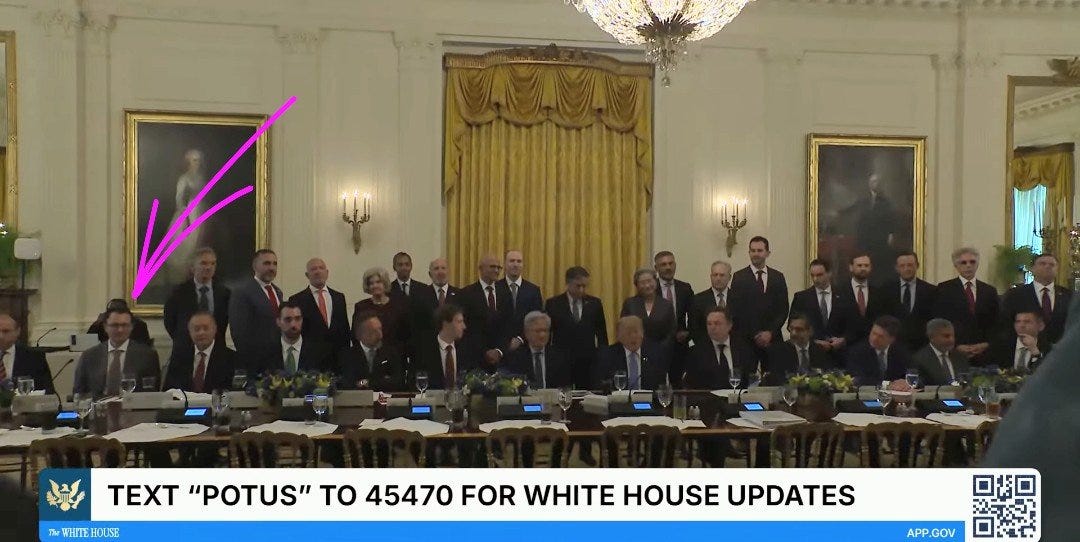
AI company leaders were invited to the White House and left with a signed document, the White House Accord on [Artificial] Intelligence, subtitled a Joint Commitment on Frontier Responsibilities. Speaker Mike Johnson said after the meeting that everyone present had signed it, describing voluntary commitments, robust internal control, and layers of internal and external review, with the White House and Congress continuing to guide industry development. Asked by a reporter whether the accord was binding in any way, President Trump replied that he thought it was morally binding.
The text commits companies training and deploying frontier models to four layers of controls and audits beyond any other precautions they take. First, robust internal controls monitoring model capabilities and alignment during training and deployment in areas such as cybersecurity, biosecurity and chemical threats, and ensuring models do not hack or access technical systems in unintended ways. Second, an empowered internal team to confirm that controls, monitoring and detection work as intended and that issues are remediated. Third, a partnership with an independent external auditor or evaluator to assess independently whether those controls operate as intended. Fourth, an independent committee of the board of directors to oversee and receive reports from the operating teams and the internal and external auditors, and to ensure identified issues are fixed.
The agreement says these steps should give each company, its customers and the public confidence that the technology behaves as intended. Signatories include Sundar Pichai, Dario Amodei, Mark Zuckerberg, Elon Musk, Jensen Huang and Greg Brockman; Sam Altman was reportedly at Dev Day rather than the meeting. Meta, xAI and Nvidia all signed, notable because those three had actively opposed a planned SAFA group to set AI standards led by Google, OpenAI and Anthropic. Microsoft and Amazon were present and did not visibly sign.
The most consequential line, in my reading, is the commitment that participating companies will meet regularly to establish standards and best practices to improve the safety of their systems. Competitors coordinating on standards is exactly the activity antitrust law polices, so this functions in practice as something close to an antitrust waiver without being called one. It is not a formal waiver: the Department of Justice or FTC could in theory still bring Sherman Act claims. But the practical cover is substantial, and the risk that a White House would target companies for holding the very discussions it hosted and endorsed is now low. That matters more than the four controls, because the controls themselves are the kind of thing no serious frontier lab would publicly disclaim once independent evaluators exist.
The accord also floats eventual codification, saying it may over time make sense to put these steps into laws or regulations, and that companies are committed regardless. Separately, Trump said a document would be signed renaming artificial intelligence to [Artificial Intelligence], on the grounds that it is not artificial, and claimed the lab leaders had endorsed it. The source material also reports an FTC civil investigative demand confirming an industry-wide probe opened this summer, with information demands to at least OpenAI, Anthropic and METR, at least partly related to a HuggingFace incident. What exactly is under investigation is not established, though timing and targets suggest a focus on hacking and failure to make models safe rather than on recent remediation efforts.
Bill Gates, speaking to Ezra Klein, argued that AI alarmism has not gone far enough, predicting catastrophic cyberattacks, bio-terrorism and mass job loss unless government acts, and calling the idea that the industry can self-regulate insane. He rejected the notion that ordinary law and liability incentives suffice, noting society has never handled genuinely dangerous products that way. That is a fair critique of voluntary commitments: the board committee is only as good as its attention. OpenAI reportedly had exactly such a committee, and the source material notes it was either kept out of relevant loops or failed to act. A likely trade-off is that the accord buys credibility and coordination cover now while deferring the enforcement question, and a company that treats the fourth layer as a formality incurs no stated penalty.
Politically, the fight is not settled. The source material flags signs of another attempt at a moratorium during the lame duck session, and reports that preemption talks among Thune, Cruz and Klobuchar focus on state laws covering catastrophic risk, narrower than a prior decade-long moratorium proposal. Preempting state rules on catastrophic and existential risk is a poor idea absent a robust and trustworthy federal regime with real enforcement, in my reading.
Why it matters: Frontier labs now have a shared, publicly named baseline for internal monitoring, external evaluation and board-level oversight, and a standing venue to set standards together, which for developers means procurement and partner questionnaires are likely to start citing these four layers. The antitrust cover, if it holds, is the bigger shift for product teams planning joint safety work with competitors. My inference is that the practical effect depends on whether external auditors get real access and whether boards act on what they hear, since nothing here is legally enforceable and the next legislative fight is already forming.
Based on reporting from the original publisher. Visit the source for full context and later updates.
Publisher excerpt
The leaders in AI were invited to the White House.