Report from the Vatican
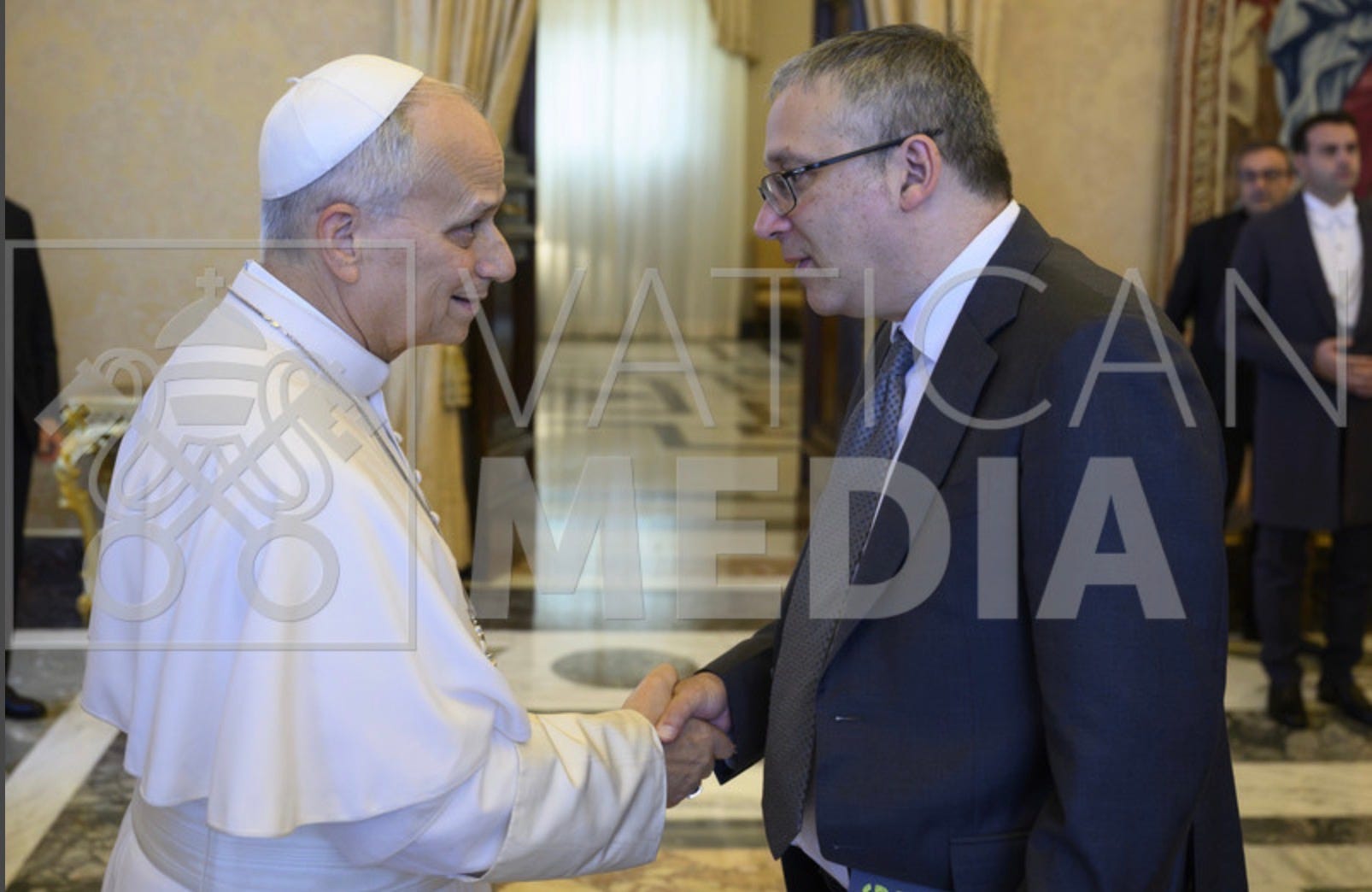
Pope Leo XIV gave a short speech on artificial intelligence at the Vatican on 29 October 2026, laying out five principles he drew from his encyclical on AI, Magnifica Humanitas. Gary Marcus, a cognitive scientist and AI commentator who describes himself as a global ambassador for the encyclical through the Domus Communis Foundation, was in the room and published a report dated 30 October 2026 describing the address and recounting his own earlier remarks at a small private meeting held just before the group met the Pope, where Max Tegmark, Stuart Russell and Valérie Pisano also spoke.
The first point was that the future of AI is not fixed. Because the technology is built by people, its direction rests on human choices, and the Pope said there is a responsibility to guide applications, change them, and reject them where necessary. He framed the decisive question as not what AI can do but what purpose it should serve, warning that treating development as a race to be won means fixating on the finish line and overlooking those left behind. A dependable system that serves people, he argued, is worth more than an exceptionally capable one whose consequences cannot be foreseen or controlled.
The second point held that machines are tools, not persons. Citing paragraph 99 of the encyclical, he said these systems have no experiences, no body, no joy or pain, do not mature through relationships and do not know from within what love, work, friendship or responsibility mean. Proposals to grant such systems rights or legal personhood risk blurring human accountability and leaving people who are harmed facing an entity with no one behind it.
Third, he said some decisions must never be delegated. Being placed on a target list or entered into a border control database can reduce a person to a data point, and choices touching human life, freedom and the use of force should stay under effective, informed and responsible human oversight, referencing paragraphs 198 to 200. He called for AI to be disarmed, citing paragraph 110, and urged states meeting in Geneva in November to take concrete steps toward banning lethal autonomous weapons.
Fourth, intelligent technologies should serve the common good. Quoting paragraph 161, he said justice requires access to the benefits of innovation, including care, knowledge, tools and opportunities. Development should not become an end in itself or serve only a privileged few, but should foster solidarity and participation and share gains equitably, especially with those most in need, referencing paragraphs 71 and 72.
The fifth point was the one he called perhaps most urgent. Many ethical principles for guiding AI are already understood, but institutions capable of applying them are lacking, particularly effective international bodies able to protect the global common good, citing paragraph 64. That would require shared standards, independent oversight and clear accountability mechanisms, so that decisions about building and deploying AI can be examined, challenged and paired with remedies when harm occurs, referencing paragraphs 105 and 107. The paragraph numbers throughout refer to the encyclical itself.
Marcus used his own remarks to argue that the field has over-invested in one component of intelligence. A cognitive scientist who trained with Steven Pinker at MIT and later sold an AI company to Uber, he described intelligence as modular, spanning verbal, mathematical and physical abilities, and said that capturing prediction extremely well, which large language models do, is not the same as capturing reasoning, emotional judgment or reliable instruction-following. In his account, these systems track correlations rather than causation, so they can produce a convincing-looking legal citation while ignoring an explicit instruction not to invent references. In practice that failure mode is what turns an unreliable model into a liability once it is looped into tools that act.
That led to his sharpest proposal. He distinguished narrow systems such as GPS navigation and AlphaFold, which work within a bounded problem and cause little trouble, from open-ended agents with broad internet access and the ability to acquire credentials. He referred to a Hugging Face incident and to attacks on a French refrigeration system and in Japan, and said the volume of such incidents is higher than ever. He called for the open-ended agents to be pulled from the market until fixed, either voluntarily or under government mandate, comparing the situation to the Ford Pinto.
He also disputed the idea that current systems could be conscious, arguing that correlated word patterns inside a next-word predictor say nothing about real experience, and illustrated it with a chatbot that claimed to send its children to a New York school. He praised the encyclical's insistence that consciousness requires experience, which these systems lack.
Why it matters: The Vatican's five points give AI governance debates an explicit moral vocabulary, and the call to ban lethal autonomous weapons ahead of the November meetings in Geneva is the most concrete item. For developers, the practical weight sits in the argument that human oversight must be built into high-stakes decisions and in Marcus's push to treat open-ended internet-connected agents as a product-safety problem, which, if adopted, would change how such tools are released and audited. That agents should be withdrawn is Marcus's own position, not the Vatican's, and it remains a proposal rather than a policy.
Based on reporting from the original publisher. Visit the source for full context and later updates.
Publisher excerpt
Yesterday I had the singular honor of meeting His Holiness, Pope Leo XIV