Optimizing cost per task and proving agent ROI on Amazon Bedrock
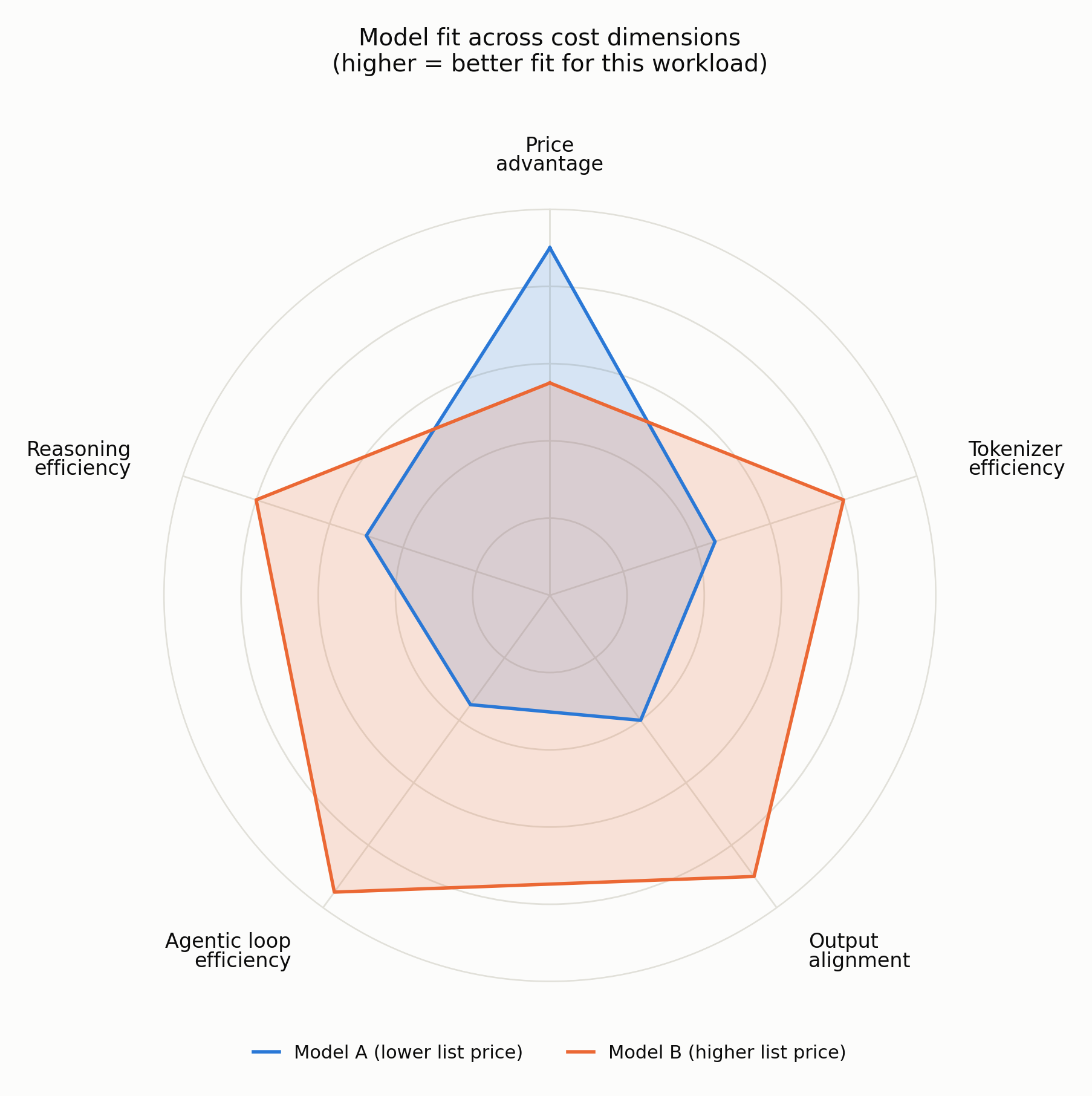
An AWS Machine Learning Blog post published as the second part of a series on governing Amazon Bedrock spend shifts the unit of analysis from cost per token to cost per task. Where the first installment covered attribution, logging and enforcement, this one argues that published per-token rates say little about what a real workload costs, and pairs that with a method for deciding whether an agent is worth running at all. The intended audience is twofold: application and platform engineers who hold the optimization levers, and product owners and FinOps partners who must defend agent budgets to leadership.
A task, as the post defines it, is one complete unit of work, such as resolving a support email, extracting fields from an invoice or answering a user question. It spans from the initial request to a usable result, no matter how many model calls that takes. The central illustration is an agentic workflow that reads a 750-word customer email, extracts entities, calls an API to verify account status and returns strict JSON. Using illustrative prices, Model A lists at $0.50 per million input tokens and $1.50 per million output tokens; Model B lists at double those rates, $1.00 and $3.00. Yet Model A's total task cost comes to $0.0042 against $0.00145 for Model B. Three effects compound: A's tokenizer turns the email into 50% more tokens, A pads its JSON with filler and triples output volume, and A misreads the tool schema, requiring two correction turns that each resend a growing history. Model A needs three turns and 6,150 cumulative input tokens; Model B needs one turn and 1,000.
The post names four hidden cost drivers. Tokenizer efficiency comes first: token counts differ across model families for identical text, structured schemas and numeric arrays are especially sensitive, and non-Latin scripts can fragment into two to three times more tokens than English. A 15% lower list price can lose to a rival needing 40% more tokens. Output alignment and verbosity follows, with output tokens commonly costing three to five times input tokens, so a model that ignores instructions like returning only raw JSON charges that premium for filler. Agentic loop efficiency matters because function calling is a multi-turn loop and every turn resends the full conversation and tool results as input. Reasoning overhead closes the list: extended thinking tokens bill as output, so 2,000 reasoning tokens plus a 200-token answer bills as 2,200, and some models redact the reasoning while still charging.
The framework extends to failed attempts, since failures are rarely free. For retry-until-success workflows, cost per successful task is cost per attempt divided by success rate. For escalate-on-failure workflows, it is cost per attempt plus the failure share times escalation cost. With prompt caching active, input splits into uncached tokens at base rate, cache reads below base rate and cache writes above it.
Measurement leans on existing Bedrock features. Model evaluation handles the quality side, scoring uploaded prompt datasets with automatic metrics and optional human review. CountTokens returns the input tokens a model would charge for a payload without running inference, letting teams compare tokenizer efficiency before paying for generation. Invocation responses carry a usage block with inputTokens, outputTokens, cacheReadInputTokens and cacheWriteInputTokens. A gotcha the post flags: with caching on, inputTokens counts only uncached tokens, so footprint is the sum of all three, which must be priced separately. Invocation logging writes per-call token counts to Amazon S3 or CloudWatch Logs, but those are log fields, not cost allocation tags, and never appear in Cost Explorer or the Cost and Usage Report; application inference profiles do reach both but only at one usage type per day, too coarse for cost per task. Estimates from logged tokens must be reconciled against the CUR, since they ignore commitments, batch pricing and provisioned throughput.
Four levers map to the four drivers: prompt caching, called the largest win on agentic paths; intelligent prompt routing that sends easy requests to a cheaper model in the same family; a tool schema plus a maxTokens cap to hold verbosity down; and batch inference, which halves rates on bulk single-turn work but rules out tool calling and multi-turn exchange. Extended thinking stays off until a benchmark shows it earns back its cost.
The ROI half starts from a human baseline. The post says teams should document the current process operationally before building, then measure time to completion, queue time, active effort, reopen rate, escalation rate, cost per task and outcome quality before the agent ships, because retrospective baselines flatter the agent. Agents should then run as experiments from day one, each with a trace ID and a workflow-run record. A sample record includes run ID, principal ARN, team, cost center, variant and prompt version, latency, retries, tool calls, human approvals, human minutes, escalation counts, token counts, estimated cost and outcome status. Three fields get emphasis: the experiment block, propagated into request metadata so records join; humanMinutes, which most teams omit and which otherwise hides reviewer time; and a revenue event ID, cheap to record and impossible to reconstruct later.
Joining that store to priced invocation logs lets teams query per-workflow cost per success, retries per success and human minutes per success with Athena, grouped by experiment arm. The comparison rests on holdout or A/B tests (randomizing at visitor, lead, account or case level for customer-facing work, matched cohorts for internal work) across efficiency, quality, cost and business value. Revenue is the hardest metric; holdout tests separate agent-driven lift from ordinary momentum. A small green/yellow/red scorecard, reviewed on a cadence, decides scale, tune or retire, and actually retiring a red agent is what keeps it credible. Thresholds are starting points to calibrate.
This suggests the practical takeaway for builders is instrument-first: capturing token usage, turn counts and human minutes per run makes both optimization and justification possible, and any cheaper-looking model deserves a benchmark on your own prompts before adoption.
Why it matters: Teams procuring models on list price alone may be overpaying through tokenizer mismatch, verbose output and correction loops, and retrying or escalating failures pushes real cost per successful task higher still. Product owners gain a defensible vocabulary (cost per success, human minutes) for budget conversations, though the analytics plumbing of run records, priced logs and A/B splits is real engineering work.
Based on reporting from the original publisher. Visit the source for full context and later updates.
Publisher excerpt
Comparing per-token prices hides the real cost of running a model on Amazon Bedrock. This post shows how to calculate the true cost per task across four hidden cost drivers, reduce it with caching, routing, and output constraints, and prove agent ROI with human baselines, holdout experiments, and a five-dimension scorecard.