Jensen Huang Really Liked Selling China Advanced AI Chips
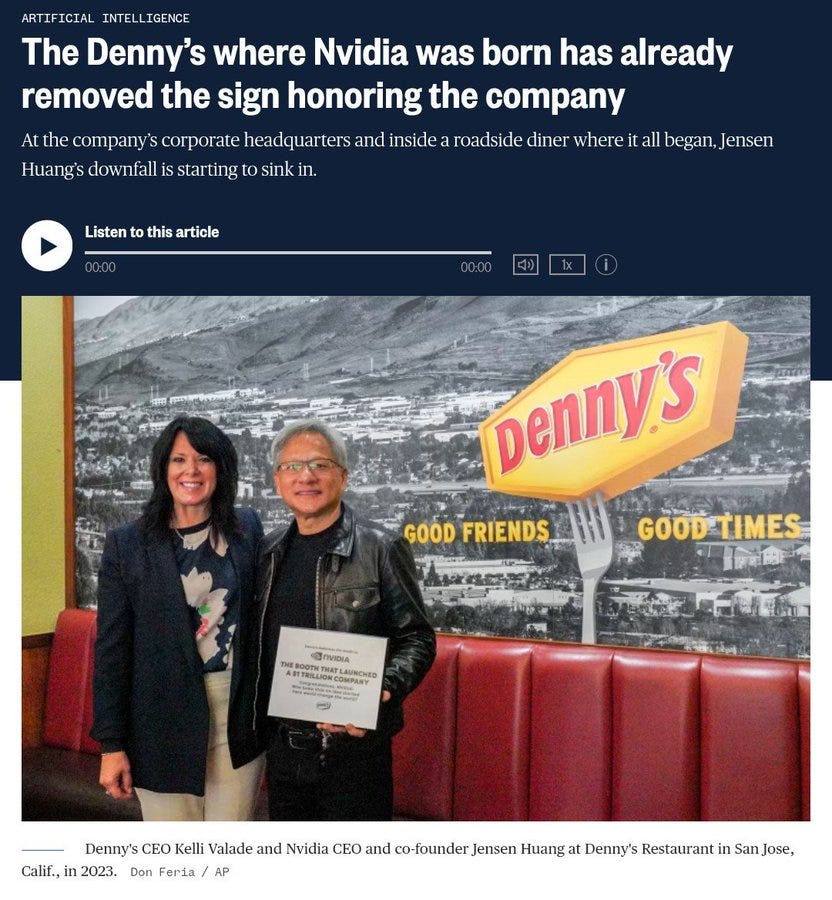
Jensen Huang has resigned as Nvidia's chief executive after multiple affairs came to light, according to Zvi Mowshowitz's account. One relationship was with Alice Huang, described as an alleged Chinese spy who also helped divert billions of dollars in Nvidia chips to China, and another was with a direct report at the company. Colette Kress, identified as interim CEO, now leads Nvidia day to day alongside a newly created board committee focused on national security and export compliance.
The resignation is the precipitating event for a scandal Mowshowitz argues has been visible to close observers for years: that Nvidia treated the US government as an adversary, running a long lobbying and influence campaign to keep selling its most advanced chips into China and to tolerate their movement there through smuggling and remote access. Mowshowitz frames the core harm as compromised government integrity, weakened national security, a damaged US position in the AI race, and pressure on US AI companies to move faster while sane policy became harder. He also reports a further covert Nvidia influence operation disclosed on Monday, aimed at promoting chip sales to China under the argument of keeping US-made rather than Chinese-made chips dominant in the AI market.
The spy question has grown murkier. After several days in which Alice Huang's status as a Chinese spy went undisputed, pushback emerged: ODNI officials described that characterization as "not quite accurate," CIA sources said intercepts do not show her knowingly passing information to China, and Representative Himes expressed doubt, saying lawmakers still lack enough to say how she acted. Trump now says he does not know she is a Chinese spy. Mowshowitz puts his own probability that she is a spy above 50% but below 95%, and notes that most of those denying it have an interest in explaining their own inaction. He argues that even absent formal recruitment she acted as a de facto Chinese agent, since her primary business was smuggling billions of dollars of Nvidia's top AI chips and giving China access to them.
The sharper allegations come from Dmitri Alperovitch, quoted at length. He argues Alice Huang's formal MSS recruitment was always a tertiary issue: she was a large Nvidia customer, controlled a shell company called Megaspeed dedicated to smuggling compute to US-listed Chinese AI companies and to data center buildouts inside China, and sat atop a web of Chinese shell companies doing the same. Alperovitch lists the grounds he sees for dismissal: multiple affairs within Huang's reporting chain in violation of company policy, lying to the board and forcing false public statements, a relationship with a smuggler who had violated US export controls, exposure to blackmail by Chinese intelligence, likely direction of the general counsel to interfere with a US investigation into his mistress's smuggling operation, and broad compliance failures around chips reaching mainland China and PLA-affiliated institutions. Jessica Tillipman says the case will become a teaching staple in anti-corruption and compliance courses because it bundles conflicts of interest, third-party due diligence, tone at the top, board fiduciary duties, disclosure obligations and internal investigations. Asked whether Huang resigned to avoid certifying Sarbanes-Oxley filings before next week's earnings, she said he may already face substantial personal exposure independent of that filing.
Export controls are moving. Mowshowitz reports that Commerce Secretary Howard Lutnick had long blocked new controls, forcing Scott Bessent and the National Security Council to go around him and issue a remote access rule plus expanded restrictions covering Malaysia, Thailand, Indonesia, Singapore and Brazil. The rule is meant to stop existing limits on sensitive American technology from being circumvented through remote computing arrangements in third countries. Chris McGuire of the Council on Foreign Relations called it unprecedented for a Commerce rule to be written by the NSC and Treasury, and read the press release language as evidence Commerce resisted to the end before the White House forced publication. The market reaction was sharp: Alibaba fell 6.8%, Hong Kong-listed Z.ai and MiniMax dropped more than 9% and nearly 8%, and one maker of GLM 5.3 was down nearly 33% over four trading days and about 89% from its summer peak. Kyle Chan's reading is that investors believe Chinese AI companies remain highly dependent on Nvidia silicon.
Enforcement gaps are documented. Nvidia and Commerce both say Nvidia placed Megaspeed on a "no sell" list in June 2025, yet trade data obtained by the Times showed Megaspeed's Malaysian subsidiary receiving more than $800 million of shipments containing controlled Nvidia chips between July 2025 and February 2026. The board's response is the new National Security and Export Control Oversight Committee, chaired by director Suzanne Nora Johnson with Stephen C. Neal and John O. Dabiri, meeting at least quarterly, retaining outside legal and trade experts, and receiving reports from Nvidia's National Security Team and Global Trade Compliance Team. Chairman Harvey Jones framed advanced silicon and artificial superintelligence as unprecedented national security challenges. Mowshowitz is openly skeptical that a committee fixes the problem.
The scandal may reach further. Reporting by the Times describes Lutnick's frequent calls with Huang, Nvidia matters routed through a deputy, and Nvidia's general counsel given direct access to comment on draft rules, alongside questions about Cantor Fitzgerald's exposure to Nvidia-dependent businesses now run by Lutnick's sons. Former Commerce officials told reporters they were sidelined after devising China tech restrictions, with a perception that Nvidia had a hand in some purges. Congress is expected to investigate, and Nate Silver is quoted arguing the political world is underreacting, including to the risk of an anti-AI backlash.
My reading: the most consequential thread for the industry is not the personal conduct but the compliance and policy shock. If export rules are now written with less Commerce input and more NSC and Treasury involvement, licensing and remote-access questions that developers and cloud operators depend on could get stricter and less predictable. The Z.ai selloff suggests markets treat Nvidia access as irreplaceable in the near term, which raises the cost of any further tightening. A likely trade-off for Nvidia's customers is higher diligence demands on end users and intermediaries, especially in Southeast Asia. Whether the oversight committee changes behavior or only optics is an open question.
Why it matters: developers and product teams building on Nvidia hardware face near-term uncertainty about allocation, pricing and legal exposure for workloads touching China or third-country data centers, and the leadership change at the top of the AI supply chain could unsettle procurement plans. Compliance teams should expect sharper scrutiny of intermediary customers and remote compute arrangements. Inference: if the new rules are enforced as written, some cross-border inference capacity will need re-architecting onto permitted jurisdictions, and that work is likely to land on infrastructure and platform teams first.
Based on reporting from the original publisher. Visit the source for full context and later updates.
Publisher excerpt
This scandal is a really big deal.