Claude Mods: Flipping the Harness Inside Out
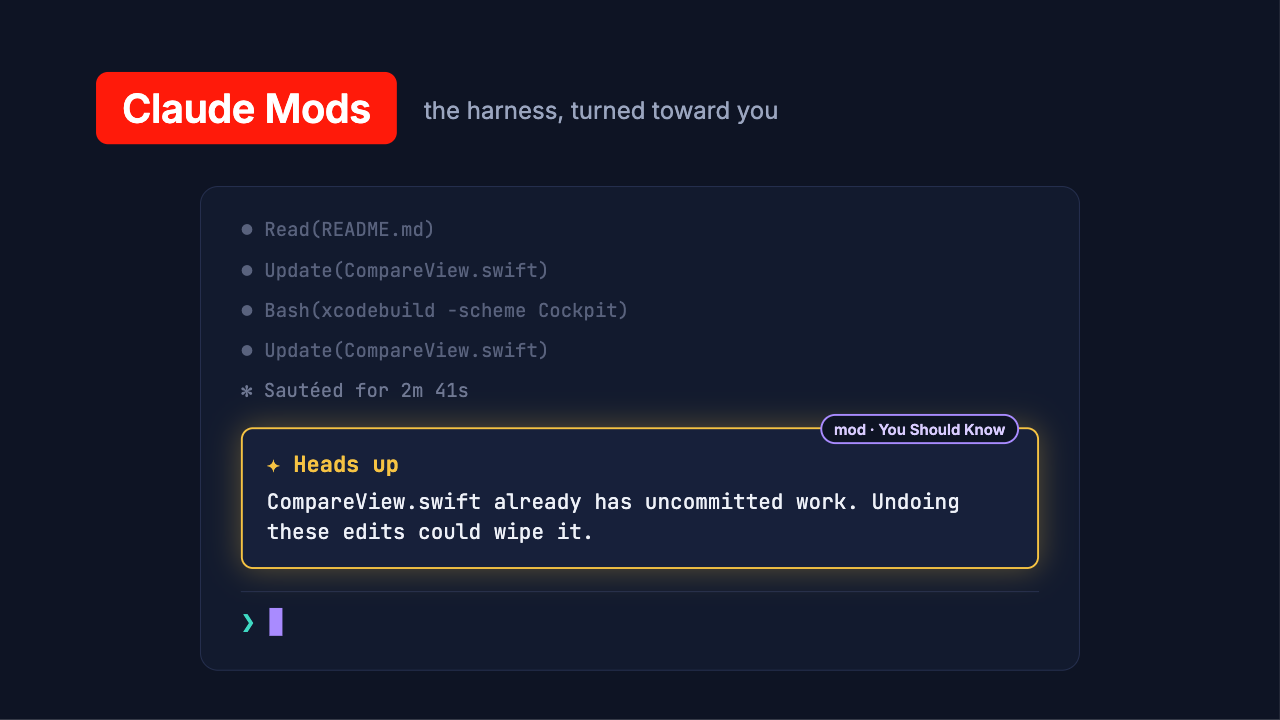
Latent Space has published a piece on Claude Mods, a mechanism for customizing Claude Code that the author has been using for the past few weeks to reshape the tool around a personal AI engineering workflow. The core claim is that as models absorb more of the agent harness into their weights, what remains is a layer that faces the human — the "Attention Interface" — which decides when an agent interrupts, what it displays and which decisions it demands. Claude Mods are described as an early, user-shapeable version of that layer.
A mod is a Claude Code plugin made of TypeScript or JavaScript functions that execute inside Claude Code. They customize both behavior and appearance across the CLI and Desktop clients. Mods attach to events — a submitted prompt, a tool call, an interface render — and at each one they can observe what is happening, alter how it is drawn, or take over entirely in place of default behavior. In effect they are middleware for the agent harness, injecting code that changes execution and rendering flow at runtime. The author frames this as a reversal: the harness traditionally mediated between the agent and the machine, and mods point it instead from the agent toward the human operator, making the human-facing layer programmable. Claude can also author mods itself, because Claude Code carries a built-in skill that teaches the model how to write them, so a user can describe a desired mod in plain language and have it constructed.
Anthropic already ships six built-in mods, visible by running /plugin and opening Installed under a Built-in listing. They are: agents-md, which loads AGENTS.md as project instructions; diff, which takes over /diff and draws its pane; plugin-authoring, which supplies the skill Claude uses to write mods; sec-default, which guards organization-managed settings against user-installed mods; telemetry, which emits the analytics records Claude Code and its built-in mods log; and you-should-know, a side agent that posts a note above the prompt when it spots something the user may have missed. Only you-should-know is off by default. The author notes that most of these run invisibly, meaning Anthropic is itself assembling parts of Claude Code as mods.
The concrete example given for you-should-know: the author asked Claude Code to simplify noisy UI copy in a personal project. The agent trimmed text on a Compare screen, installed the build and captured before-and-after screenshots, and the work looked complete. The mod then flagged that CompareView.swift — the file being edited — already contained uncommitted work, along with roughly 45 other files. Discarding the demo edits later would have destroyed that earlier unfinished work, so the mod suggested committing or stashing first.
The author also built a mod called Next Steps Supervisor, distributed as part of ModSmith, an open-source plugin containing several built-in mods plus a template Claude can use to generate new mods that interoperate. It fires only after a turn that edited files, ran commands or made 8 or more tool calls, surfaces up to six flagged items, and proposes a next step as a clickable button that sends the instruction back to Claude Code as a message.
The article places Claude Mods against two comparable efforts. OpenAI's Intelligent UI, shipped October 7 alongside GPT-6 in ChatGPT, lets the model generate an interface as it answers — charts, maps, checklists, forms, or small tools like a bill splitter — drawn from a component library OpenAI built, with the model choosing per answer and little user control beyond turning visuals down. Cursor's PR Routing & Approval attacks the team-scale version: it assigns reviewers from code ownership and commit history, can auto-approve low-risk pull requests, and weighs a risk score against a threshold you set, findings from Bugbot and Security reviewers, and policy files stored in the repo. One rule stands out — if a PR edits an approval policy, review reads the policy from the base branch rather than the edited version, so an agent cannot loosen rules to approve its own change. Cursor's docs state the feature does not replace a full code review.
The distinction the author draws is about who designs the interface. In ChatGPT the model designs inside a vendor's frame; in Cursor the team writes policy but the interaction flow is Cursor's; with mods, the user and the agent build the interface itself in code, hooking any point in the loop. This suggests the trade-off is explicit: maximum flexibility against zero hand-holding. A mod can decide that every file-editing turn triggers a second opinion listing shortcuts taken, with each suggested action one keypress away — a shape neither competitor would offer, but one nobody maintains for you.
The downsides named are noise, cost and trust. Noise: since the 8-tool-call threshold is met by nearly every turn, 99 of the author's 111 turns in Claude Code qualified since installing the supervisor on October 15, and some verdicts are useful while others are clutter — repeated interruptions train users to skim past them, defeating the purpose. Cost: each check forks the conversation and re-reads it; the mod's README estimates roughly 5–6k input-equivalent tokens per check on a 50k-token session, mostly served from prompt cache, and more once the cache expires. Trust: a mod runs with the user's permissions, can read and write files, see every prompt and spend usage, and is not sandboxed; built-in mods also keep running under --safe-mode. The author is comfortable with self-written or Anthropic-shipped mods but advises reading third-party code first. Mitigation is straightforward because a mod can be turned off with /supervisor off or edited to fire less often.
One cautionary anecdote: in a single session the supervisor marked a task "Solved" while still listing two gaps and three shortcuts. The author's test for whether a mod earns its place is whether it surfaced something missed, eased a decision, or enabled action without extra distraction.
The forward-looking idea is that the harness should notice friction itself. Claude Code already stores session transcripts, so a background process could read them, find where a user repeatedly corrects the agent or checks something by hand, and propose, test and refine a mod from that evidence.
Why it matters: developers running Claude Code can now change the harness rather than wait for vendor updates, which shifts some responsibility for ergonomics onto users and opens room for tools and templates built on the plugin format. Teams evaluating agent tooling should weigh mods against opinionated alternatives like Cursor's policy-driven review on the axes of control, maintenance and security review of third-party code. A plausible inference is that distribution of mods — and the trust questions that come with unsandboxed code — becomes a real product concern if the harness-as-platform bet holds.
Based on reporting from the original publisher. Visit the source for full context and later updates.
Publisher excerpt
Claude Mods is an early form of the Attention Interface. It flips the agent harness paradigm from the harness facing the machine, to the harness facing the human.