Beyond hours saved: Building the business case for agentic automation
An AWS Machine Learning Blog post proposes a framework for justifying agentic automation investments, arguing the standard ROI model — hours saved times labor cost minus build cost — was designed for rule-based tools such as robotic process automation and misses most of the value agents create.
The post introduces what it calls the Agentic Value Model, which measures four dimensions plus a condition it calls value realization, meaning each benefit needs a defined mechanism converting an operational improvement into economic value and an accountable owner. The dimensions are time savings; exception handling, where AWS guidance offers planning ranges that correcting an error can cost 1.5–4 times the original transaction and human error can account for 2–15 percent of operational cost; decision quality; and change resilience and maintenance economics, which the post says cuts both ways because agents shift maintenance into evaluations, prompts, monitoring and model operations rather than removing it.
The post cites McKinsey's "1:3:5 pattern" from "Agentic AI change management: Closing the adoption gap" (2026), describing spending of three dollars on process redesign and five on capability building and adoption for every dollar invested in agentic technology, and states most companies invert this. It also cites McKinsey's "Scaling agentic AI with data transformations" (2026) saying nearly two-thirds of enterprises have experimented with agents but fewer than 10 percent have scaled them to tangible value.
An illustrative claims-triage example uses figures including 200,000 claims a year at about 12 minutes per claim and $45 an hour fully loaded, a base cost of roughly $1.8 million, 70 percent routine automation, and roughly $1.26 million of released capacity, cautioning that freeing hours is not the same as saving money.
Three early Amazon Quick Automate deployments are cited. Kitsa, a clinical-trial site-selection company, automated extraction of more than 50 data points across hundreds of thousands of websites and reported 91 percent cost savings and 96 percent faster data acquisition at 96 percent coverage. dLocal, a cross-border payments provider, automated up to 75 percent of merchant-compliance reviews in controlled evaluations. Genpact, automating supply-chain risk across multiple SAP systems, reports cutting disruption-impact analysis from 2–3 days to minutes.
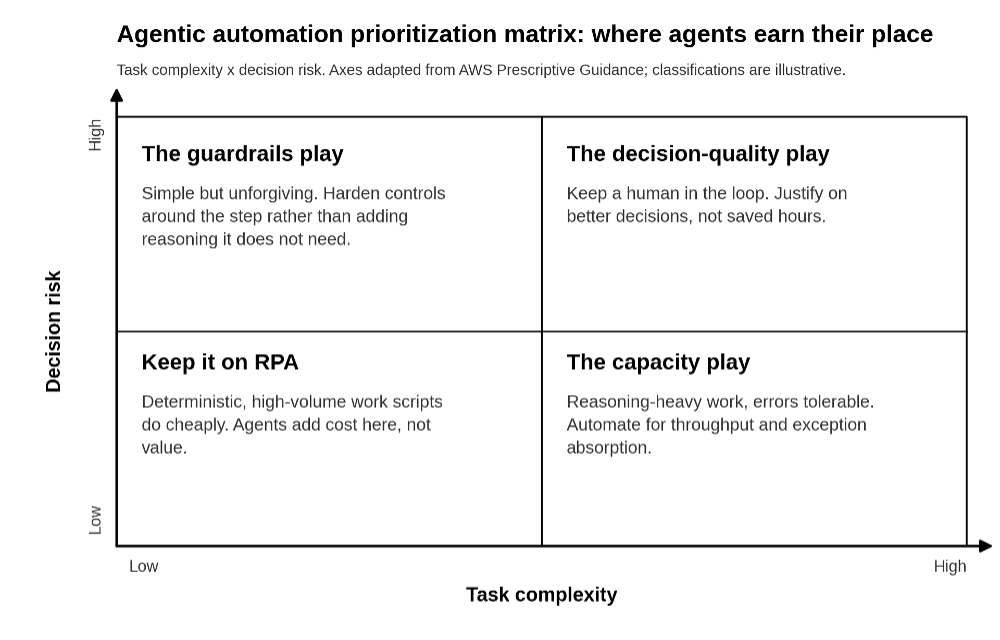
The post also offers a prioritization matrix scoring workflows on task complexity and decision risk, and advises presenting investment as a portfolio of workflows with stop rules and KPIs.
Based on reporting from the original publisher. Visit the source for full context and later updates.
Publisher excerpt
The RPA-era ROI model misses most of the value agentic automation creates. This post gives AI center of excellence leaders a framework to size the full value of agents across time savings, exception handling, decision quality, and maintenance economics, and to prioritize which workflows to automate first.