How Social Department built culture-aware video discovery
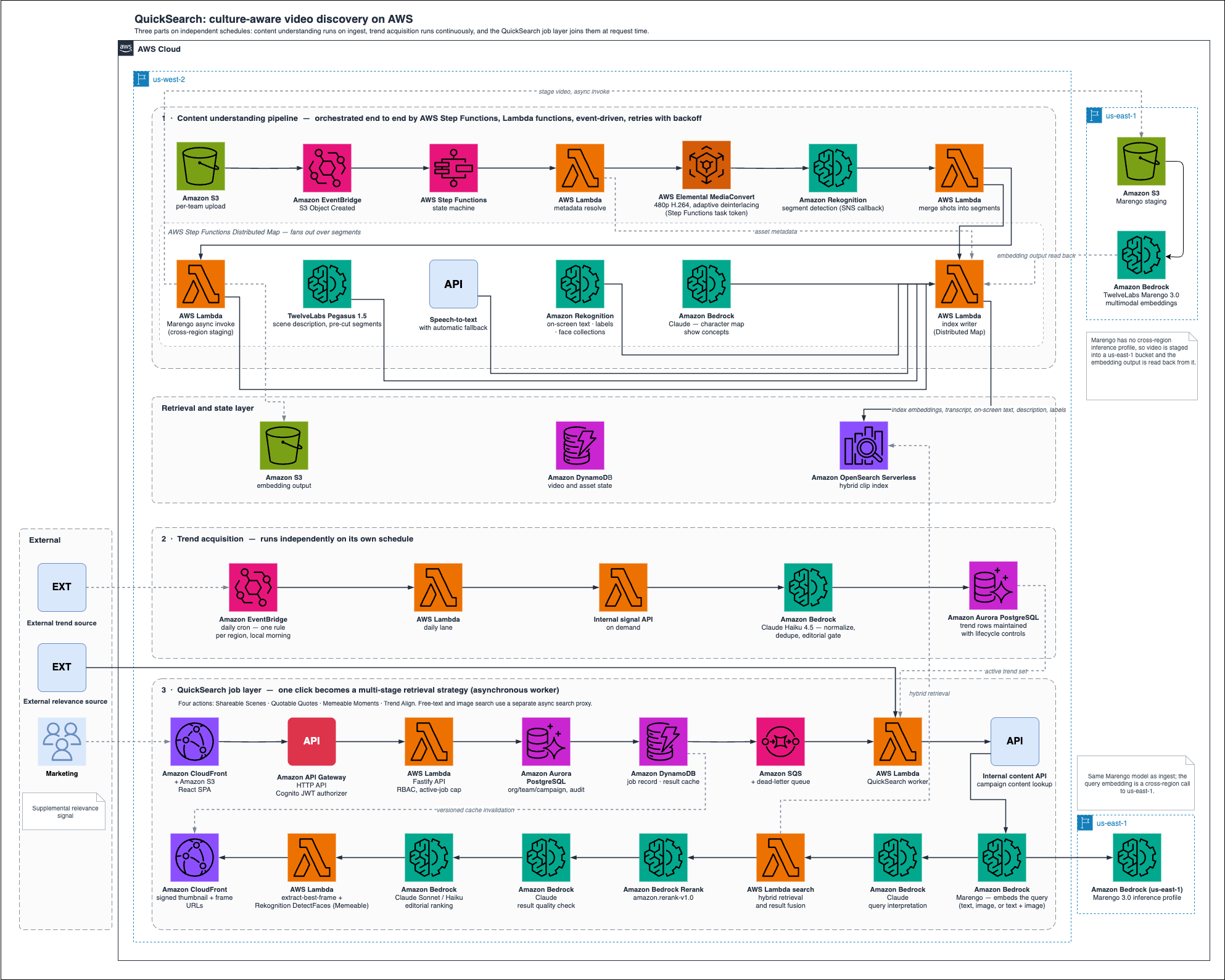
Social Department, which describes itself as an AI operating system for entertainment marketing, has published an architecture for QuickSearch, a set of four one-click discovery actions built on Amazon Bedrock. The write-up appears on the AWS Machine Learning Blog and is co-authored by Mariah Miller and Sirajus Salekin of AWS and Nicholas Chase of Social Department. Social Department serves studios, networks, streamers and FAST applications, and the company says semantic clip discovery has been core to its product since the beginning.
The premise is that typing a description into a search box only gets a marketer so far. A keyword or semantic query can find a coffee mug in a thousand episodes, but the questions that drive campaigns are judgments: which scene will travel, which line is quotable, which frame becomes a meme. Those depend on an editorial definition of terms like "quotable" for a given library, plus a current view of what audiences are talking about outside it. Historically that meant an expert watching footage for a week.
QuickSearch turns that judgment into four actions. Shareable Scenes surfaces self-contained sequences such as confrontations, climaxes and set pieces rather than brief reactions. Quotable Quotes returns short dialogue clips, weighted toward lines that have already circulated where a popularity signal exists for the title. Memeable Moments picks a single frame through a dedicated extraction and scoring step, then writes a caption grounded in that frame. Trend Align matches live cultural trends to moments in the library so an old title can re-enter the conversation. Natural-language and image-similarity search remain available for everything else.
The architecture has three parts on independent schedules: a content understanding pipeline, a trend acquisition pipeline, and a job layer that joins them only when a user picks an action. Ingest is event-driven. Video landing in a per-team S3 bucket triggers a Step Functions execution through EventBridge, and roughly two dozen Python Lambda functions carry the asset through metadata resolution against Social Department's data backbone, DynamoDB writes, transcoding to 480p H.264 via Elemental MediaConvert, Rekognition shot detection with an SNS callback, and merging of raw shots into ranges of about 10 to 20 seconds.
Those ranges become the unit of fan-out. A Step Functions Distributed Map sends start and end times to TwelveLabs Marengo 3.0 on Bedrock through asynchronous invocation, producing multimodal embeddings across visual, audio and transcript dimensions without splitting files. TwelveLabs Pegasus 1.2 runs in parallel per segment to generate narrative descriptions, emotions, themes, dialogue type and narrative position, which form the text layer later ranked over; because Pegasus takes pre-cut files, a Lambda cuts each range with a few seconds of padding. Speech-to-text with automatic fallback, Rekognition on-screen text and face collections, and Claude models extracting character maps round out enrichment. A final Distributed Map indexes everything into Amazon OpenSearch Serverless.
One operational detail stands out: Marengo is available only in selected Regions, and Bedrock asynchronous invocation reads and writes S3 in the same Region as the endpoint. The pipeline therefore stages each video into a dedicated bucket in US East (N. Virginia), runs the embedding job next to the model, then reads results back, while the rest of the infrastructure stays in its home Region. Every Lambda task retries with exponential backoff, scene description gets a throttling retry with full jitter, and non-critical enrichment degrades gracefully instead of failing a run.
Trend acquisition is a separate always-on pipeline. A daily lane fetches once per region per day, timed to each region's local morning, across four feeds (worldwide, US, UK, Australia), each discovered independently rather than filtered from a global list. A demand-driven "Heat Seeker" lane returns early-stage, momentum-ordered trends only when a user asks, reusing stored data if recent enough; the post frames this split as a cost decision. Raw trends are never shown to customers. Claude Haiku on Bedrock normalizes them into a category schema, deduplicates near-matches, caps counts per category, and applies an editorial gate that drops trends primarily about death, violence, self-harm, disaster, politics, protest, crime or public-health crises. Accepted trends are upserted by stable fingerprint, age out when they stop appearing, and refresh runs take a claim so two cannot overlap.
At request time, selecting an action writes a job to DynamoDB and an SQS message that a worker Lambda picks up; non-retriable errors go to a dead-letter queue. Each action expands into retrieval queries. For Trend Align, Claude models translate a cultural topic into queries the index can act on. Marengo embeds the query once as text, image or both, and it runs against six k-NN channels (visual, audio, transcript, on-screen text, scene description, labels) and seven BM25 text channels, with per-modality weights and query-type routing that pushes dialogue queries toward transcript and emotion signals. Reciprocal Rank Fusion merges the channels because it uses rank positions rather than raw scores, avoiding the scale mismatch between k-NN and BM25; top candidates then pass through the Amazon Rerank model's cross-encoder and a Claude validation step.
The front end is a React single-page app on S3 behind CloudFront, with a Fastify API on Lambda behind API Gateway and Aurora PostgreSQL for relational data. Because the index stores short fixed-length clips, adjacent clips with high visual-embedding similarity are merged before results return, so a scene query yields one 20-to-60 second moment instead of five fragments. A Claude model then ranks deduplicated candidates against the action's editorial criteria, with the pool capped to the model's output token limit; Sonnet is used where cultural recall changes the answer and Haiku where the task is bounded and cost-sensitive. Memeable Moments adds a step that extracts candidate frames, scores face quality with Rekognition and sharpness, re-extracts the winner at full resolution and trims letterboxing.
Results are cached in DynamoDB for 30 days, keyed by a per-action pipeline version and, for Trend Align, a hash of the active trend set, so criteria changes, model upgrades or refreshed trends invalidate cleanly. This suggests a deliberate split between cheap, high-recall retrieval and expensive judgment on a capped candidate pool, which keeps per-query Bedrock cost predictable regardless of library size—one embedding call, one rerank call and a small fixed number of Claude invocations.
On responsible AI, Social Department says AI proposes and people decide. Code checks generated output against source material, discarding a quote that is not in the episode transcript, Amazon Bedrock Guardrails screens search text for prompt attacks, and a person on the customer's team approves every post before publishing. Data stays within the AWS boundary, is not shared with model providers and is not used to train the underlying models. Social Department owns the pipeline architecture, retrieval system and editorial criteria; TrackIt, an AWS Premier Tier Services Partner, implemented and delivered against that design.
Why it matters: Product teams building search over large video catalogs get a concrete reference design for combining mixed vector and keyword retrieval, cross-encoder reranking and model-based editorial ranking without paying for a frontier model on every asset. The culture-aware pieces—separate trend pipelines, an editorial gate, explicit cache invalidation—are likely the harder parts to copy, since they encode product policy as much as engineering. Marketers, meanwhile, gain one-click entry points aimed at replacing a week of manual footage review, though how well those editorial judgments generalize across libraries is, by inference, the open risk.
Based on reporting from the original publisher. Visit the source for full context and later updates.
Publisher excerpt
Social Department, an AI operating system for entertainment marketing, worked with TrackIt and AWS to build QuickSearch: single-action queries that surface shareable scenes, quotable lines, memeable frames, and trend-aligned moments across large video libraries, using TwelveLabs models on Amazon Bedrock and Amazon OpenSearch Serverless.