On Ezra Klein’s Podcast With Jensen Huang
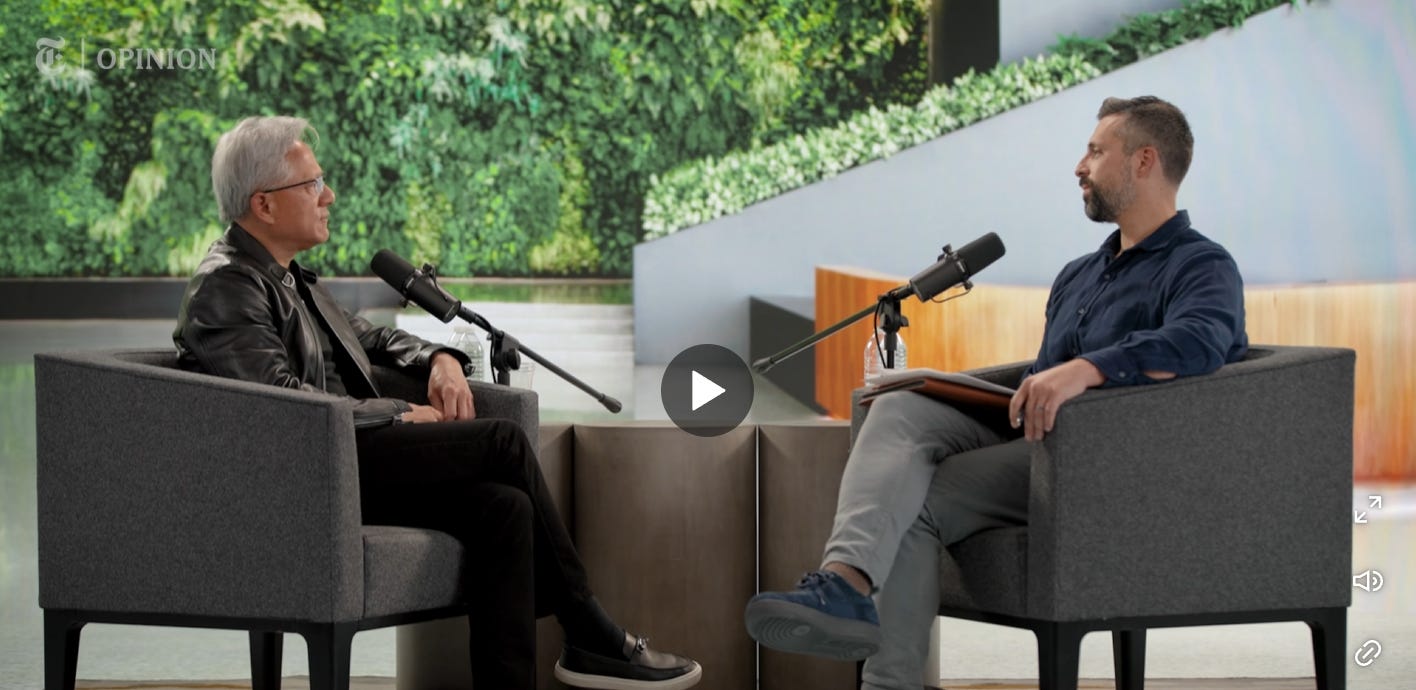
Zvi Mowshowitz published commentary on an episode of Ezra Klein's podcast featuring Nvidia CEO Jensen Huang. According to the analysis, Huang called for spending vastly more on safety, verifications and evals, and, in Mowshowitz's reading, accidentally called for shutting down OpenAI. Mowshowitz writes that Huang does not believe in ASI, or superintelligence, and thinks demand can rise by a billion times and that AI can be accelerated, but that it will remain no more than a new abstraction level.
The review describes Huang's framework of AI as a five-layer cake: energy, chips, infrastructure, models and applications. Huang said AI became useful in the last six months, an inflection point after 15 years of trying to make it work. On jobs, Huang cited $500 billion invested in AI natives in the last six months as evidence jobs are being created. Mowshowitz disputes the employment math and argues technology and automation dominated US manufacturing job losses, citing Hicks and Devaraj (Ball State, 2015).
On junior engineers, Huang told Klein to wait two years, saying the mean time to graduation of the new technology is two years away. He said young people are starting companies. Mowshowitz calls this innumerate. Huang said he does not know his own address, zip code or telephone number, and said he thinks people will lose some finer intellectual dexterity but become better systems thinkers.
Mowshowitz notes Huang's role as Nvidia CEO, his decisions on chip allocations and investments, and his influence on President Donald Trump and American AI policy, with a forceful lobbying arm. He also mentions Huang and his wife at the head table of a state dinner with Donald Trump, Melania Trump, Xi, Peng, Musk and Cook.
The piece lists sections including The HuggingFace Incident, Open Weights Models Are Good For Nvidia, Astra Is Hard To Monitor, Explicit Denial of Existential Risk, and Chip City.
Based on reporting from the original publisher. Visit the source for full context and later updates.
Publisher excerpt
Jensen Huang accidentally called for shutting down OpenAI and intentionally called for spending vastly more on safety.