Open challenges in LLM research
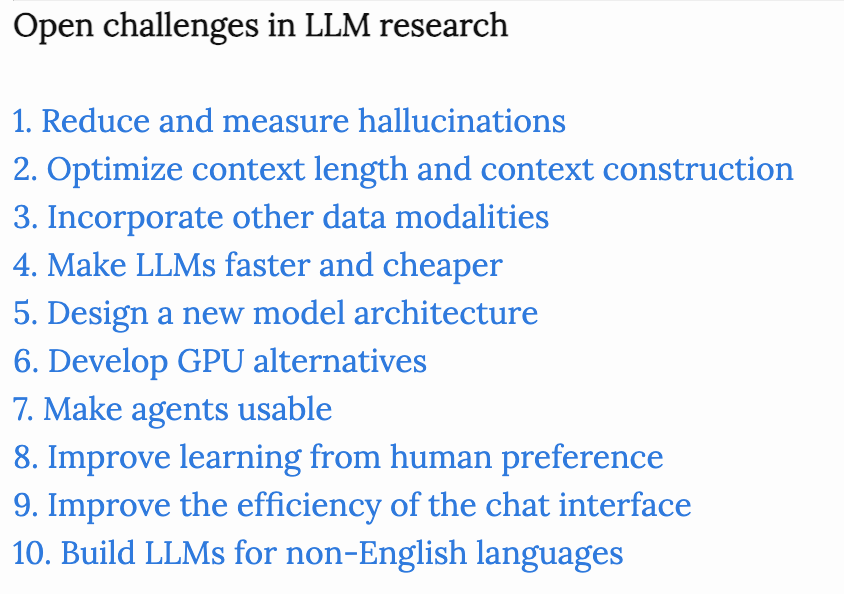
Chip Huyen has published a list of ten major open research directions in large language model work, drawn from conversations with people in both industry and academia.
She writes that the first two directions, hallucinations and context learning, are probably the most discussed today. On hallucination, she notes that it is a feature for many creative use cases but a bug for most others, and reports that at a recent LLM panel with Dropbox, Langchain, Elastics and Anthropic, hallucination was cited as the number one roadblock to companies adopting LLMs in production. Mitigation and measurement are described as a blossoming research topic.
On context, Huyen cites SituatedQA (Zhang and Choi, 2021), which found roughly 16.5% of the Natural Questions NQ-Open dataset has context-dependent answers. She describes Retrieval Augmented Generation as the predominant pattern for LLM industry use cases and points to Lost in the Middle (Liu et al., 2023) on how models handle information at the beginning and end of an index versus the middle.
Huyen says she is most excited about directions three, five and six. For multimodality, she lists medical prediction using notes and scans, product metadata and visual search as use cases, and cites CLIP, Flamingo, BLIP-2, KOSMOS-1, PaLM-E, LLaVA and NeVA.
On speed and cost, she notes that within half a year of GPT-3.5's late-November 2022 release, the community produced a model close to it in performance using just under 2% of GPT-3.5's memory footprint. She lists quantization, knowledge distillation, low-rank factorization and pruning as optimization techniques, noting Alpaca used distillation and QLoRA combined low-rank factorization and quantization.
For architecture, Huyen notes Transformer dates to 2017 and describes Monarch Mixer (Fu et al., 2023) from Chris Ré's lab with Together, whose idea is that attention complexity is quadratic in sequence length and MLP complexity quadratic in model dimension.
On GPU alternatives, she lists Google's TPUs, Graphcore's IPUs and Cerebras as notable attempts, notes SambaNova raised over a billion dollars and appears to have pivoted to a generative AI platform, and discusses quantum computing and photonic chips, citing Lightmatter ($270M), Ayar Labs ($220M), Lightelligence ($200M+) and Luminous Computing ($115M). The remaining directions cover agents, learning from human preference, and the efficiency of the chat interface.
Based on reporting from the original publisher. Visit the source for full context and later updates.
Publisher excerpt
[ LinkedIn discussion , Twitter thread ] Never before in my life had I seen so many smart people working on the same goal: making LLMs better. After talking to many people working in both industry and academia, I noticed the 10 major research directions that emerged. The first two directions, hallucinations and context learning, are probably the most talked about today. I’m the most excited about numbers 3 (multimodality), 5 (new architecture), and 6 (GPU alternatives). 1. Reduce and measure hallucinations Hallucin