Manage private pricing offers for Amazon Bedrock with managed entitlements
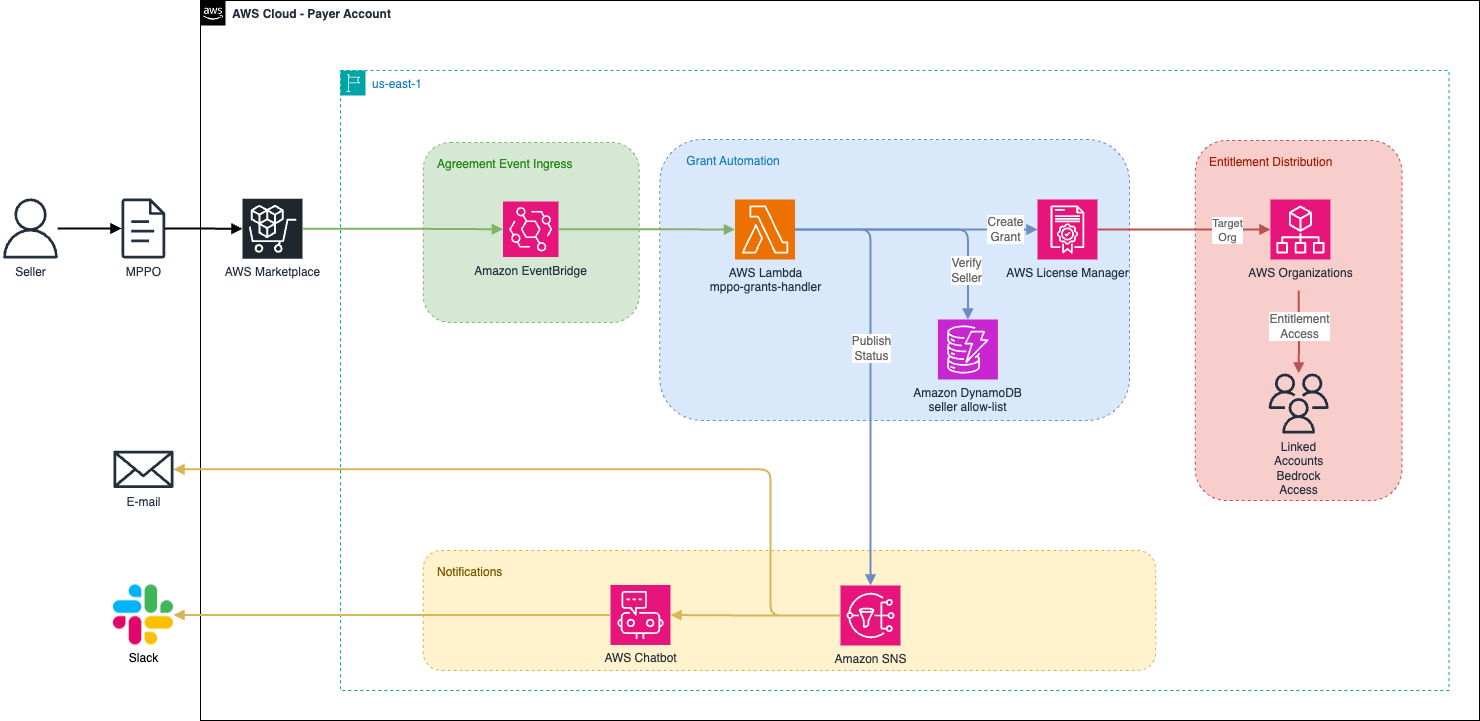
AWS has published a sample repository, sample-bedrock-managed-entitlements, that gives teams two ways to activate AWS Marketplace Private Pricing Offer (MPPO) entitlements for Amazon Bedrock in AWS License Manager. The post is aimed at organizations running AI model workloads across many AWS accounts, where each workload account would otherwise need to subscribe to and accept a private offer individually. Managed entitlements let a central account subscribe once and distribute access across the organization.
The underlying mechanics are worth spelling out. When a customer negotiates custom rates for third-party models on Amazon Bedrock and accepts an eligible private offer, AWS Marketplace creates a license in AWS License Manager. In AWS Organizations with all features enabled, organization-level grants are auto-accepted, but they remain in a Disabled state until someone activates them. Until activation happens, the negotiated pricing simply does not apply. Teams have been handling this by watching the License Manager console and flipping grants on by hand, an approach that works but is easy to miss and repeats every time a new model is adopted or a term is renewed. This is the operational gap the sample code targets.
Path 1 is a standalone script requiring no infrastructure. Run in its default mode, it lists every received license in the management account and prints a dry-run plan. Only when re-run with the --apply flag and --confirm-account-id does it create and activate organization-wide grants. AWS frames the dry run as the review gate: operators are told to check that the ISV Partner issuer and account scope match the private offer they expect before applying. The script has no seller allow-list, so AWS restricts its recommended use to situations where every received license in the management account is already trusted.
Path 2 deploys ongoing automation with the AWS CDK in the management account. Three components do the work. An Amazon EventBridge rule on the default event bus in us-east-1 matches events with source aws.agreement-marketplace and detail type Purchase Agreement Created - Acceptor, and invokes a Lambda function. That function receives the agreement event, verifies the seller against an allow-list, discovers the license, creates a distributed grant, and requests activation through CreateGrantVersion(Status=ACTIVE). Outcomes are written to Amazon CloudWatch Logs. The grant itself can target the whole organization, selected organizational units, or specific accounts, and negotiated pricing takes effect only once the grant reaches ACTIVE or WORKFLOW_COMPLETED.
Prerequisites are specific: the AWS Organizations management account in us-east-1, Python 3.12 or later, the AWS CLI, and AWS CDK v2. AWS Organizations must use all features, and the private offer must cover a License Manager-backed Bedrock model. SaaS products are out of scope. Setup runs through a bootstrap script that can check prerequisites or apply them — enabling License Manager organization integration, License Manager trusted access, AWS Marketplace license-management trusted access, and required service-linked roles — followed by a config script that populates the organization ID, seller allow-list, notifications, and optional grant targets, then a CDK bootstrap and deploy, and finally a seeding step that loads the seller allow-list from config/sellers.json into Amazon DynamoDB.
AWS treats the allow-list as a security boundary and warns against broad or unverified entries, since any matching seller can trigger grant creation and activation across the configured targets. Verification tooling includes an end-to-end validation script with a simulate flag, a CloudWatch log tail on the mppo-grants-handler Lambda, and a discount-check utility that can be adapted to a given ISV Partner issuer.
Two timing caveats stand out. Activation may be deferred while License Manager works through the grant workflow, and both activation and billing visibility can take hours or days. Cost Explorer data lags, so discount verification is a retrospective exercise rather than an immediate confirmation. Cleanup is a cdk destroy for test deployments, which removes small ongoing Lambda and EventBridge charges.
Heidi Health's Head of Platform Engineering, Marcus Lau, is quoted describing the company as an AI Care Partner supporting millions of clinician consults weekly that relies on third-party foundation models at scale, using private pricing to attribute usage and pricing across accounts and organizational units and to automate grant management as it adopts new models.
This is a reference architecture and sample code rather than a new managed service, so adopting it means owning the CDK stack, the allow-list data, and the IAM and Organizations configuration around it. The trade-off is straightforward: Path 1 is quick but unscoped and trust-dependent, while Path 2 adds moving parts and a security-sensitive allow-list in exchange for repeatable, logged behavior. A likely friction point in practice is the regional constraint — the event bus and stack live in us-east-1, which may not match where workloads run, though License Manager grants are organization-scoped rather than regional. The deeper point is cost governance: negotiated rates that never get activated are just paper discounts, and multi-account model adoption multiplies the number of places that can silently go wrong.
Why it matters: Teams running Bedrock across many AWS accounts now have a concrete, AWS-authored pattern for turning private pricing into applied pricing without console babysitting. Platform and FinOps engineers should weigh whether the seller allow-list and management-account access are acceptable security surface, since the automation acts across the whole organization once deployed. For product teams, the practical effect is that negotiated model rates can show up in spend sooner — with the caveat, per the source, that billing confirmation may lag by hours or days.
Based on reporting from the original publisher. Visit the source for full context and later updates.
Publisher excerpt
Managing AI model access across dozens or hundreds of AWS accounts creates friction when each account must accept AWS Marketplace Private Pricing Offers individually. This post shows two ways to activate MPPO entitlements in AWS License Manager: a lightweight script for a one-time fix, and CDK automation for ongoing event-driven processing.