AI Is Helping Care Teams Get Patients the Right Care, Sooner
NVIDIA published a set of healthcare case studies on Monday, Nov. 16, describing how three organizations are running AI applications on its hardware and software stack. The post covers Artisight's in-room fall detection device, Sword's Phoenix AI health partner, and Dyania Health's Synapsis clinical reasoning engine, with a companion item on Dyania dated Friday, Nov. 13. Each deployment keeps clinicians in the review loop, and each relies on NVIDIA compute, libraries or optimized inference runtimes underneath.
Artisight's All-in-One device targets inpatient falls, which NVIDIA cites at roughly 700,000 to 1 million per year in U.S. hospitals, with an injury-causing fall costing more than $14,000 on average and potentially extending a hospital stay by days. The device watches for a patient moving toward the edge of the bed and beginning to rise, then alerts nursing staff so they can reach the patient before standing. It automatically timestamps and charts each alert rather than leaving documentation to staff. NVIDIA says the resulting workflow frees about five hours per unit per day for other care tasks.
Each device runs an NVIDIA Jetson Orin NX, a compact edge computer, processing audio, video and movement data from the room. Multiple models run concurrently to recognize posture and motion and fire alerts quickly. Performance is tuned with CUDA and TensorRT, while Dynamo-Triton manages model serving. Inference stays on the device and within the hospital, which keeps latency low and avoids sending identifiable patient video off-site.
This is a sensible architecture for the problem. A fall alert that arrives seconds late is useless, and streaming continuous room video to a central cloud service would add network delay, bandwidth cost and a privacy surface a hospital would rather not own. Edge inference trades some central manageability — model updates, fleet monitoring and hardware replacement across many rooms — for speed and data locality. The five-hours-per-unit figure is the kind of operational metric hospital buyers weigh against device and integration cost, though it depends heavily on how often alerts fire and how many are false positives.
Sword's Phoenix health partner serves nearly a million members across more than 2,500 organizations, helping people judge whether a new symptom needs a clinician visit or can be handled at home. Sword fine-tuned an NVIDIA Nemotron open model to its own clinical standards for musculoskeletal care. NVIDIA reports that on repeated test runs of scenarios with a predetermined correct answer, Phoenix made the right call nearly 80% of the time, up from under 50% before tuning. Sword estimates an open model costs 5-6x less than frontier models.
Phoenix is trained with reinforcement learning on de-identified care conversations using an NVIDIA HGX B300 system. An AI judge scores each conversation against seven criteria set by physical therapists, nurses and dietitians on Sword's clinical team, covering tone, clinical boundaries and respect for the clinician's role; crossing a clinical boundary drives the safety score to the minimum. For every member message, Phoenix decides whether to answer directly or bring in the person's dedicated clinician, and whether to speak at all so as not to interrupt an ongoing clinician-patient conversation.
The accuracy figures are worth reading closely. With Nemotron, first-try accuracy on musculoskeletal scenarios rose from 78% to 93%, and women's health first-try accuracy went from 79% to 87%. Correct results across all 10 runs in women's health climbed from 50% to 72%. That last number is the more demanding bar: a model that gets a question right most of the time can still be unreliable across repeated identical prompts, and consistency is what clinical teams actually need before trusting an automated triage layer. Megan Hill, Sword's head of clinical specialists, framed trust as a matter of repeatability rather than a single correct answer. Retraining is possible whenever Sword identifies a problem, and member data is kept private. The work builds on Dawn 1, Sword's earlier mental health model.
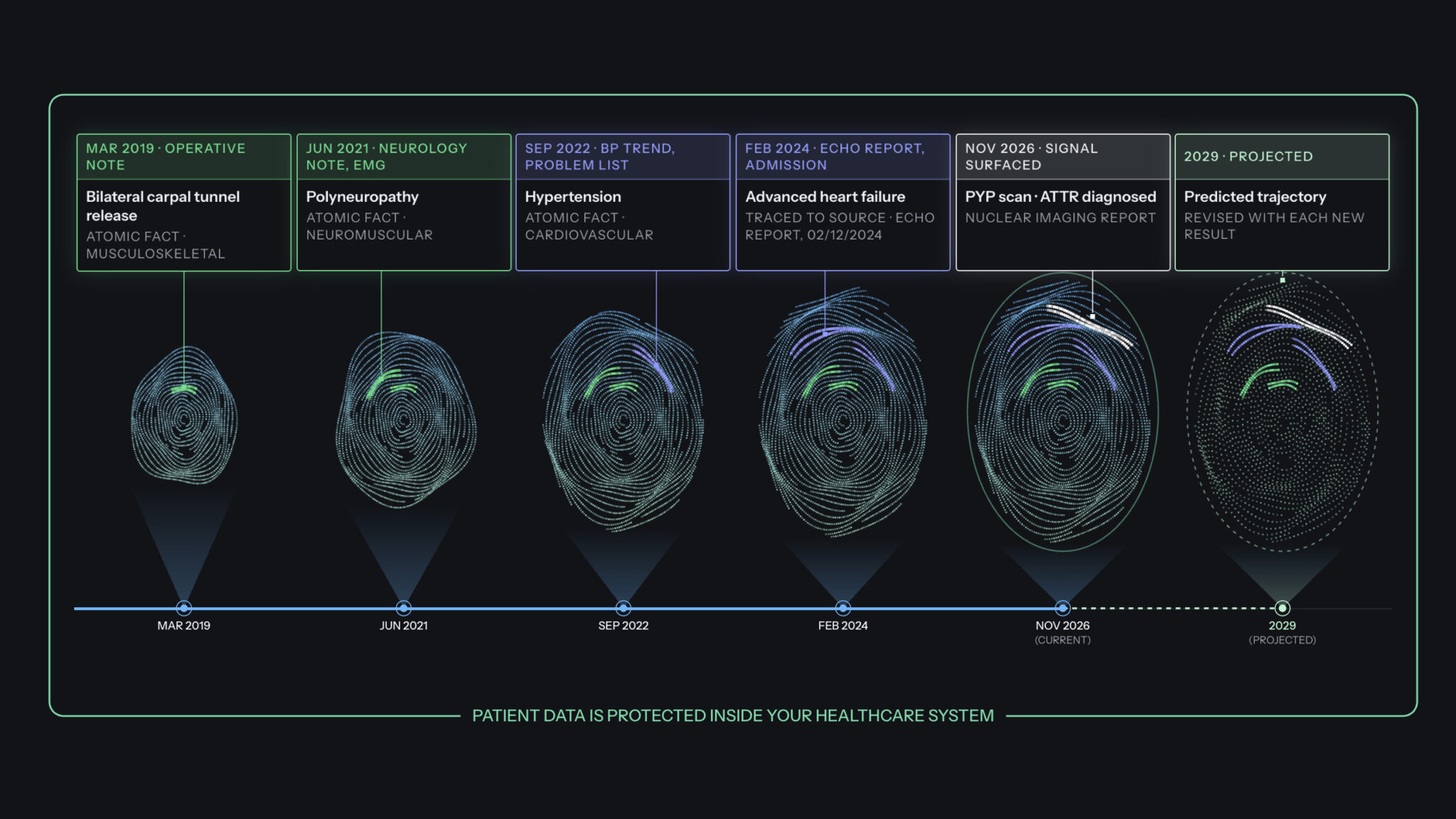
Dyania Health, based in New Jersey, built Synapsis AI to read the free-text bulk of a patient's history — physician notes, operative reports, imaging and pathology reads, discharge summaries and lab results — and connect findings that may be years apart. Its output is a set of clinical signals, each traced back to its source in the record, flagging which patients need attention and why. Clinicians review the evidence and make the decisions; NVIDIA describes it as assistive rather than autonomous.
Synapsis runs on NVIDIA-accelerated computing inside a health system's own firewall, so records can be processed onsite without patient data leaving the hospital. Dyania trains its models with NVIDIA NeMo libraries and optimizes them with TensorRT and TensorRT-LLM for the hospital's own GPU servers. Cleveland Clinic used Synapsis in a study of more than 7,800 aortic valve replacement patients treated between 2005 and 2021. The system reasoned across each record, including echocardiograms added in later years, and supported a predictive model of valve deterioration and reintervention risk at the three-, five- and ten-year marks. The chart review across the full cohort would have taken clinicians years by hand. Dr. Lars Svensson, chief of the Heart, Vascular & Thoracic Institute at Cleveland Clinic, called the ability to predict implanted valve duration a promising step toward better outcomes and more personalized care. NVIDIA notes the same pattern could apply to trial eligibility screening, cardiology and oncology care gaps, and clinical registries.
Taken together, the three examples show a common shape: domain-tuned models, heavy optimization for the target hardware, and deployment close to the data — on a room device or inside a hospital's own servers. That pattern fits healthcare's privacy and latency constraints better than sending records to a hosted API, but it shifts integration and operations work onto the health system or vendor.
Why it matters: Product and engineering teams in healthcare now have concrete reference points — Jetson-based edge inference for real-time alerts, fine-tuned open models as a cheaper alternative to frontier APIs, and on-premises GPU serving for record-wide reasoning. The reported gains are real but narrow, measured on specific tasks and test scenarios; my inference is that procurement decisions will hinge on prospective validation in each hospital's own patient population and on the total cost of running and maintaining the hardware.
Based on reporting from the original publisher. Visit the source for full context and later updates.
Publisher excerpt
From pediatric research to smart hospitals, AI is helping care teams spend less time on routine tasks and more time with patients. Health systems and startups are putting it to work across healthcare, from matching patients to clinical trials to supporting radiologists, hospital teams and patients at home. Clinicians stay at the center, reviewing AI […]