Leaked Anthropic Draft AI Regulatory Bill Is Unacceptable and Troubling
A draft federal AI regulatory bill attributed to Anthropic leaked and is reportedly being pitched to lawmakers, drawing sharp criticism from AI safety commentators within days. Zvi Mowshowitz, writing from a conference, says the draft is similar to the FRONTIER Act but with stronger preemption of state law, stronger transparency provisions and weaker enforcement. He argues Anthropic is trying to use the final stretch of a Republican-controlled Congress to lock in preemption of state safety laws, calling the trade unacceptable. This account is based on Mowshowitz's post and the commentary he quotes; Mowshowitz notes he had not read the full bill text himself and links to a copy.
Charlie Bullock offers the most favorable reading of the draft, calling it a pretty reasonable AI safety bill by the standards of an industry trying to fend off stronger regulation, and giving Anthropic credit for proposing something at all. But he says it is weaker than the Trahan-Obernolte FRONTIER Act in two significant respects: rulemaking, strong in FRONTIER and close to nonexistent in Anthropic's draft, and emergency shutdown authority. He also identifies improvements, including auditors employed on a continuing basis and better provisions for auditor access to information, while flagging possible Fourth Amendment problems with the access language. His judgment on drafting quality is that there are a few clear mistakes, which he treats as normal for a leaked discussion draft, and he credits Claude as a reasonably good legislative drafter.
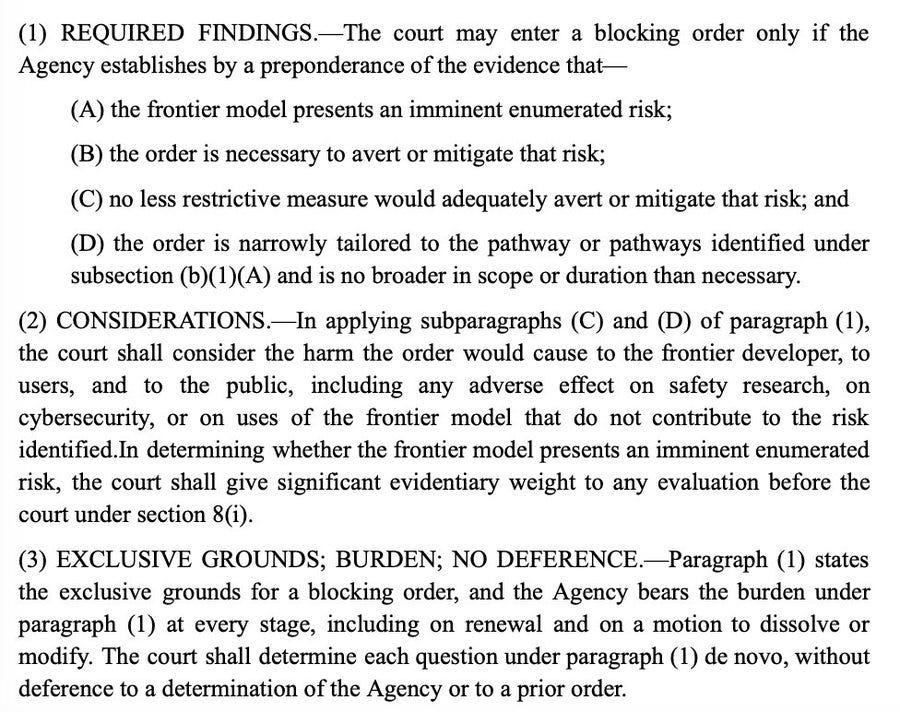
Nathan Calvin is harsher, describing anger at multiple points, and singles out two provisions that compound each other. First, he says the preemption language reaches beyond statutes like SB 53 to remove state courts' general powers to enjoin defendants and protect the public, including a provision that appears aimed at stopping states from enforcing laws or decrees that suspend the development, deployment or internal use of an AI model to protect citizens from imminent catastrophic harm. Second, he says the federal bar for restricting a frontier model is set absurdly high: an imminent risk of catastrophic harm, defined as killing more than 50 people or causing more than a billion dollars in damage, plus a detailed determination by the agency head, with no deference given, that no alternative would prevent the catastrophe. He adds that courts are told to weigh harms to the developer from restricting the model but not considerations on the other side, concluding the bill would likely make it harder than existing law to get a court order blocking frontier model development.
Bullock adds a further objection: the draft has no government licensing for independent auditors. Without it, he argues, auditors will compete to sell labs the least bothersome audits at the lowest price, a race to the bottom.
Alex Bores points out that Anthropic's own June framework said Congress should not preempt state law unless it enacts a rigorous federal regime meeting or exceeding the strongest measures in that framework. He says the draft is weaker than the framework and in places weaker than existing state laws, covering internal use, reporting timelines and the types of risks covered, so by Anthropic's own standard it should carry no preemption at all. Sydney says the bill would bar state rules touching frontier-risk disclosure, third-party evaluation and incident reporting, replacing almost all of SB 53 and the RAISE Act with a weaker federal regime.
Kelsey Piper offers a diagnosis: Anthropic, having been on the receiving end of abrupt executive-branch treatment it considered unprincipled, wants procedural protections for itself, while the safety movement wants authority to stop dangerous development and room for states to go further than Congress will. Those goals now point in opposite directions. Nat Purser calls the draft a step back from FRONTIER and suggests stronger mechanisms to compel corrective action when auditors find problems, true auditor independence from lab funding and selection, and government power to set and iterate minimum standards.
Mowshowitz concedes some provisions are good: broader coverage, thresholds that can move in both directions, required risk reports and annual audits, apparently strong whistleblower and security requirements, and the inclusion of automated AI R&D among the risks. His objection is to treating those as a trade against enforcement. He notes the draft keeps familiar industry objections, such as resisting a 72-hour incident reporting deadline outside true emergencies, and drops FRONTIER's cost-benefit analysis of catastrophic risks.
Why it matters: Frontier labs are now writing the federal template, and if this draft advances, developers building in states with AI statutes could face a single weaker federal ceiling rather than stricter local rules, an inference from the preemption provisions described. Product and policy teams should track the bill text and state enforcement outlook, since compliance obligations could shift from state incident reporting and evaluation rules to federal transparency duties. Anthropic has not publicly confirmed the draft, and the commentators are reacting to a leaked document whose provisions could change.
Based on reporting from the original publisher. Visit the source for full context and later updates.
Publisher excerpt
There is a newly leaked bill that Anthropic is purportedly shopping around is (if you assume its bugs get fixed).