Customize answers per tenant in Amazon Bedrock Managed Knowledge Base
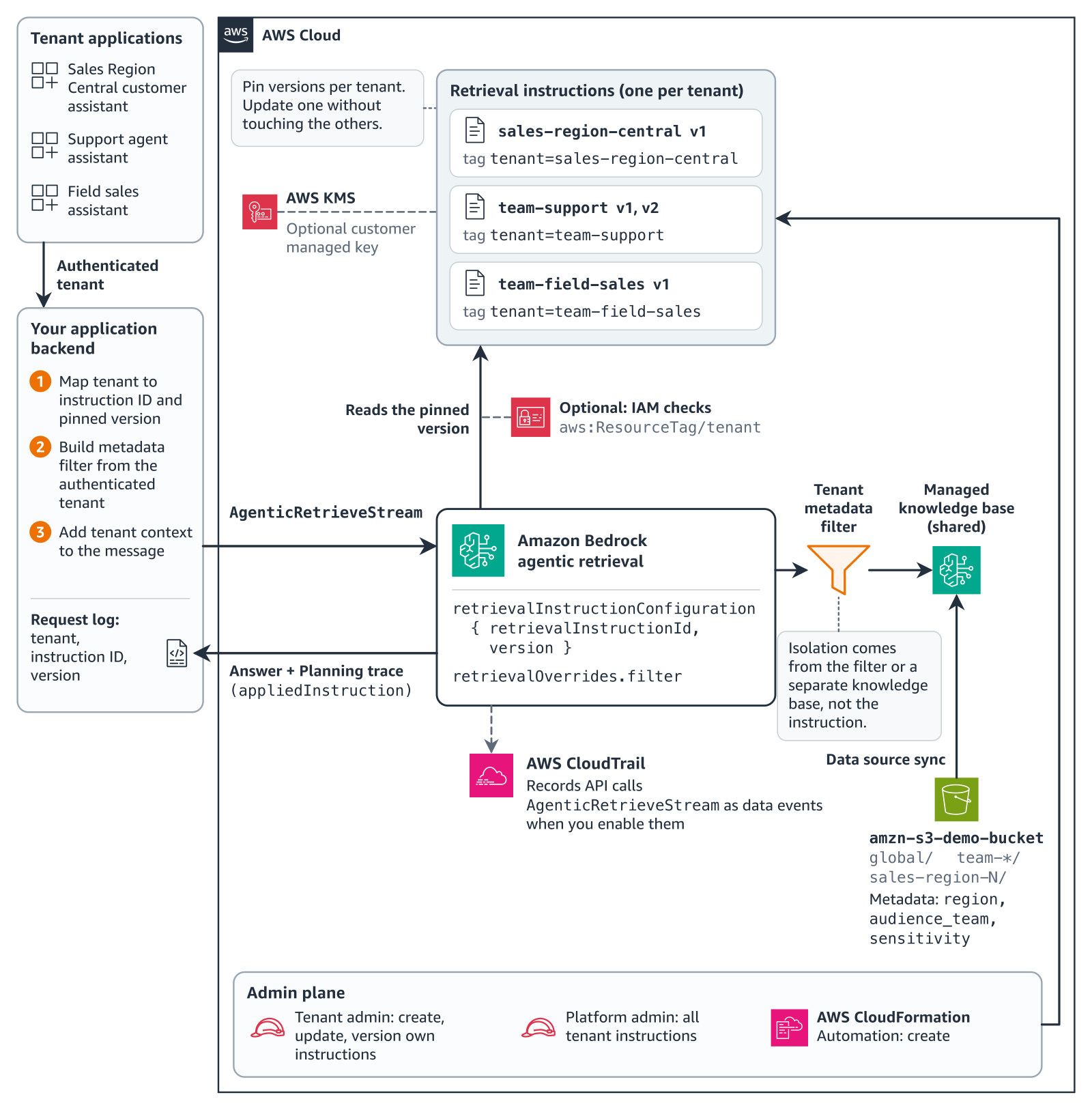
Amazon Web Services has added retrieval instructions to Amazon Bedrock Managed Knowledge Base, a way to give the same shared documents a different answer style per audience. The feature targets multi-tenant assistants: a single set of product and policy documents served to several groups, where each group needs its own language, conventions, tone and rules. Previously agentic retrieval had no way to fix an answer style, so the voice could drift between requests; teams wanting a fixed format had to disable response generation, call a model themselves and maintain the prompt in every application. Now the guidance lives once as a managed, versioned Bedrock resource that each request references, and a changed instruction can be pinned to a version so applications cut over when ready.
A retrieval instruction has four fields. persona sets who the assistant is, including identity, tone and language. answerFormat governs structure and source citation. retrievalGuidance tells the agent how to interpret the question and what to prioritize when searching. answerPolicy governs whether and how to answer, including out-of-scope questions. The first, second and fourth apply only when generateResponse is true, which is the default; retrievalGuidance applies either way. Instructions belong to an AWS account and Region rather than to a knowledge base, and a request can search up to five knowledge bases with the tenant's instruction applied across all of them.
The lifecycle runs through five stages. CreateRetrievalInstruction returns HTTP 202, then Bedrock reviews the fields asynchronously and you poll GetRetrievalInstruction; failures surface in lastTransitionStatusReasons. A passing review makes the instruction ACTIVE with DRAFT pointing at current content, CreateRetrievalInstructionVersion saves an immutable numbered version, and a request names the instruction plus an optional version that defaults to DRAFT. The first Planning trace event carries appliedInstruction, which is how you confirm which version answered a given call. Updates replace the whole instruction including the description, so every field you want to keep must be resent. Optional customer-managed KMS keys can encrypt instructions at creation, but the key cannot be added or changed later.
The most important caveat is architectural: instructions shape how an answer is written, not which documents the agent may retrieve. They are not an authorization or data-isolation boundary. On a shared knowledge base, one region's question can surface another region's addenda, or internal notes no tenant should see. Isolation has to come from metadata filters built from the authenticated tenant, from a separate knowledge base per tenant, or a combination where one request hits a shared knowledge base and the tenant's own, each with its own filter. A single filter keeps one corpus to sync and maintain but demands accurate per-document metadata and a correctly constructed filter on every request; per-tenant knowledge bases isolate by design but multiply the knowledge bases and data sources to create, sync and pay for.
Notably, Bedrock applies whatever filter the request carries, so the filter must be built server-side from the authenticated tenant and never from user input. The sample filter uses equals, andAll and orAll operators over document metadata; it is not per-user access filtering through userContext. Answer policies are best effort: a rule forbidding restricted notes can keep values out of prose, but if those documents are retrieved an answer may still name a mechanism or record ID. Excluding them with a filter is the reliable path.
The published walkthrough uses a fictitious company, AnyCompany Smart Home, selling an AnySmartProduct-5 home controller and AnySmartProduct-6 room sensors across three sales regions, with support, field sales and legal teams sharing the same corpus. Thirty-two short documents live in an S3 bucket tagged with region, audience_team and sensitivity metadata, and six tenants (three regions, three teams) each get an instruction pinned to version 1, while two restricted engineering notes belong to no tenant. A Sales Region Central customer gets Spanish with day/month/year dates and a Source line; a North customer gets 40 days from delivery and a $15 restocking fee on opened units; Central gets 45 days and a 12,00 USD restocking fee; a support agent gets a compact ticket note listing the global 30-day base and each region's window. The sample code is on GitHub in Python and TypeScript, defaults to us-east-1, and needs Python 3.10 or later with a current Boto3, since older versions lack the retrieval instruction operations. AgenticRetrieveStream has no CLI command and must be called through an SDK. The default quota is 50 retrieval instructions per account per Region at the time of writing, with increases requestable.
A request can reference only one instruction, so a user who belongs to both a region and a team needs a single instruction covering both. The post compares starting from the team's instruction plus a region tenant line, which keeps the count at N + M, against creating combined instructions only for pairs whose formats differ from the team default. Combined instructions add up fast against the quota.
In practice, the split between identity and entitlement is the design lesson. A short tenant line prepended to the question (for example, naming the sales region) tells the agent who is asking and helps it quote the right values, but it does not set language, format or date conventions; those still come from the instruction, and without one an answer can return in English, without the Source line, or in the wrong date style. Likewise, instructions do not guarantee structured output: formats such as the ticket note are not assured on every answer, so code depending on them should validate. Facts continue to come from retrieved documents, which suggests exact computed values like a return deadline are better calculated in the application than trusted to generated prose.
Why it matters: Teams building multi-tenant assistants on Bedrock no longer have to maintain prompts per application or fork a corpus per audience to control voice and format, and version pinning gives them a staged rollout and an audit trail per request. The trade-off is that per-tenant isolation now explicitly depends on filtering, so product and platform teams should treat metadata quality and server-side filter construction as security-relevant code. Inference: organizations already using separate knowledge bases may keep them for hard isolation while adopting instructions purely for consistency of tone and format.
Based on reporting from the original publisher. Visit the source for full context and later updates.
Publisher excerpt
Retrieval instructions in Amazon Bedrock Managed Knowledge Base set the voice, format, retrieval guidance, and answer policy for each tenant on shared knowledge bases. This post shows how to give each tenant its own answers, keep tenant data apart with metadata filters, scope access with IAM tags, and roll out changes one tenant at a time.