Agility Robotics' Nasdaq debut invites scrutiny of humanoid robot market
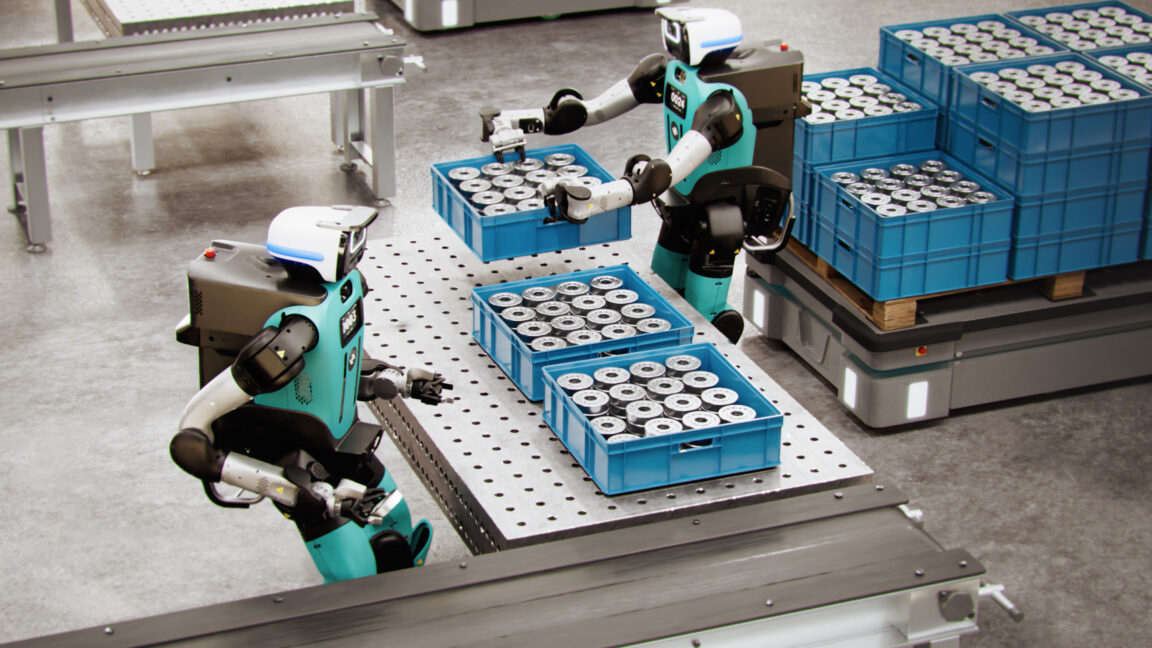
Agility Robotics, the Salem, Oregon company behind the Digit humanoid, began trading on the Nasdaq on November 5, making it the first dedicated humanoid robot developer to be publicly listed in the United States. The listing came via a merger with a special purpose acquisition company, a route that brings a registration statement and investor disclosures rather than the quieter path most of its privately held rivals have taken. The company had previously claimed the first full-time commercial deployment of humanoid robots at a customer warehouse, in 2024.
The filings put unusual detail on a market that has mostly been described in demos and promotional video. Agility outlines two commercial models: robots-as-a-service and outright ownership. Under the subscription route, a customer pays roughly $25,000 per robot up front for delivery and deployment, then $8,500 a month for software and maintenance. Under the ownership route, the hardware costs $200,000 plus $20,000 for delivery and deployment, with an ongoing annual subscription of $36,000, or about $3,000 a month, for software and maintenance. Either way, customers get the latest machine, Digit 5, starting in 2027.
Digit 5 is bipedal with swappable end-effector hands, can lift loads of up to 50 pounds, and can work more than 20 hours in a 24-hour period with the help of a fast-charging battery system. That battery comes from UK-based Nyobolt and delivers 90 minutes of runtime from a nine-minute charge. Co-founder and chief robot officer Jonathan Hurst said the two companies worked together for well over a year on a custom pack, and that Agility holds an exclusive agreement covering use of the chemistry in humanoid robots. The robot also carries an onboard safety system that detects nearby people and responds, for instance by standing still or squatting, which the company has said could let it work outside isolated cells in warehouses and factories.
Agility's chief financial officer, Michael Beer, framed the economics for investors on October 6: the subscription model lets a customer swap $200,000 in annual labor costs for $100,000 in annual robot costs, while buying outright could replace $1.1 million in labor over five years with about $400,000 in robot costs. Hurst's pitch rests on the same logic. Renting lowers risk for the customer, he said, because the rate is comparable to human labor and returns arrive from day one.
The other side of the ledger is where the disclosures get interesting. Agility puts its own annual operating cost per robot at $15,000 for software and maintenance, with a one-time $15,000 to deploy each unit. It estimates Digit 5's bill of materials at $150,000 today, with a useful operational life of about five years. Those costs are projected to fall to $75,000 per robot at annual production of 1,000 units and to $30,000 at 10,000 units a year, as output ramps at its RoboFab facility in Oregon. On revenue, Agility anticipates roughly $500,000 per robot per year under subscription and about $400,000 per robot per year under ownership with ongoing fees.
Those per-robot figures derive partly from a single large order: an unidentified customer's $300 million commitment covering 1,000 Digit 5 robots on a three-year subscription. The filing cautions that the contract is contingent on meeting contractual milestones, product features and specifications, so the headline value is not guaranteed revenue. The broader financial picture is early-stage: Agility states it has incurred net losses since inception and expects to keep doing so, and in 2025 it recorded $1.8 million in revenue against a $140 million operating loss.
Deployments so far span logistics and manufacturing. GXO, the first customer, has said it will extend Digit use from a Georgia warehouse to sites in North Carolina and Tennessee. Schaeffler has deployed the robots at a South Carolina factory, and Toyota Motor Manufacturing Canada on automotive production lines. On October 21, Agility announced plans for a facility in Pittsburgh, Pennsylvania to support deployments and further develop robot software and AI. It says substantially all of its resources go to research, development and commercialization.
The filings also name the competition plainly, describing the humanoid and robotics market as intensifying rapidly with well-funded entrants including Boston Dynamics, Tesla, Apptronik, Figure AI, 1X Technologies, Sanctuary AI, Hexagon and NEURA Robotics. Many of those companies, Agility acknowledges, have significantly greater brand recognition, customer relationships and financial, technical and manufacturing resources. Listed risks include uncertain AI-driven robotic performance in the real world, safety when sharing workspaces with people, changing regulation and cybersecurity threats.
For developers and product teams, several practical threads stand out. The pricing structure is essentially a hardware-plus-subscription split familiar from enterprise software, with software and maintenance billed separately whether the robot is rented or bought. That suggests the durable revenue is intended to sit in software, and it implies customers will be evaluating robot vendors much as they evaluate SaaS: on contract terms, uptime and renewal rather than sticker price alone. The exclusivity arrangement with Nyobolt is a supply-side bet worth watching, since battery chemistry is rarely a differentiator companies lock up.
The production cost curve is the crux. Falling from $150,000 to $30,000 per unit depends on reaching 10,000 robots a year, an order of magnitude beyond the largest disclosed order. This suggests the disclosed unit economics are a target state rather than a current reality, and that near-term margins will be thin until RoboFab volumes rise. Whether buyers accept a labor-rate-comparable subscription before the robots are proven across many sites is the open commercial question the public filings now let outsiders track quarter by quarter.
Hurst's own expectations are modest by the standards of the sector's marketing. He expects customers to publish footage of Digits doing routine work within a year, to the point where the novelty wears off, and compares the coming market to the early auto industry, with different companies occupying different niches. He has repeatedly dismissed near-term deployment in unstructured settings such as homes, saying Digit 5 will not be walking into living rooms to do dishes. The filing's frankness about unproven scale is itself notable, since it sets a public benchmark against which private rivals will be measured.
Why it matters: Agility's listing turns humanoid robots from a demo-driven story into a reported one, giving customers, investors and competitors a reference point for pricing, deployment costs and margin assumptions. Product teams weighing automation now have concrete subscription and ownership numbers to model against labor costs, while developers building integrations should expect software and maintenance fees to be a recurring line item rather than an afterthought. The disclosed losses and contingent order also signal, as an inference, that adoption will be judged on delivered milestones rather than announced contract value.
Based on reporting from the original publisher. Visit the source for full context and later updates.
Publisher excerpt
US leader in deploying humanoid robots goes public on the Nasdaq stock exchange.