Reason over time-series data with OpenTSLM on Amazon SageMaker JumpStart
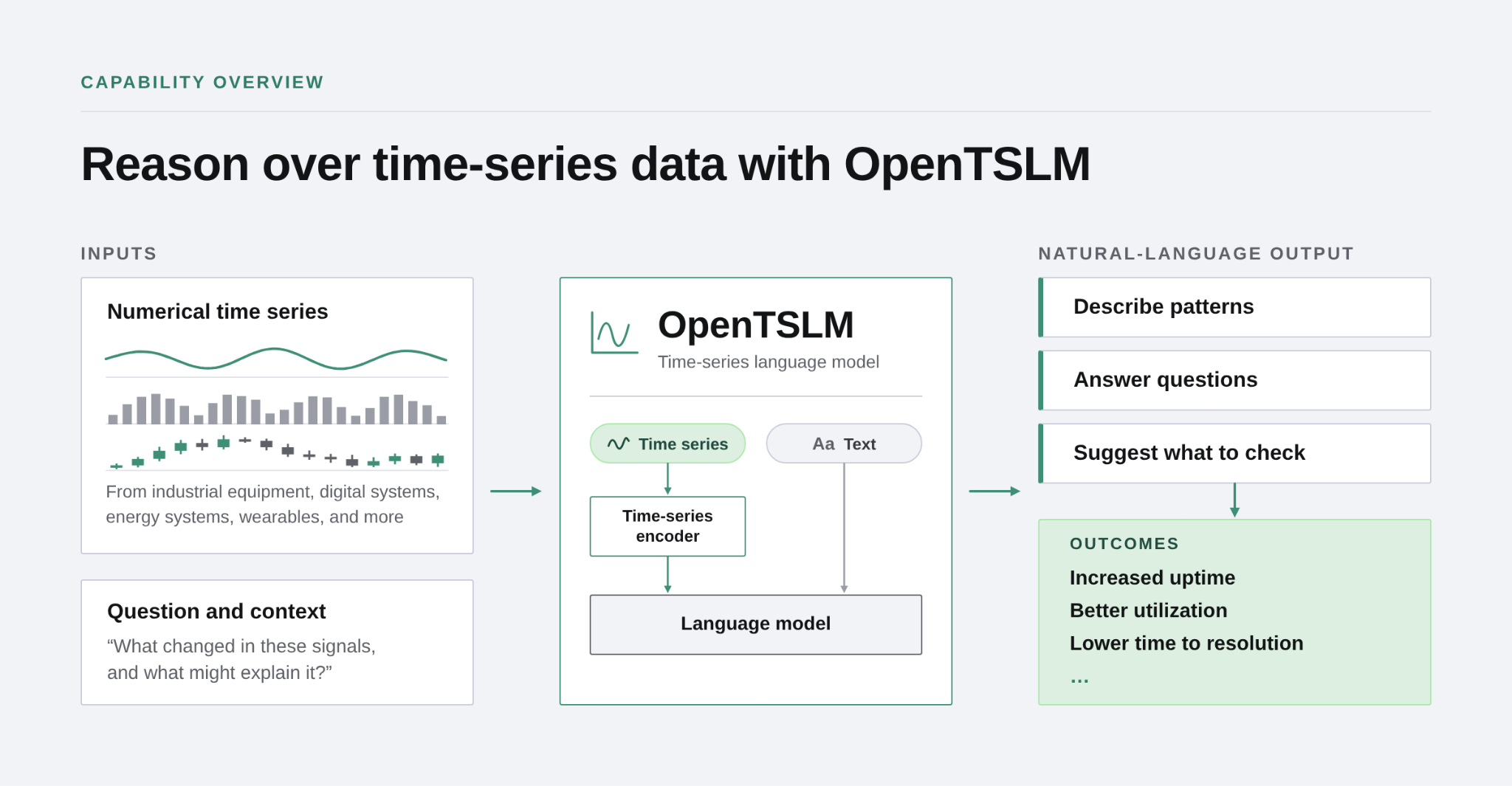
Aionic Labs' OpenTSLM, an open source family of time-series language models, is now listed in Amazon SageMaker JumpStart, AWS said in a blog post describing the deployment path. The specific JumpStart model is OpenTSLM-Flamingo, built on Gemma 3 4B. Nexthink, which makes an employee-facing IT agent called Spark, is named as a customer using the approach for proactive IT support.
The pitch rests on a cost argument. Feeding long histories across hundreds of operational metrics to a general-purpose model as text or images burns tokens, and therefore money. A time-series language model instead takes numerical measurements plus accompanying text, such as maintenance records, market news or an engineer's notes, and answers questions about how the signals are changing. TimeNet, described as shared data infrastructure for time-series data, supplies one format and API for finding, building and loading the datasets used to train and evaluate these models.
The architecture is straightforward. OpenTSLM-Flamingo combines the Gemma 3 4B language model with a time-series encoder and cross-attention layers, which let the language model attend to encoded series. The blog puts the total at 5.24 billion parameters stored in bfloat16, so the weights occupy roughly 10.5 GB of GPU memory. An application assembles numerical series and text context, calls the SageMaker endpoint, and gets back a response that can be shown to an expert or piped into another workflow. Separating the application from the model lets the caller set the observation window, pick which signals matter, and check output before acting on it; a new checkpoint can also be scored against representative cases before switching over.
For Nexthink's Spark, the model produces three things: a state summary explaining the likely issue and the signal patterns behind it, a recommended action with checks to confirm the problem, and an expected outcome that Spark can verify afterward. The inputs are recent device telemetry such as CPU activity, memory use, free disk space, application stability and connectivity, plus timestamped events and software and hardware context. In a worked low-disk example, declining free space, a rising disk queue and more frequent application hangs are tied to symptoms like a slow machine or trouble saving files. Spark then checks the device, proposes an IT-approved cleanup of temporary files, asks the employee to confirm what will be removed, runs it, rechecks available space and follows up; if the problem persists it offers to hand findings to IT support.
Getting started requires an AWS account with a SageMaker AI domain and an execution role. The walkthrough suggests AmazonSageMakerFullAccess for setup, with the caveat that production should use narrower policies. Hardware requirements are a single GPU with at least 24 GB of memory and bfloat16 support, plus a recommendation of 32 GB of host memory. The default is ml.g6.2xlarge, one NVIDIA L4 with 24 GB GPU memory and 32 GB host memory. JumpStart also supports ml.g6.4xlarge, ml.g6.8xlarge, ml.g5.2xlarge, ml.g5.4xlarge, ml.g5.8xlarge, ml.g6e.xlarge and ml.g6e.2xlarge. Endpoint quotas must allow at least one instance of the chosen type, and fine-tuning additionally needs quota for ml.g7e.2xlarge training jobs.
Deployment runs through SageMaker Studio: open JumpStart models, search for OpenTSLM, select OpenTSLM-Flamingo Gemma 3 4B, accept the Gemma Terms of Use, pick an instance type and deploy. AWS reports endpoint provisioning took about six minutes in its tests, and endpoint names begin with jumpstart-dft-. Python users can call ModelBuilder from the SageMaker Python SDK v3, supplying the model ID pytorch-reasoning-opentslm-flamingo-gemma3-4b and accept_eula=True, since the model is gated.
Requests are JSON with one or more instances, each holding a question, one or more numerical series and optional context lines. A series carries its values, a name and a short description such as units and sampling interval, and can hold up to 32,768 values. The endpoint standardizes each series to mean 0 and standard deviation 1, passing the original statistics to the model as text so it sees both shape and scale; None marks a missing value, which the model masks. Calls go through the SageMaker Runtime InvokeEndpoint API, and the caller needs sagemaker:InvokeEndpoint permission.
Limits matter in practice. A request can carry up to four instances with 1 to 32 series each, and the response returns one answer per instance in generated_text. max_new_tokens ranges from 1 to 512. Decoding is greedy, so identical requests tend to return identical answers. Real-time calls must finish within 60 seconds and the body can be at most 6 MB. On ml.g6.2xlarge the model produces about 20 tokens per second, and instances are handled sequentially, so a 512-token answer takes roughly 30 seconds; AWS advises several instances per request only with short answers, such as max_new_tokens of 128, and points to asynchronous inference for longer jobs.
On long inputs, OpenTSLM-Flamingo compresses encoded series into a fixed-size set of representations, which bounds what the language model receives but does not make the whole system unbounded in memory or guarantee that a brief event stays easy to spot in a long recording. AWS cites TS-Haystack, a benchmark evaluating event retrieval over recordings of varying length, which finds the tested TSLM variants often lose accuracy as history grows, particularly when locating event start and end times. The guidance that follows is sensible: pick a window containing the event plus surrounding context, compare overlapping windows for long recordings, keep sampling resolution for brief events, align related channels in time, state units, interval and observation period in the text, and validate on both normal and abnormal examples at the intended lengths. Payload size and useful analysis window are separate constraints.
Fine-tuning uses a notebook that loads ARFBench, a public benchmark of multiple-choice questions about anomalies in Datadog software-incident telemetry, through TimeNet, submits a SageMaker training job on a managed GPU, stores the artifact in Amazon S3 and deploys it to a separate endpoint for evaluation. ARFBench was chosen because multiple-choice answers can be scored automatically, making fine-tuning gains measurable; the same flow applies to open-ended tasks like Spark's summaries. AWS suggests first testing the pretrained model, fixing missing units, sampling rate, context or window before fine-tuning, and only adapting when the model consistently misses domain-specific patterns, then comparing against held-out examples.
Why it matters: teams with large operational telemetry can now stand up a time-series language model inside their own AWS accounts without building containers, at a known instance cost and with documented request limits. The published caps, throughput and long-context caveats suggest developers should design around bounded windows and short answers rather than assuming arbitrary-length histories work. My inference is that the fine-tuning route, not the base checkpoint, will decide most real deployments, since domain-specific signal patterns are exactly where a small Gemma-based model is likely to struggle.
Based on reporting from the original publisher. Visit the source for full context and later updates.
Publisher excerpt
OpenTSLM, an open source family of time-series language models, is now available in Amazon SageMaker JumpStart. See how Nexthink and Aionic Labs apply it to proactive IT support, then deploy OpenTSLM to a real-time endpoint and fine-tune it on your own data with TimeNet and a SageMaker training job.