Building AI for Reliable Execution: Lessons From Industrial Robotics
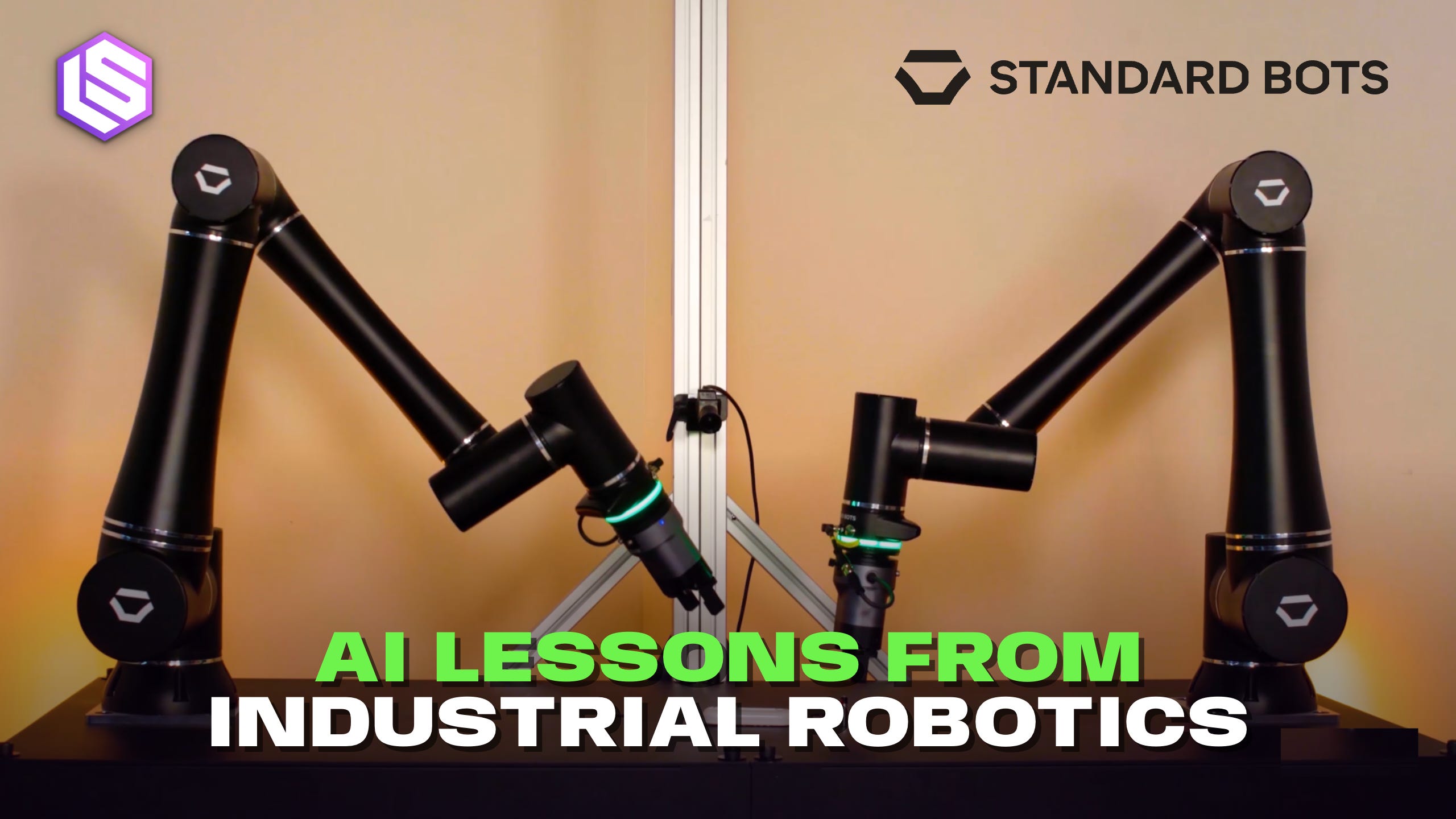
Standard Bots, which describes itself as "America's largest AI-native industrial robot manufacturer," recently raised $200 million at a $1 billion valuation in a Series C round led by General Catalyst and RoboStrategy, a robotics-focused fund. Its customers include NASA, Amazon and Lockheed Martin. Latent Space spoke with co-founder and CEO Evan Beard and Head of AI Leif Jentoft about how the company's models actually work. Standard Bots builds industrial robot arms for tasks such as machine tending, welding and assembly, not humanoids.
The architecture centers on a shared base model that customers adapt through demonstrations and fine-tuning. Beard says the company's largest model sits in the low billions of parameters, small by frontier-lab standards. Jentoft's framing is that data quality outweighs raw volume: the team focuses on squeezing the most out of targeted data rather than chasing the biggest possible dataset. He adds that market access gives Standard Bots unique access to high-value data, and that in-situ interventions can fix an edge case with a few dozen examples.
That division of labor is the most concrete detail in the conversation. In its machine-tending solution for high-mix manufacturing, a zero-shot system lets a user tell the robot which parts to look for on a given task. The learned model handles perception, locating and identifying parts, while conventional programming handles motion and the cell logic around it. The backbone for that task is trained on over a billion images, which Jentoft says is what lets the robot distinguish between lighting conditions, material types, and an object versus its background. Beard notes the company deliberately concentrates on short-horizon tasks to meet production requirements around cycle time and reliability.
Where models are trained and where they run are split. Training happens in the cloud; inference runs locally. Beard says on-premises inference is a requirement for factories, which he describes as most of what the company is doing right now. Jentoft explains the sensor path: wrist cameras and other sensors feed raw pixels and signals over internal gigabit Ethernet, routed internally so no cables tangle, and edge GPUs process that data to generate action chunks that stream to low-level control. His stated reason for keeping the loop local is operational: cloud compute for robotics is extremely hard because most factories and warehouses lack reliable internet, and that is even more true for mobile robots, while uptime is crucial to customer acceptance.
Standard Bots also controls what Jentoft calls the full stack, spanning the robotic arm, end effector, control system and AI. He argues that this allows co-optimization of models and control policies, and asserts that no model today is truly hardware-agnostic, making co-optimized low-level control and higher-level functions an advantage for both performance and iteration speed. Skild, a company pursuing general-purpose robotic intelligence through cross-hardware generalization, might quibble with that claim — a tension worth watching as the field matures.
Simulation covers some of the training need, but Beard says certain production tasks are hard to reproduce in current simulators, naming liquids, suction, and cutting flexible material. Real-world demonstrations fill the gap. On failures, Jentoft says the company captures failure signals and human corrections from deployments, and how that data gets used depends on the customer. Many defense customers deploy in air-gapped environments where nothing comes back; for other customers, fleet learning delivers enough benefit to their own applications that pushback on contributing data in exchange for performance is typically not seen.
Standard Bots has opened its platform to outside developers through StandardOS, a set of APIs and SDKs. Beard says developers can build robotics applications using whichever parts of the stack they need, including bringing their own models; NVIDIA Cosmos, an open family of omnimodal world models for physical AI whose version 3 shipped in late May, is one example. Today that requires writing custom integration code, with the company planning to make data collection, model training and deployment onto its robots easier over time.
The broader lesson for AI engineers is about scoping. Standard Bots keeps the learned component narrow — perception in the machine-tending case — and leaves motion and cell logic to conventional programming. That is a deliberate trade-off: it limits what the model has to get right, which helps with cycle time and reliability in production, but it likely caps how much flexibility a single deployed system has. Applying the same pattern to software agents means deciding early which parts of a workflow genuinely need learned behavior and which are better served by deterministic code.
Why it matters: Teams building on physical AI should note that the constraints that matter most here are operational, not model-centric — on-premises inference, uptime, and short-horizon scope. The pattern of a modest-size perception model plus conventional control, improved by a few dozen corrections per edge case, is directly transferable to software agents. For platform teams, StandardOS signals that industrial robotics vendors are beginning to compete on developer experience and bring-your-own-model support, not just hardware.
Based on reporting from the original publisher. Visit the source for full context and later updates.
Publisher excerpt
Inside Standard Bots’ AI stack, pretrained models learn factory tasks from demonstrations and improve through corrections from real deployments.