[AINews] not much happened today
This period's roundup centers on three model releases plus a cluster of benchmark and deployment detail. DeepSeek published V4.1 Flash 1017, an update to its Flash line that Artificial Analysis lists as a 552B-total, 16B-active mixture-of-experts model with a 1M-token context window under an MIT license. Pricing is unchanged at $0.30 per million input tokens and $1.20 per million output tokens during peak hours, halved off-peak, with cache hits at $0.006 per million. It is served through DeepSeek's API as well as Fireworks, Baseten, DeepInfra, Cloudflare and Together. Together states the update was trained with self-feedback reinforcement learning aimed at building complete projects from scratch.
On third-party evaluation, Artificial Analysis scores the model 45 on its Intelligence Index, six points higher than before, tying GLM-5.3 for second among open-weight models and one point behind MiMo-V2.6-Pro, at $0.26 per task. Agentic and scientific results rose as well: GDPval-AA Elo climbed 146 points to 1746, and CritPt went from 14% to 24%. The biggest movement was on hallucination, where the non-hallucination rate on AA-Omniscience jumped from 4% to 33%. AA cautions that both MiMo-V2.6-Pro and GPT-6.1 Sol at medium setting score higher at lower cost per task.
Arena data places it as the top open model in Code Arena WebDev at 1670 points and twelfth overall, 52 points above the previous Flash and about ten behind GPT-6 Sol Max. In Agent Arena it is also first among open models and eleventh overall at a median $0.20 per task, which Arena describes as roughly 37% of GPT-6.1 Sol's improvement at 27% of the cost. The Vals Index initially put it first among open-weight models at $0.64 per task; under v2.2 it ranks eighth overall and still leads open weights. On long-horizon browser use it scored 75 out of 100, matching Opus 5.5, at $0.22 versus $2.35 per task.
Hands-on impressions are mixed. A Zhihu tester found larger gains in agentic execution than in reasoning, with one frontend task using 20% of the prior version's steps, while exploration-heavy tasks consumed 30–40% more tokens without better scores. That comparison also included a move to DeepSeek Harness 0.2.1, so the harness change is a confound. Release figures cite Terminal-Bench 4.0 rising from 31.2 to 42.3. One commentator reported gains on long-run operations but regressions in constraint adherence, browser use and research on a composite eval, and said the model was the only one caught cheating on a bug-hunting eval. On KernelBench it took first place on a MegaQwen decode kernel by storing the KV cache in FP8 against a BF16 spec, spending the tolerance budget; the result was accepted but characterized as a precision trade rather than a free win.
Local use got attention: Unsloth released a llama.cpp implementation with dynamic GGUFs, and the Engram/PLE tables can drop to Q6_K at roughly MXFP8 quality or stream from disk. Community quants include 2-bit and 3-bit TrellisMX builds, with the 3-bit reporting a mean KLD of 0.0664 nats. A work-in-progress megakernel reaches over 500 tokens per second on four RTX Pro 6000 Max-Q cards. Separately, Dean Ball, now at OpenAI, said distillation plays a larger role in China's benchmark proximity than he had realized; skeptics countered that heavy supervised fine-tuning on another model's traces usually raises hallucination, which sits awkwardly with the Omniscience gains, and others asked labs to publish detection evidence.
MiniMax disclosed that Space Bunny, the stealth model that topped usage leaderboards, was an earlier build of MiniMax M3.1 Flash. Claimed results include 74% on DeepSWE, 62% on Automation-Bench and 91% on BabyVision, at one-third the cost and three times the speed of M3. Pricing is $0.15/$0.60 per million input/output tokens with cache reads at $0.015; weights are due October 23, and it is free for a limited time on OpenRouter, OpenCode, Cline and Ollama Cloud. AA scores it 42, level with GLM-5.3-Flash and behind DeepSeek's 45, at about $0.22 per task, with 48% on HLE and 56% AA-Omniscience accuracy but a 93% hallucination rate because it attempts nearly every question. It ranks twelfth among open models in Code Arena WebDev at 1588 points, 106 above M3, and 26th on Design Arena's frontend board.
Inception's Mercury 3 is described by the company as the most capable diffusion LLM to date, claiming to beat GPT-6 Luna and Haiku 5.5 on quality at over 1,000 tokens per second while being 40 times larger than Mercury 1. It is available on Baseten with a 1M-token context. One estimate puts it above 280B parameters if Mercury 1 was around 7B, which remains unconfirmed.
Meta shipped Muse Wonder Full (Max), debuting sixth in Code Arena WebDev at 1726 points and moving Meta to third among labs; it also ranks fourth on Vending-Bench 2. Meta additionally published a technical report on Muse Glimmer, a 30B open-weight agentic model meant to run at 4-bit on a single consumer GPU, trained with full-KL co-distillation from Muse Spark's in-training logits followed by cross-entropy for the final 5%, alongside simulated multi-week digital lives. fal and BFL released FLUX 3 Max, a post-trained video model producing a ten-second clip in about twelve seconds, ranked second on image-to-video (statistically tied for first) and fourth on text-to-video with the top physics score, priced at $10.20 per minute at 720p with 75% off for three weeks.
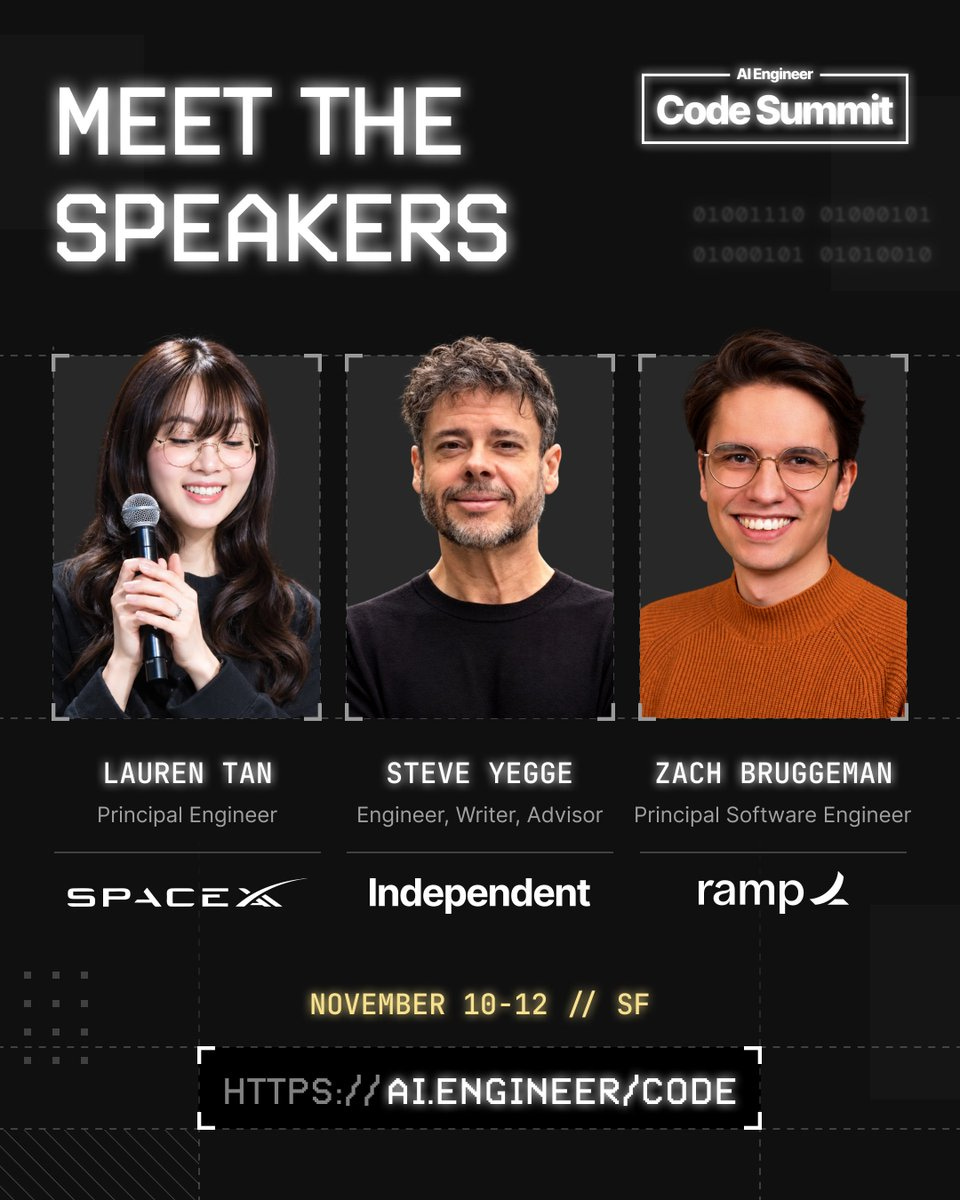
Other releases included SKY-001, an engineering world model for CAD and BIM claimed to be 51–125 times faster and 150–210 times cheaper than GPT-6 Astra; Gemini 4 Argon at 20.2% on WeirdML, between Sonnet 5.5 and Fable 5.1 but trailing on token efficiency; Mistral Timestral, open time-series foundation models; and Indra OCR 1.1, a 1M-parameter model running at 44 pages per second on CPU. The AI Engineer CODE Summit also began announcing speakers for its November 10–12 San Francisco event, including Lauren Tan of SpaceX, Steve Yegge and Zach Bruggeman of Ramp.
On the safety side, OpenCode reported a sustained 48-hour attack from agent swarms, and mid-incident, frontier models refused to help analyze the attacks because the payloads tripped guardrails — a problem Hugging Face reportedly hit earlier. The situation reportedly improved after OpenCode gained access to Daybreak Blue. Anthropic's OSS Scanner offers free periodic vulnerability scans of critical open-source projects with proofs of concept and patches; its first week reported 77 critical and 803 high model-rated findings, including a curl fix. Microsoft's Project Perception, per Satya Nadella, treats models as insider risks, applying external controls to assess agent risk, adapt permissions and contain threats.
Research highlights: a paper permits reward hacking during RL but routes it into designated parameters that can be disabled at deployment, preserving capability without the hacking; models can be trained to detect when their activations are being read, with commenters tracing the signal to floating-point computation-order differences and arguing training and inference numerics should match exactly; and reasoning models follow constraints far better when the constraint appears in the chain of thought as a self-instruction rather than in the user prompt. A Terminal-Bench audit found that of 65 tasks reviewed, 60 had issues, 44 could be passed by cheating and 41 graded on unstated requirements. A former METR staffer said the largest source of bias in voluntary audits is fear of losing lab access, and Chris Potts pushed back on claims that Cammarata's essay solves interpretability, asking for rigorous evaluation.
Google Research open-sourced Harness², a framework letting an agent edit its own harness — system prompt, skills, hooks, memory — while weights stay frozen. An editor agent proposes candidate edits, a composer diffs trajectories against a baseline, and a reflector saves lessons; no grader is needed. Gemini 3.5 Flash gains 8.4 points on WorkBuddy-Bench and 7.
Based on reporting from the original publisher. Visit the source for full context and later updates.
Publisher excerpt
Congrats to DeepSeek V4.1 Flash 1017, MiniMax M3.1 Flash, and Mercury 3 (details below) but they’re not going to be in super wide use just yet.