Adaptive agentic intelligence framework using Strands Agents
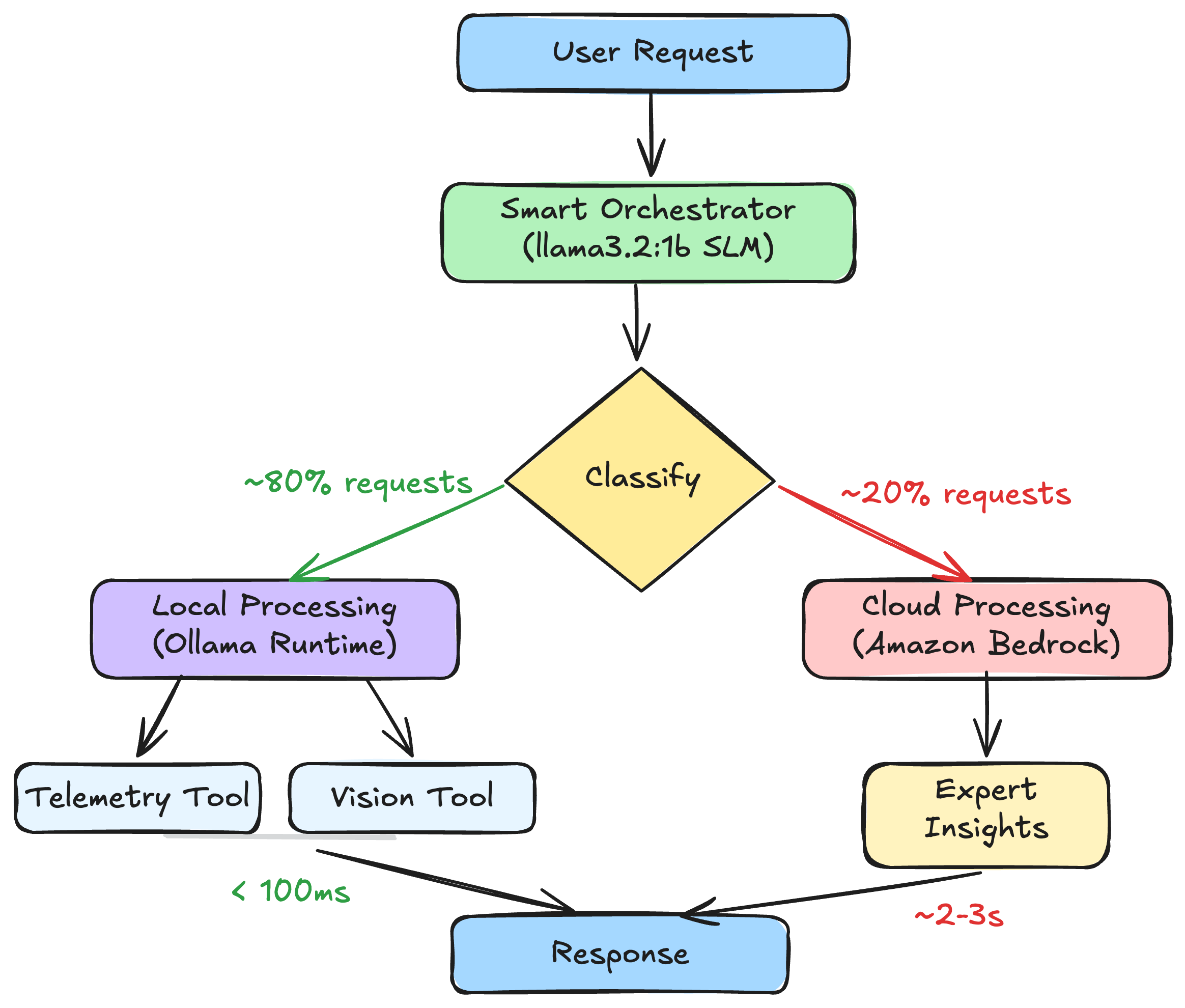
AWS published a walkthrough of the Adaptive Agentic Intelligence Framework (AAIF), an agent pattern built with its open-source Strands Agents library. The framework splits incoming requests across three layers: a small local model decides what each request needs, routine work is handled by small language models running on local hardware through Ollama, and heavier analysis is forwarded to frontier models on Amazon Bedrock via boto3. The reference implementation is an Internet of Things monitoring scenario in which a facility assistant answers questions about sensors, cameras and HVAC equipment.
The problem the design targets is the default habit of sending every request, from a simple status check to a multi-step analysis, to one large cloud model. That pattern raises API spend, makes latency dependent on network round-trips, and rules out offline operation. AAIF's authors cite a research position from Belcak and colleagues at NVIDIA arguing that small language models are sufficiently capable, better suited and more economical for many calls inside agentic systems.
In the architecture, a Strands agent sits at the centre and connects to an Ollama runtime hosting two models: llama3.2:1b, which acts as the orchestrator, and llama3.2-vision, which handles images. The agent exposes three tools defined with the @tool decorator. get_device_telemetry pulls sensor data, analyze_camera_feed runs vision inference on the local device so camera footage need not leave it, and get_expert_insights calls Bedrock's converse API with inference settings of 512 max tokens, temperature 0.5 and topP 0.9.
Routing is not keyword-based. The orchestrator model itself reads each request against a system prompt and picks a tool. A question about device status or a camera feed is handled locally with low latency, while a request for optimisation strategies is escalated to the cloud and pays a network round-trip. The source describes this as classification through the model's understanding rather than hardcoded rules. For developers, this is the interesting trade: an extra tiny-model call on every request, in exchange for avoiding large-model calls on the ones that don't need them.
The orchestrator is configured through the Ollama provider with 300 max tokens and temperature 0.3, and the same agent can be pointed at other deployment shapes by swapping model classes. A fully cloud setup replaces Ollama with BedrockModel so every request hits managed inference and autoscaling, which suits teams with reliable low-latency connectivity and no data residency constraints. The default hybrid keeps the local router and adds cloud models for escalated requests; AWS estimates that roughly 80 percent of traffic in that mode never reaches a paid API endpoint. An air-gapped variant drops the cloud tool and substitutes a larger local model, llama3.2:3b, on machines with enough memory. That gives up reasoning depth on the hardest queries but keeps data on premises.
Hardware requirements are modest on paper. The source says the pattern runs on an edge device such as a Raspberry Pi with 8 GB of memory. Prerequisites are an AWS account with Bedrock model access in the target Region, Python 3.10 or newer, Ollama with both models pulled, the strands-agents and strands-agents-tools packages, a configured AWS CLI and boto3. The sample telemetry tool returns simulated records for a temperature sensor, a security camera and an HVAC controller rather than connecting to real hardware.
Two operational notes stand out. Cleanup steps revoke Bedrock model access and remove the Ollama models, which occupy roughly 2 GB of local disk. And the post recommends attaching Amazon Bedrock Guardrails to the Strands BedrockModel with a guardrail ID and version for cloud traffic, covering content filters, prompt injection filters and contextual grounding checks, while calling the standalone ApplyGuardrail API on local model inputs and outputs so one policy applies in both tiers. In practice, that dual enforcement is additional plumbing many tutorials skip, and teams handling regulated data should budget for it.
The authors also sketch a distributed version in which tools become Model Context Protocol servers rather than in-process functions. One device runs the orchestrating agent and a local telemetry tool, a second hosts an edge vision server, and a third acts as a cloud analytics gateway to Bedrock. Because MCP handles serialisation and network transport, the orchestrator treats remote tools as ordinary local calls. That is a reasonably well-known pattern now, but it is worth noting that adding network hops to tool calls can reintroduce exactly the latency the design tries to remove, unless the hops stay on a fast local network.
Beyond IoT, the post suggests healthcare monitoring with cloud-assisted diagnosis support, financial transaction processing on premises with cloud risk analysis, and manufacturing quality-control vision at the edge with cloud optimisation requests. These are illustrative rather than demonstrated deployments.
Why it matters: Teams building agents on Strands Agents get a concrete, copyable pattern for cost and latency control that does not require abandoning cloud models altogether. The main engineering work shifts from prompt design to routing accuracy and safety policy, since a misrouted request either wastes a cloud call or returns a weaker local answer; whether the 1B orchestrator classifies reliably in messy production traffic is the open question to test. Inference: expect similar tiered-routing reference designs to appear across agent frameworks as small-model quality improves.
Based on reporting from the original publisher. Visit the source for full context and later updates.
Publisher excerpt
The Adaptive Agentic Intelligence Framework (AAIF), built with Strands Agents, handles routine tasks locally with small language models and routes complex requests to cloud models through Amazon Bedrock. This post walks through building AAIF with local SLMs through Ollama and Amazon Bedrock, using an Internet of Things monitoring scenario.