Regina Barzilay and Jim Collins win Pritzker Prize for AI and Science Research Excellence for work in AI-enabled antibiotic discovery
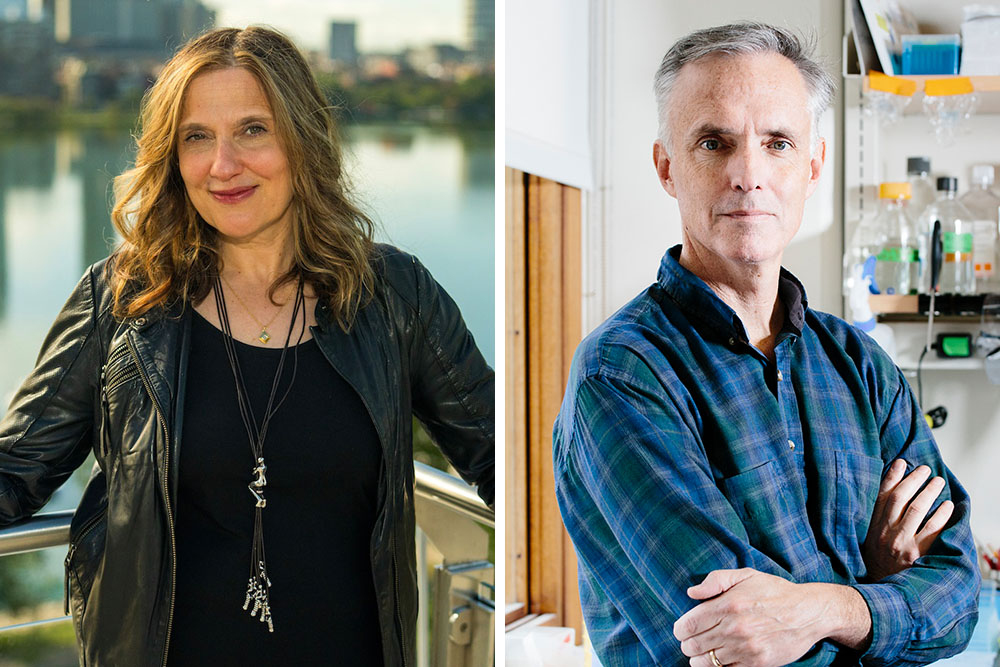
Regina Barzilay, MIT's School of Engineering Distinguished Professor of AI and Health, and James Collins, MIT's Termeer Professor of Medical Engineering and Science, are the recipients of the 2026 Pritzker Prize for AI in Science Research Excellence. The citation credits their joint work in pioneering AI-enabled antibiotic discovery, describing an approach that combines deep learning, bioengineering and experimental validation to surface new antibacterial candidates against drug-resistant pathogens. The University of Chicago established the prize in 2024 in partnership with Caltech; it honors contributions that advance artificial intelligence and the natural sciences or engineering together.
Both winners hold leadership roles at MIT. Barzilay and Collins are faculty co-leads of the Abdul Latif Jameel Clinic for Machine Learning in Health, and both are affiliated with the MIT Schwarzman College of Computing and the MIT School of Engineering. Their collaboration produced its first major result in 2020, in a Cell paper whose first author was then-MIT postdoc Jonathan Stokes, who worked in the Collins lab from 2017 to 2021.
That paper reported halicin, described as the first antibiotic discovered by artificial intelligence and named after the fictional HAL 9000 system in Stanley Kubrick's 1968 film 2001: A Space Odyssey. Halicin is a broad-spectrum antibiotic originally studied as a possible diabetes drug. A deep learning model trained on 2,500 molecules flagged it, and laboratory testing showed it killed antibiotic-resistant bacteria, often called superbugs, including Clostridium difficile, Acinetobacter baumannii and Mycobacterium tuberculosis. The team reported completing a discovery process that historically took years in only a few weeks, a result that landed as alarm over global antimicrobial resistance was mounting.
A follow-up in 2023, again with Stokes, now an assistant professor at McMaster University, used machine learning to identify abaucin. This one is a narrow-spectrum antibiotic effective against A. baumannii, a treatment-resistant organism the announcement associates with hospital doorknobs and the wounds of U.S. soldiers serving in Iraq and Afghanistan. The narrow spectrum is presented as abaucin's central advantage: targeting a single species limits the pressure on bacteria to develop resistance and spares beneficial gut bacteria that broad-spectrum drugs wipe out.
Collins framed the arc of the work as a change in the role AI plays. Antibiotic discovery, he said, has historically relied on laborious trial and error that is slow, costly and unpredictable, and that often yields few viable candidates. With generative AI, he argues, the field is moving from using AI as a discovery tool toward using it as a design tool, which he says could open new frontiers and yield a next generation of lifesaving drugs. Barzilay struck a more measured note, saying that despite significant progress in molecular modeling, drug discovery remains at an early stage. AI, in her account, can automate parts of the pipeline rather than transform the whole process, and realizing more will require building realistic AI models of human biology.
This suggests the award is recognizing a template as much as two drugs. In the halicin workflow, the machine learning model does not replace the lab; it narrows an enormous chemical search space down to a shortlist, and conventional wet-lab experiments then confirm or reject each candidate. That pairing of cheap computational screening with physical validation is what lets a screen run in weeks, and it is why the prize citation explicitly mentions experimental validation alongside deep learning. The abaucin result adds a second idea: models can be tuned to favor specificity, not just potency, which matters because broad-spectrum drugs tend to select for resistance across many species and disrupt the microbiome.
A likely trade-off, and one the researchers' own comments point toward, is that the approach is most reliable when the training data and assays already exist. Barzilay's caution about modeling human biology is a reminder that a compound shown to kill bacteria in a dish still faces the long, expensive path of animal studies and clinical trials, which this announcement does not claim to have completed. For developers and product teams, the pair's work is a useful reference point for how machine learning gets deployed in regulated, high-stakes domains: as a prioritization layer feeding expert review rather than an autonomous decision-maker. Teams building similar screening or generative design tools should expect the same architecture, where model output is a hypothesis and downstream verification carries the burden of proof.
Why it matters: The prize puts a mainstream scientific stamp on AI-assisted drug discovery, and the halicin and abaucin papers give teams a concrete case study in combining deep learning with experimental validation. For developers working on molecular or materials search, the takeaway is that the value sits in fast, well-scoped candidate ranking rather than end-to-end automation. Researchers and product teams in biotech should read Barzilay's caveat as a constraint on timelines: the discovery step can shrink to weeks, though the path from candidate to approved drug is, by inference, still governed by years of clinical testing.
Based on reporting from the original publisher. Visit the source for full context and later updates.
Publisher excerpt
The MIT professors collaborated to identify the first AI-discovered antibiotic, a scientific breakthrough that is widely recognized as a milestone in AI-driven drug discovery.