Production AI, Architecture Trade-offs & Team Design: InfoQ Opens Registration for 6 January Cohorts
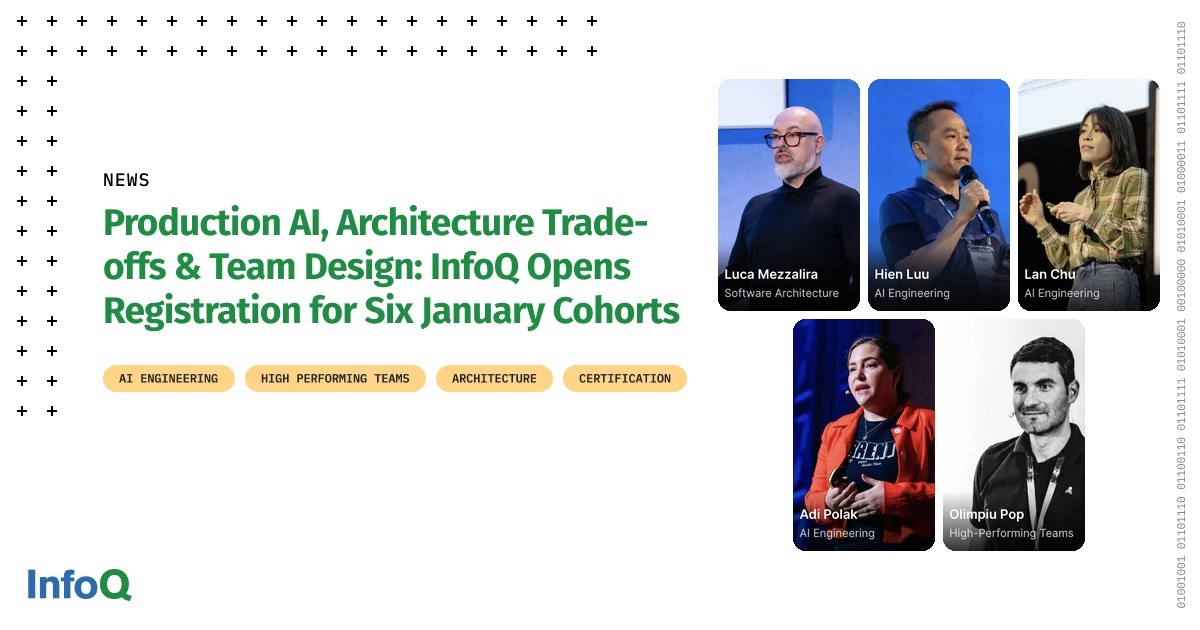
InfoQ has opened registration for six online cohort workshops that begin between 9 and 22 January 2027, each running five weeks across three tracks: AI Engineering, Software Architecture and High-Performing Teams. The sessions are aimed at senior engineers, architects and engineering leaders, and are designed around applying frameworks drawn from QCon and InfoQ to decisions participants bring from their own organizations. The announcement was reported by Artenisa Chatziou.
Each cohort mixes four hours of live facilitated sessions per week with independent application work between meetings and a capstone specific to the program. The format is explicitly discussion-led rather than lecture-based: sessions are not recorded, which the organizers present as a way to let participants speak more openly about constraints inside their organizations. Certification requires attendance, active participation and completion of the capstone. The price is USD 1,470 per person, with full schedules and syllabi on InfoQ's Online Certification Programs site.
The AI Engineering track centers on retrieval, agents and evaluation. Its framing is that production AI decisions go well beyond picking a model: how context is retrieved and kept current, how much autonomy to grant an agent, and how reliability, latency and inference cost are managed. Participants work through RAG architectures, agent design, platforms and evaluation methods along with associated failure modes, applying them to AI systems or proposals already in progress at their own companies.
Three AI Engineering cohorts are scheduled. Hien Luu, an AI and ML leader and author of MLOps with Ray, starts on 9 January with Saturday sessions at 09:00 PST. Adi Polak, Director of Developer Experience Engineering at Confluent, starts 21 January with Thursday sessions at 08:00 PST. Lan Chu, a principal engineer at Rabobank and author of Post-training LLMs, starts 22 January with Friday sessions at 14:00 CET; her QCon London 2026 talk covered a production RAG system built on more than 10,000 documents and used by more than 300 people, which indicates the kind of worked example the track draws on.
The Architect Program addresses how architecture choices are shaped not just by system requirements but by team boundaries, platform ownership and organizational constraints. Topics include distributed systems, decentralized decision-making, platform engineering and AI architecture. Participants apply the material to architecture decisions they currently own and practice explaining their trade-offs to stakeholders. Its capstone is unusual: co-authoring a technical article on AI's role in software architecture or platform engineering, with selected pieces eligible for publication on InfoQ. Two cohorts start on 22 January, both facilitated by Luca Mezzalira, an independent software architect and author of Building Micro-Frontends, with Friday sessions at 09:30 GMT and 10:00 EST.
The High-Performing Teams Program starts from the observation that faster coding does not by itself speed up delivery when review queues, approval steps or infrastructure dependencies are the real constraint, and that AI agents shift how responsibilities are split and which work still needs human judgment. The track treats team structure, ownership, delivery flow, AI responsibilities and engineering metrics as a single operating model. Participants diagnose constraints in their own teams and draft a proposed target operating model covering responsibilities, workflow and measurement. The January 12 cohort is facilitated by Olimpiu Pop, an InfoQ Podcast co-host with backgrounds in solutions architecture, engineering management and CTO roles, meeting Tuesdays and Thursdays from 16:00 to 18:00 CET.
For developers and product teams, the practical appeal is the cross-company comparison: working alongside practitioners from other organizations is meant to surface assumptions and trade-offs that an internal discussion may leave unexamined. A likely trade-off is cost and time commitment. At USD 1,470 per person plus four live hours a week for five weeks and capstone work in between, the programs suit teams with a live decision to work through rather than those seeking a general course. The spread of facilitators and time zones, from PST through GMT and CET to EST, also suggests the cohorts are built for distributed international teams.
Why it matters: Engineering leaders weighing how much autonomy to give agents, how to structure platform ownership, or where AI changes team responsibilities may find structured peer comparison useful before committing to an approach. Teams evaluating the programs should note the January 2027 dates, the USD 1,470 fee and the attend-and-participate requirement for certification, since there is no recording to fall back on. My inference is that the unrecorded, discussion-first format will favor organizations comfortable discussing internal constraints openly, and that the architecture track's published-article capstone is aimed at practitioners who want a visible artifact from the exercise.
Based on reporting from the original publisher. Visit the source for full context and later updates.
Publisher excerpt
From agent reliability to architecture decisions and delivery bottlenecks, InfoQ’s January 2027 cohorts give senior practitioners five weeks to examine current challenges, test approaches in their own work, and compare results with peers. By Artenisa Chatziou