Why we rebuilt LangSmith around the agent
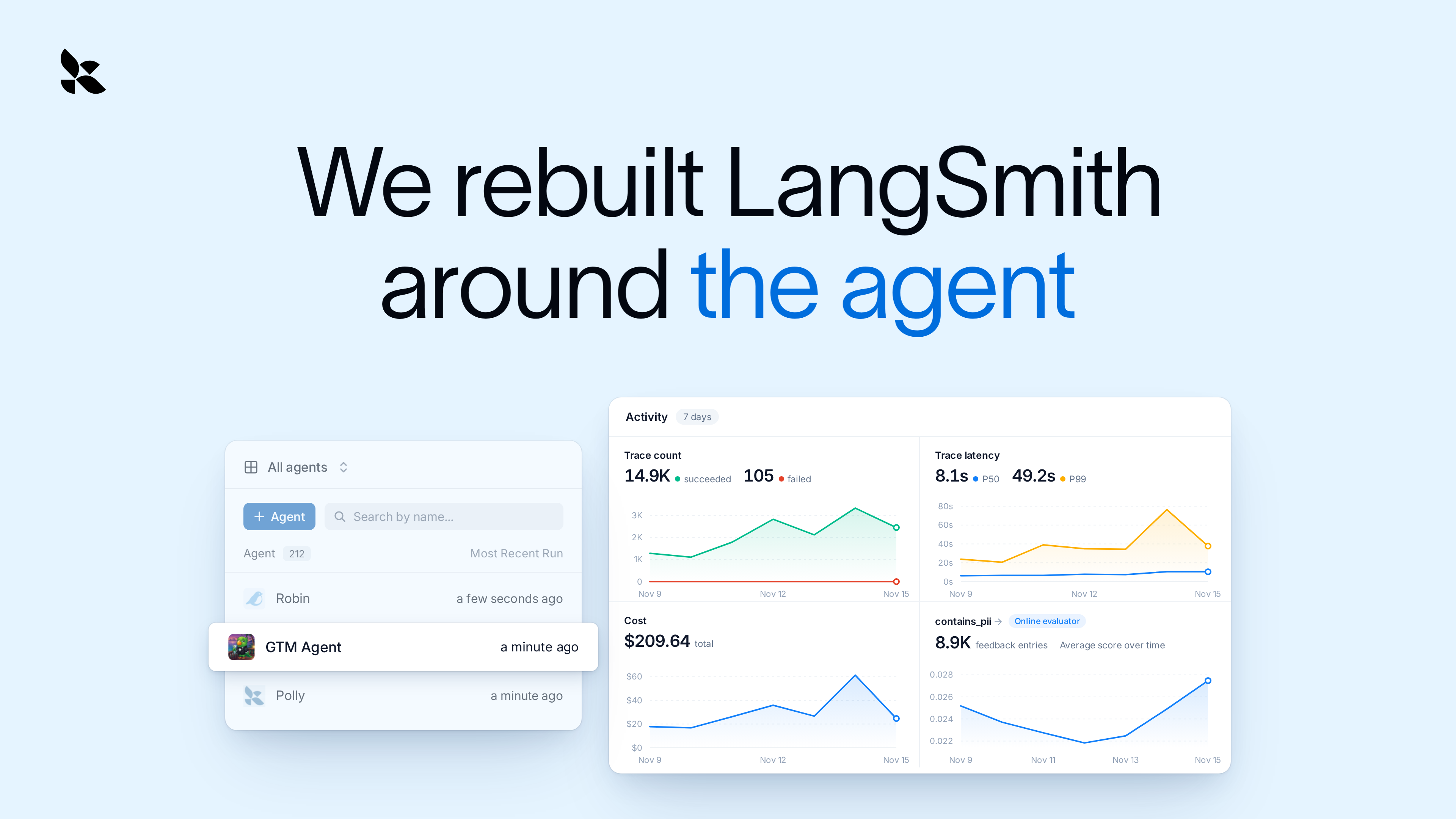
LangChain has rebuilt LangSmith around a single "agent record," the company said in a post following last week's announcement of its Series C round and the introduction of the LangSmith Agent Platform. The goal is to make the agent, rather than the project, the core object across the product, so that building, running, improving and governing an agent happen in one place regardless of framework or runtime. The post was published this week and describes a reorganisation of the existing platform rather than a wholly new product.
The motivation is fragmentation. In LangChain's account, companies now run many agents at once — coding agents in engineering, customer-facing agents in product, assorted productivity agents elsewhere — built with different frameworks and hosted on different runtimes. For engineers that means tracing, monitoring and deployments live on separate surfaces, forcing context switches; teams end up skipping steps like building evals. For AI platform teams, basic questions become hard to answer: which agents exist, who owns each, what they cost, how they perform, and whom to ask when costs spike.
Under the old data model, traces arriving in LangSmith sat in a flat project hierarchy with no link to a particular agent, so traces from the same agent in different environments were unconnected. Now a single agent record groups its environments and traces, and every lifecycle stage attaches to it. Opening a record puts its traces, evals, Agent Server and Engine issues one click away, and an agent's local, dev, staging and production environments share the same agent ID, which makes before-and-after comparisons straightforward.
Each record carries three properties. Owner names the person responsible. ID is a globally unique, immutable identifier. Type categorises the agent and drives what its dashboard shows, which data connections it offers, and how it is evaluated. LangSmith Studio offers a natural-language builder, the open source harnesses handle code-based construction, and other frameworks are supported; deployment can go to LangSmith Agent Server or stay on an existing runtime. Tracing, evals, datasets, annotation and Engine work on any agent that sends traces to LangSmith, and the registry and LLM Gateway provide org-level visibility and controls.
The platform is composable: teams already running agents elsewhere can attach them to LangSmith purely to improve and govern them. LangChain argues that building and running on LangSmith compounds the benefit, giving the example of Engine validating a proposed fix against an Agent Server preview before it reaches production.
Agent types are where the evaluation model gets opinionated. LangChain's example: a coding agent is judged by whether its code gets merged, while a support agent needs low latency. Assigning a type yields a ready-made dashboard with no custom views — for a general purpose agent, a description, recent activity, online monitoring, common models and tools, and failures surfaced by Engine; for a coding agent, merged PRs, token cost and the kinds of work completed. Because every agent of a type is measured the same way, three people running coding agents produce comparable numbers. The coding type also lets you connect a GitHub repo to track downstream outcomes. General purpose and coding types are available now, with voice on the horizon — a type that would need to surface latency and audio quality alongside problem resolution.
Governance targets what LangChain calls agent sprawl, arriving from three directions: engineers building custom agents, business units adopting vendor agents such as ServiceNow for IT or Glean for enterprise search, and employees picking up tools on their own. Rather than demanding standardisation, LangSmith registers agents from any platform that supports OpenTelemetry Protocol (OTLP), including labs and hyperscalers, and measures them the same way. Every registered agent has an owner, ID and type, so a cost spike on, say, a Glean agent has a named contact and trace details showing what went wrong.
OTLP matters here because it is the vendor-neutral wire format for traces, metrics and logs in the OpenTelemetry project. Accepting OTLP means an agent instrumented for another observability backend can report into LangSmith with little or no change to its runtime — a low-friction path compared with SDK-specific integrations, though the depth of data captured will depend on how richly the agent is instrumented.
The new LangSmith is available globally in cloud, BYOC and self-hosted environments. On the roadmap: more agent types beyond general purpose and coding, org-level dashboards (centralised dashboards are workspace-level today), and identity — registering agents in an identity provider so security teams can audit them like any other identity. LangChain also sketches a future loop in which Engine red-teams an agent, teams review production traces in a custom annotation app, reviewed examples flow into eval datasets, and trajectories from the best runs become fine-tuning data, all bound to the same record.
This suggests the competitive wedge is less any single feature than the data model: making the agent a first-class, owned, typed entity is what lets evals, cost and quality roll up per agent across environments and vendors. A likely trade-off is that opinionated dashboards cut setup work but may not fit teams whose metrics differ from the defaults. Whether registering agents that run elsewhere yields comparable numbers also depends on consistent instrumentation.
Why it matters: Platform and AI engineering teams juggling agents across frameworks, clouds and vendor products get a single registry with ownership and type-based metrics, plus an OTLP path for agents they did not build. Developers working in LangSmith should expect their existing projects to map onto agent records and shared IDs across environments. Inference: the biggest near-term shift will be governance, since named owners and rolled-up cost data turn agent sprawl into something an accountable team can audit and budget for.
Based on reporting from the original publisher. Visit the source for full context and later updates.
Publisher excerpt
We reorganized LangSmith around a single agent record. Build, run, improve, and govern every agent from one place, on any framework or runtime.