NVIDIA CUDA-X Libraries Give Agents the Tools to Accelerate Scientific Discovery
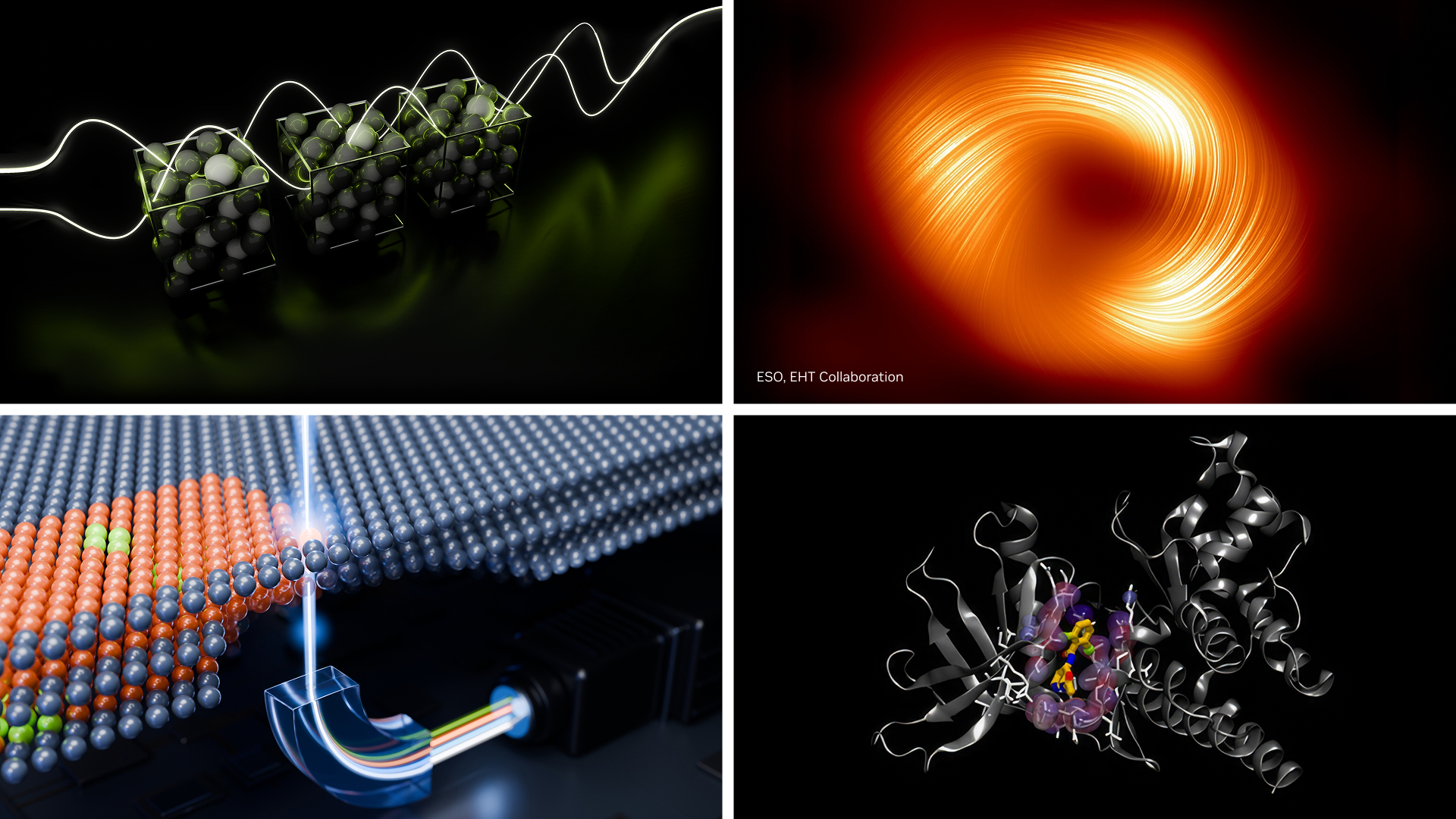
NVIDIA used its SC26 conference announcements to expand the CUDA-X family of scientific computing libraries, introducing cuPhoton, cuPotential and cuSpa alongside GPU-accelerated versions of existing tools, and positioning the whole set as a stack that AI agents can drive on researchers' behalf. The pitch is workload-specific speedups rather than a general-purpose framework: each library targets one scientific domain, from radio astronomy to molecular dynamics to spatial biology.
Astrophysics shows the largest single jump. The Event Horizon Telescope combines radio dishes around the world into an Earth-sized virtual aperture, and its observations produce petabytes of data that can take months to process. NVIDIA's cuPhoton.xBeam module, part of the cuPhoton Toolkit, now correlates those observations orders of magnitude faster: work that once took more than a month completes in about eight minutes, according to the company. NVIDIA says cuPhoton has already correlated observations of the black hole jets J1924 and 3C279, and frames real-time reconstruction of the Messier 87* black hole as achievable. The full pipeline, covering loading, processing and visualization, runs either across distributed multi-GPU systems or on a single DGX Spark desktop system.
A separate cuPhoton module, xLens, addresses fusion. Plasma simulations at petascale cost days per time step and run for weeks, while experiments produce data faster than conventional pipelines can analyze it. Pacific Fusion researchers used xLens to extract insights while simulations were still running. NVIDIA says the pipeline can be coupled with a Nemotron-powered agent running locally on the same machine, enabling interactive analysis that could help steer simulations in real time for reactor target and chamber design.
For drug discovery, cuPotential builds on work from the Simons Foundation's Flatiron Institute and D. E. Shaw Research. It accelerates existing molecular simulation software by up to 3x while improving numerical stability and accuracy, and NVIDIA says it speeds synthetic data generation for generative models, including finding previously unknown binding sites and estimating interaction strengths. Integration work is under way with Schrödinger and the AMBER, NAMD, GROMACS, LAMMPS and Open Molecular Software Foundation communities. Cadence, Fathom Therapeutics, Topos Bio, Genesis Molecular AI and Terray Therapeutics are named as adopters.
Materials science gets Daviator, a set of batched GPU kernels for the widely used Vienna Ab initio Simulation Package, arriving on NVIDIA ALCHEMI. NVIDIA claims quantum-mechanical calculations run up to 22x faster at up to 75 percent lower cost, and notes that GPU acceleration now extends to small atomistic systems that previously ran faster on CPUs. At Lawrence Berkeley National Laboratory, the DAQIRI networking library links a high-speed electron microscopy detector directly to GPU processing so analysis happens inside the experiment, letting researchers spot useful signals and decide what to measure next mid-run, with atomic-resolution studies that can distinguish elements.
Biology carries the most striking number. cuSpa, newly open sourced, accelerates cell polygon calculations and enables large spatial graphs for patient and cancer models at Memorial Sloan Kettering Cancer Center at a claimed 900x speedup over CPUs. The rapids-singlecell framework, codeveloped with scverse, now ships in a single agent-ready container; Therna Biosciences reports 200x faster processing for therapeutic design, and 10x Genomics has integrated it into its Sentira platform. HMMER, also open source and GPU-accelerated, speeds annotation of predicted protein sequences, with Basecamp Research measuring benchmark searches up to 84x faster than standard HMMER when preparing datasets for its therapeutic design models.
Reading across these claims, several patterns stand out. Most figures compare against CPU baselines for the same code, which is standard practice but makes cross-library comparison unreliable: 900x on small-graph biology kernels and 3x on mature molecular dynamics engines reflect very different bottlenecks. The three libraries that matter most to outside developers, cuSpa, HMMER and rapids-singlecell, are open source or containerized, whereas cuPhoton, cuPotential and the ALCHEMI-adjacent Daviator appear tied to NVIDIA hardware and platform channels. The recurring DGX Spark and local-agent framing suggests NVIDIA wants scientific agents to run beside the instrument or cluster rather than in a remote cloud, a trade-off that favors data locality and latency over centralized management.
In practice, adoption will hinge on integration rather than raw kernels. Molecular dynamics users are loyal to established engines, which is why the named AMBER, NAMD, GROMACS and LAMMPS collaborations matter more than the headline multiplier; similarly, 10x Genomics bundling rapids-singlecell into Sentira could do more for reach than any benchmark. The live-analysis workflows, fusion steering and in-experiment microscopy, are the most interesting direction: they change the loop from simulate-then-analyze to analyze-while-running, which is exactly where an on-premises agent can add value.
Why it matters: Research computing teams and biotech or materials companies evaluating GPU acceleration now have domain-specific libraries with published speedup claims and named early adopters to weigh against their existing CPU pipelines. Developers working in single-cell or protein annotation get immediately usable open-source paths, while those in molecular dynamics or astronomy should expect integration timelines shaped by the upstream engine communities rather than NVIDIA alone. The bigger shift, in my reading, is architectural: pushing analysis into the experiment and pairing it with a local agent reframes scientific software as an interactive system rather than a batch job.
Based on reporting from the original publisher. Visit the source for full context and later updates.
Publisher excerpt
With expanded NVIDIA CUDA-X libraries, including cuPhoton, cuPotential and cuSpa, researchers can sift through vast amounts of data to accelerate research, from astrophysics and materials science to single-cell biology. The speedups are helping scientists analyze larger datasets and model more complex systems. The new libraries give AI agents the tools to help researchers make discoveries […]