How U.S. Hunger connects leaders and data using Amazon Quick
U.S. Hunger, the nonprofit behind the Full Cart food-assistance program, has rolled out Amazon Quick to 17 colleagues across executive leadership, its technology team, Full Cart, finance, compliance and supporting functions, according to an AWS Machine Learning Blog account of the deployment. The organization reports delivering more than 250 million meals, reaching 59 countries historically with work now concentrated in the United States, and roughly 500 percent growth over four years against 15–20 percent headcount growth. President and CEO Rick Whitted, who spent 30 years in banking before taking the role more than six years ago, learned about Quick through an AWS Social Entrepreneur Accelerator event led by Kat Esser.
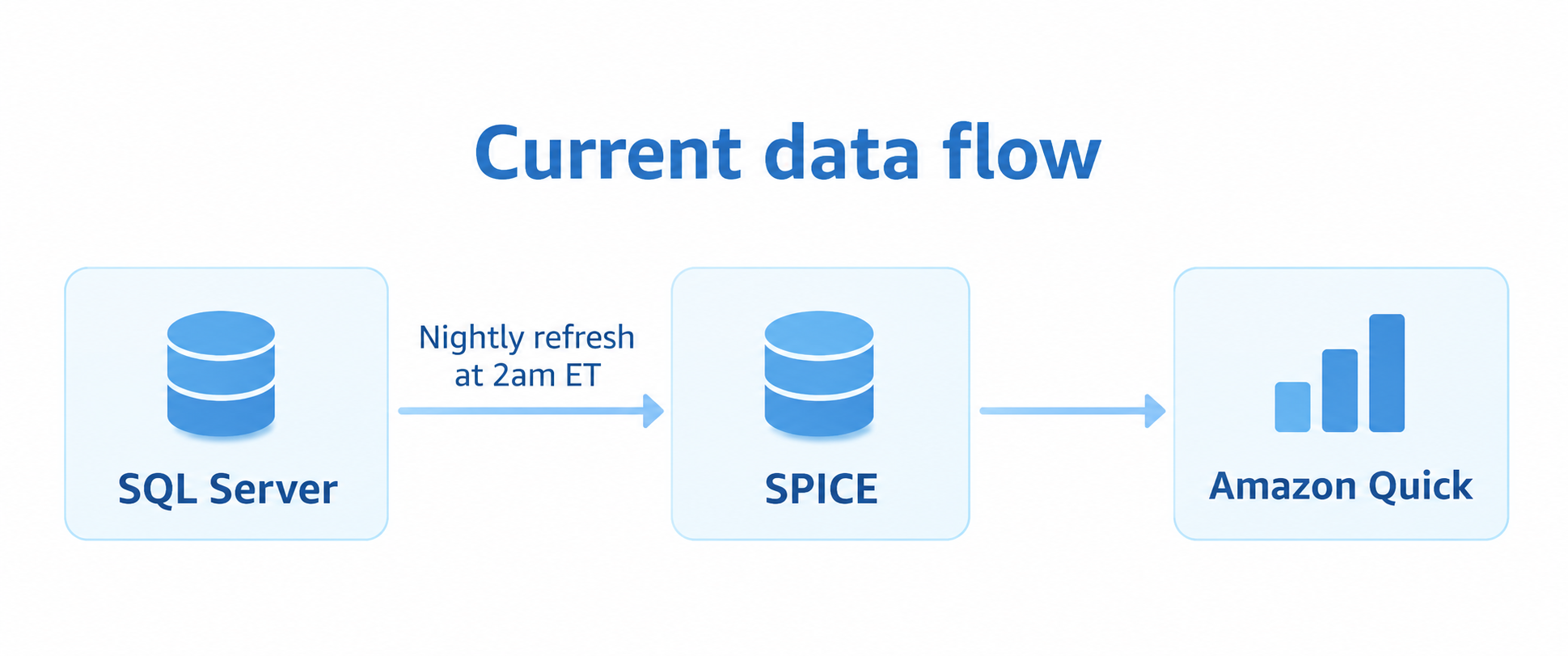
The original goal was modest: let Whitted follow questions into the data himself rather than asking the technology team for a fresh data pull each time. CTO Ezekiel Brooks gave him access to core Full Cart datasets. Those records originate in Impact Manager, U.S. Hunger's proprietary cloud-based data platform. Quick pulls from SQL Server into its in-memory engine, SPICE, via scheduled refresh jobs at 2 AM ET nightly, with the technology team and a research-data colleague preparing datasets and definitions so the CEO can interpret what he sees.
SPICE, Amazon's proprietary in-memory calculation engine, is the piece worth understanding here. Rather than querying the source database on every question, it holds a prepared copy of the data in memory, which is why refresh timing matters: anyone exploring the data is working from the previous night's snapshot. This is a common pattern for business-intelligence workloads, but it also means the freshness ceiling is a design decision, not a technical accident, and the 2 AM schedule effectively defines how current any analysis can be.
The capability that shifted Quick from a personal exploration tool to something the leadership team runs on, per the account, was Spaces. A Space is a shared workspace holding documents, metric definitions and analyses tied to a business area. For U.S. Hunger, the practical value is agreement on what a number means: a KPI document the leadership team built over more than a year across NetSuite, Salesforce, Impact Manager and its payroll system records definitions, data sources and targets, and lives alongside the analyses that use it. The finance Space is shared with the CTO, COO and finance leadership, so colleagues see not just a result but the tools and business logic behind it. Chief of Staff Sarah Aranguibel describes being able to pick up a financial model where the CEO left off, or see how he framed a KPI, without scheduling another meeting.
Day-to-day uses span several areas. Whitted drafts instructions for the technology team in a Space containing Salesforce call reports, specifying which measures to include, where data comes from and what each means, commenting on the draft and regenerating it with multiple changes rather than shuttling documents between Word and a chat window; the finished instructions are meant to guide reporting improvements for the member-engagement team. For finance, a Space holding audits, cash-flow information and board budget views, plus a debt-service calculator and nonprofit financial-health worksheet, supports planning and drafting audit footnotes, and with more than a decade of documents available he can ask Quick to compare patterns over time. He says his familiarity with the source material lets him check answers and challenge conclusions the evidence does not support.
Amazon Quick Research is used to investigate current events, inform communications and connect policy questions to U.S. Hunger's survey data, with version history letting Whitted revisit earlier iterations as an investigation develops. That has added weight because the USDA announced in September 2025 that it would end future Household Food Security Reports, making other evidence sources more important. U.S. Hunger wants to publish a national hunger-data resource for researchers and the public, alongside an enterprise offering companies can buy to help fund the mission.
The organization's own data is substantial: records covering more than 300,000 applicants since 2020, combining structured survey responses with narrative testimony. Among figures cited, 304,348 applicants are recorded; 91.2 percent report skipping meals; 90.1 percent say they sometimes or often cannot afford balanced meals; and 97 percent report difficulty paying for basics such as food, housing, medical care and heating. U.S. Hunger classifies reported social and economic circumstances using Z codes, standard codes used in health and social-services settings; food insecurity is the most frequently recorded in its view, followed by low income and then housing or financial circumstances. Because applicants can carry multiple codes, those shares are not mutually exclusive. Other views show 44.7 percent of applicants reporting illness, 79.1 percent enrolled in health insurance and 64.4 percent saying they do not need or want help finding or keeping work.
Looking ahead, U.S. Hunger plans an enterprise KPI framework during Q4 2026. Boomi already connects NetSuite, Salesforce and Impact Manager, and the organization intends to use it to move research data, historical analytics and enterprise KPIs into Amazon Redshift, which would then feed Quick through scheduled SPICE jobs. A planned pipeline diagram shows Impact Manager, NetSuite, Salesforce, Paylocity, ThriveLink and iQpay flowing through Boomi into Redshift. Whitted has asked AWS for help shaping the national-data-resource work.
In practice, the architecture described follows a familiar shape: integration layer, warehouse, in-memory BI layer. The trade-off is latency versus governance — nightly refreshes keep answers fast and reproducible, but anything time-sensitive needs a different path. A likely consideration for teams copying this pattern is that shared Spaces succeed or fail on definition hygiene; the year spent building the KPI document is arguably as much the product as the software.
Why it matters: this is a concrete example of a lean organization using a managed BI and AI workspace to let executives self-serve analysis instead of queueing for engineering time — a pattern product and data teams will increasingly be asked to support. The 17-seat, definition-first rollout, with source systems still feeding nightly rather than streaming, suggests modest scope can still change how leadership operates. Whether the planned Redshift and Boomi expansion and the commercial data offering deliver revenue is an open question the source leaves unanswered; my inference is that governance of published data will be the hard part, not the tooling.
Based on reporting from the original publisher. Visit the source for full context and later updates.
Publisher excerpt
U.S. Hunger, a nonprofit addressing food insecurity, uses Amazon Quick to connect organizational data with leadership decisions. Leaders explore applicant data directly, share KPI definitions and financial context in Quick Spaces, and investigate policy questions with Quick Research.