[AINews] Quasi-Riemann-Hypothesis: OpenAI publishes 722 math papers solving 90 of the top 500 open math problems; “the most significant moment” in >100 years of mathematics
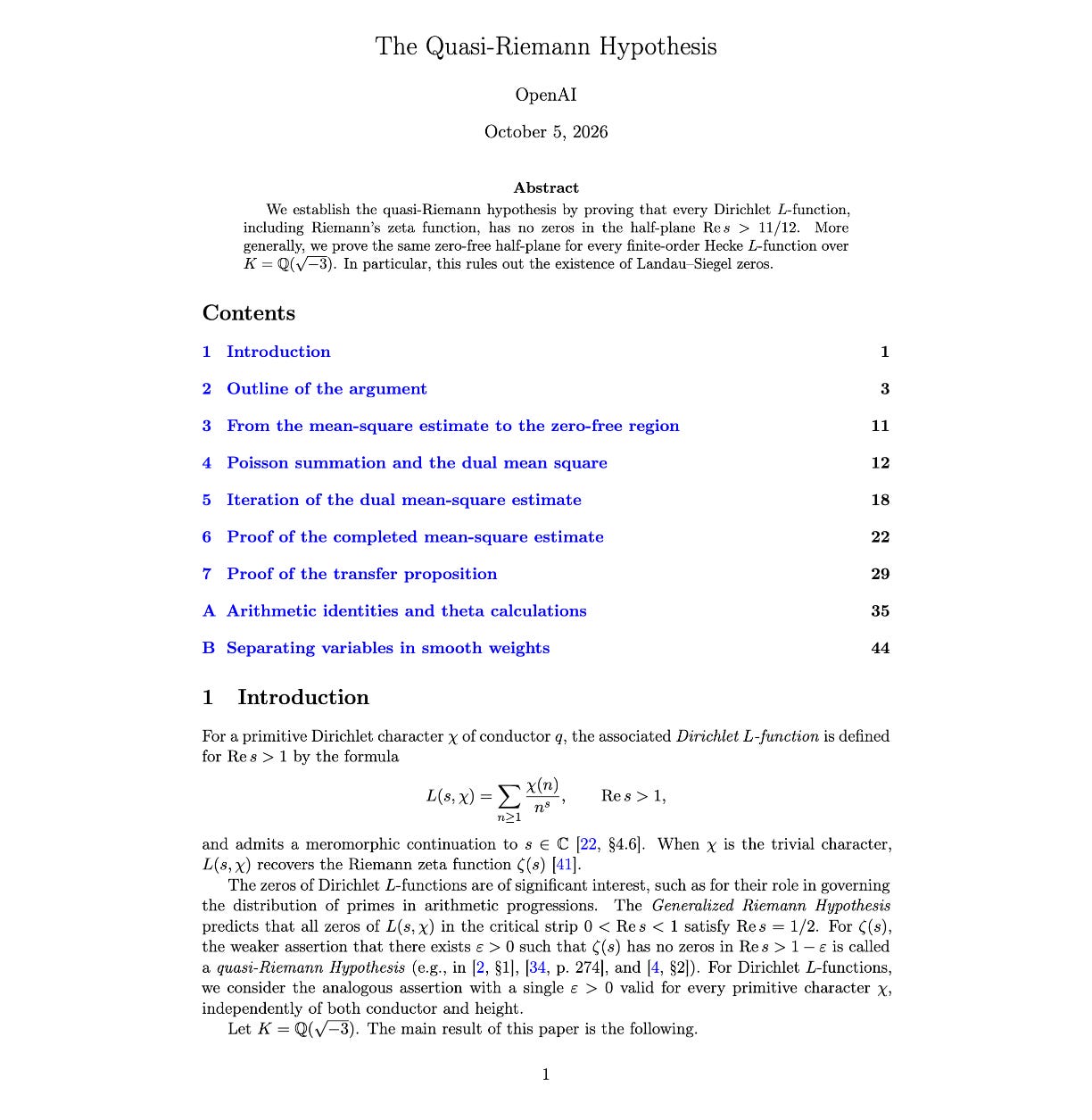
OpenAI published a set of mathematical results from an internal frontier model in a public GitHub repo. According to the announcement, OpenAI consulted the Institute for Advanced Study's independent Advisory Group on Mathematics and AI on how to release them. The model itself remains unreleased.
The collection reportedly holds 722 manuscripts grouped into 372 families of related results. They came from an evaluation of about 4,000 research problems and used an average of roughly three hours of ChatGPT Pro thinking compute per result. The release includes papers, proof artifacts and selected reasoning summaries. Sam Altman called it "a new era of discovery."
Reported results, described by individual commentators and not independently verified, include a result for integer multiplication faster than n log n; a uniqueness result for the elastic inverse problem, which the paper says had been open in 3D since 1994; and partial progress on Riemann, Hodge and BSD. One result, the Quasi-Riemann Hypothesis, was characterized as being somewhere between a Fields Medal result and the biggest result in number theory in 200 years. Mathematician Levent Alpöge praised the quasi-Riemann and no-Siegel-zeros results and called it "the most significant moment in mathematical history," while also noting reported scooping and conflict-of-interest problems involving other labs' users.
An analysis estimates about 20% of the results are disproofs or counterexamples. Will Depue expects some results should not survive scrutiny, and built citedbyagi.com to track which human papers the release cites. Teortaxes noted that three hours of compute "is not much." François Chollet asked whether gains in RLVR-friendly math and code generalize, or whether non-verifiable domains stay bottlenecked on human data.
Separately, Mistral shipped Large 4 preview, code-named "Le Chonk," with 1T total parameters and 49B active, natively multimodal and available via API now, with open weights promised for end of October. Pricing is $1.36/$4.18 per million input/output tokens, with $0.14 for cached input and 50% off for the first two weeks. The RL run is described as still in flight and showing no sign of saturation, and the model was pre- and post-trained on roughly 3,800 Grace Blackwells in Europe, with a larger model training now.
Based on reporting from the original publisher. Visit the source for full context and later updates.
Publisher excerpt
Our head hurts.