The U.S. Census Bureau and “Super Intelligence”
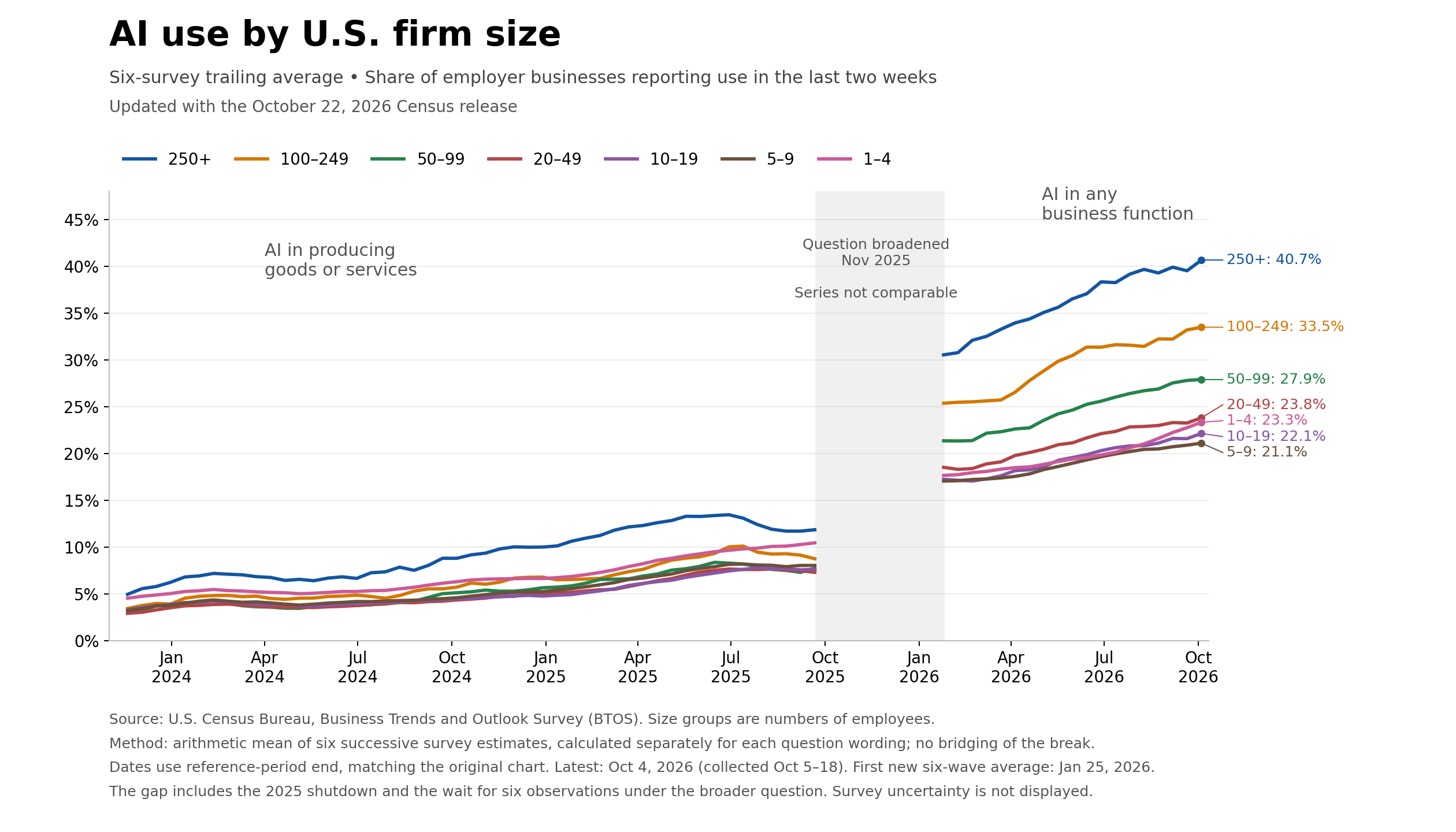
The U.S. Census Bureau has rewritten the core AI question in its Business Trends and Outlook Survey (BTOS) to ask about "Super Intelligence," or SI, replacing "Artificial Intelligence" terminology, according to Simon Willison, who examined the latest survey files and documentation. The change takes effect with the October 19, 2026 collection and is attributed by the Bureau's own BTOS about page to Executive Order 14434. The first survey results using the new wording are due for publication on a Thursday, the week after that collection began.
Willison's post is built around a chart he rebuilt from Bureau data, the same style of chart he produced a year earlier to test data-analysis capabilities in GPT-5 and then Claude's Code Interpreter. BTOS is a twice-monthly survey: the Bureau surveys 200,000 businesses drawn from a universe of 1.2 million, and the panel rotates so any individual business answers only once every twelve weeks. New results are published on alternating Thursdays at 10am. The version he used reflects numbers published October 22, 2026, drawing on the "Employment size class" spreadsheet available from the Bureau.
Two distinct changes are tangled together in that data, and they matter for anyone reading the trend line. First, the survey question itself changed materially on November 17, 2025. Before that date, businesses were asked whether they had used AI in "producing goods or services" in the last two weeks, with examples listed as machine learning, natural language processing, virtual agents and voice recognition. On December 3, 2025, the Bureau announced a replacement question asking whether the business used AI in "any of its business functions," keeping the same examples. That shift widens the scope considerably: back-office finance, HR, legal and internal tooling count under the new wording but plausibly did not under the old one. As Willison notes, answers before and after November 17 are therefore not directly comparable.
The effect is visible in the numbers. In September 2025, companies with 250 or more employees answered yes roughly 12% of the time on the "producing goods or services" question. Under the "any business function" wording, those same large firms were at around 30% by February 2026 and around 40% by October 2026. Some of that rise is almost certainly genuine adoption, but some is an artifact of asking a broader question — a distinction that matters to anyone citing the series as evidence of an adoption slowdown or acceleration. This is my own reading of the mechanics, not something the survey states.
Second, and more strikingly, the wording changed again. Beginning October 19, 2026, the question reads: whether the business used "Super Intelligence or SI (formerly referred to as Artificial Intelligence or AI) in any of its business functions." The parenthetical examples were rewritten to match: SI-powered data analysis, generative SI for marketing, product design or coding, virtual SI agents for customer service, SI-powered forecasting or pricing, and SI-driven computer vision for quality control. The Bureau's about page states that instrument wording was updated due to Executive Order 14434, and that current published figures still reflect the old AI wording.
Willison flags the obvious empirical question: whether the renaming will move the results. Respondents last saw the question up to twelve weeks earlier, when it still said AI, and the new text does spell out that SI was formerly called AI. Whether that parenthetical is enough to prevent confusion or non-response among firms filling out a government survey is unknown until the data lands. In practice, questionnaire design research generally finds that unfamiliar terminology, even when defined, can depress reported usage or push respondents toward the "don't know" end of a scale — a plausible risk here, though the Bureau has not said anything about anticipated effects.
The broader point for data consumers is that this series now carries three distinct regimes: pre-November 17, 2025 (AI in producing goods or services), November 2025 through early October 2026 (AI in any business function), and from October 19, 2026 (SI in any business function). Any long-run chart that spans them is stitching together answers to different questions. The practical fix is to break series at each instrument change rather than draw a continuous line, and to treat the 12% to 40% jump for large employers as partly a definitional widening rather than a pure adoption curve.
Why it matters: developers and product teams who cite Census adoption data — in decks, market sizing, or investor updates — need to know the underlying question changed twice in about a year, once widening scope and once renaming the technology, so numbers across those boundaries are not apples to apples. The renaming also signals that federal survey instruments are now following executive-branch terminology, which may complicate comparisons with private surveys, analyst estimates and earlier Census releases. Expect the first SI-worded results, and any discontinuity they introduce, to be scrutinized closely.
Based on reporting from the original publisher. Visit the source for full context and later updates.
Publisher excerpt
I was reminded today of AI Adoption Rate Trending Down for Large Companies , a chart produced by Apollo Global Management in September 2025, which appeared to show a slowdown in U.S. corporate AI adoption based on numbers collected by the U.S. Census Bureau. At the time I used that chart to demonstrate GPT-5 data analysis , and then to experiment with Claude's new Code Interpreter . I decided to try running those numbers again to see what had changed over the past year, and in doing so learned that the Bureau has f