NVIDIA Announces Rubin HPC — A New GPU to Accelerate Agents for Science, Engineering and Analytics
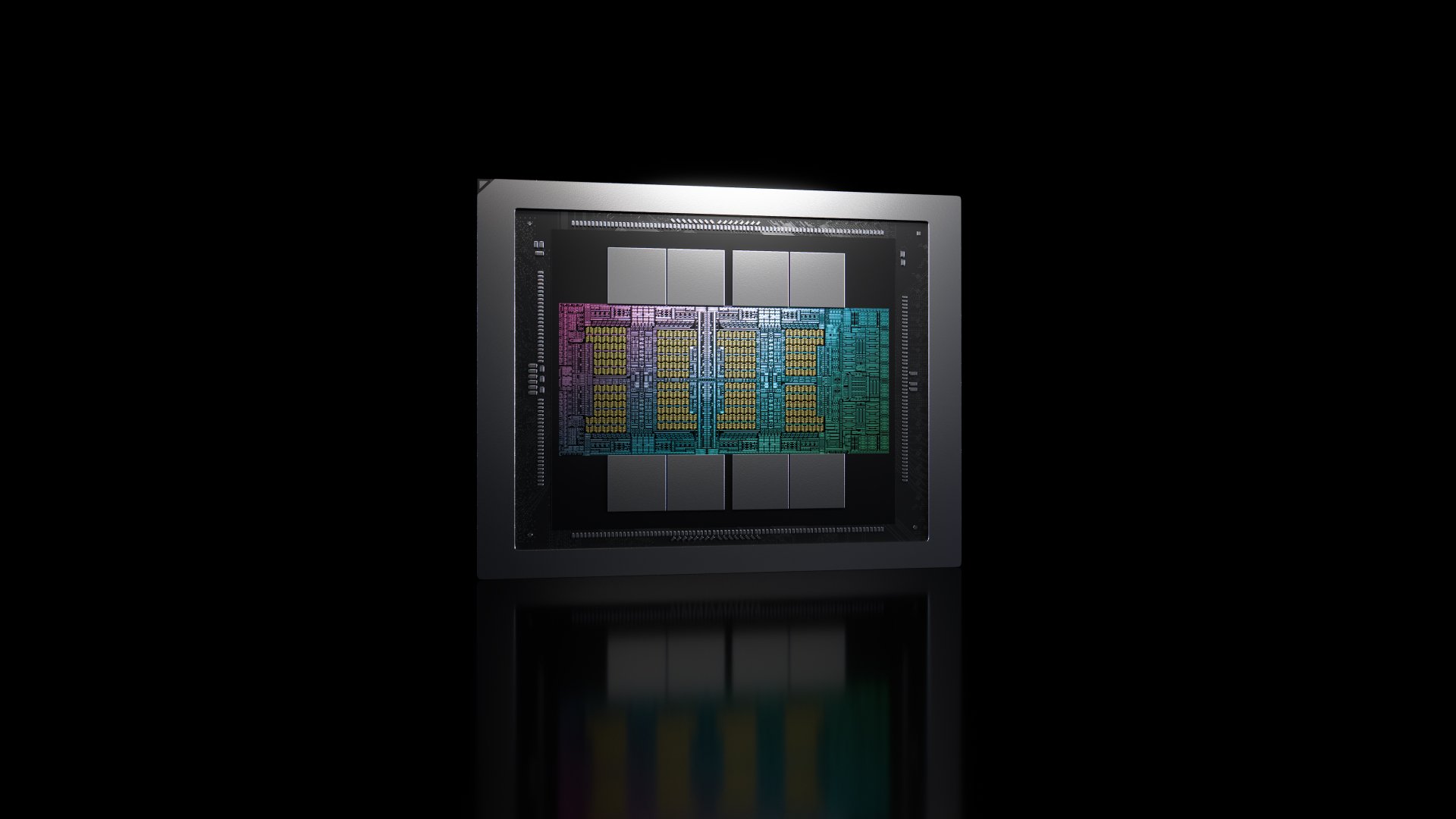
NVIDIA announced Rubin HPC at SC26, describing it as a new GPU within the Vera Rubin platform built to speed up simulation and data processing for science, engineering and analytics workflows. The company says the chip is expected to be available in 2028, so the announcement sets out a design direction rather than shipping hardware.
The headline spec is the core count: more than 50,000 CUDA cores on a single GPU, which NVIDIA calls a record. CUDA cores are the general-purpose parallel processing units in an NVIDIA GPU, the pooled capacity that kernels use for arithmetic across thousands of simultaneous threads. Pushing the count that high raises a familiar problem in high-performance computing, which is feeding those units with data fast enough to keep them busy. NVIDIA addresses that in two stated ways: a sparse data acceleration capability that it says keeps the cores supplied with data, and faster GPU-to-GPU communication through seventh-generation NVLink interconnect technology.
NVIDIA frames the design as balanced, scaling data movement and compute together rather than increasing compute alone. The workloads it names share a pattern: an application reaches into a very large dataset, gathers a handful of scattered values, computes a result, and repeats that at enormous scale. Climate models, engineering simulations, genomic analysis and financial risk are given as examples. This is the classic memory-bound shape of scientific code, where throughput often depends less on raw floating-point capacity than on how quickly the machine can pull irregular data out of memory and move results between GPUs. NVIDIA says the balanced design accelerates recurring patterns in these workloads, listing sparse matrix operations, stencil computations, sorting and reductions. Practically, that list covers a large share of simulation kernels, from finite-element and finite-difference solvers to graph and analytics pipelines.
A second thread in the announcement is agents. NVIDIA argues that as AI agents help scientists and engineers explore more candidate materials, molecules and designs, those candidates still have to be validated through simulation. More exploration therefore generates more simulation demand. Ian Buck, vice president of hyperscale and high-performance computing at NVIDIA, said faster simulation means faster discovery for agents working in science and engineering. Whether or not one accepts the causal chain, the underlying loop NVIDIA describes is a familiar one in computational research: propose a candidate, simulate it, refine based on results, and send only the most promising options to lab work or physical prototyping. Shortening each simulation step tightens that loop, which is where the company positions Rubin HPC. This is an argument about workflow economics rather than a benchmark result; no performance figures, comparisons or application speedups were disclosed.
NVIDIA also points to its CUDA-X libraries, which it describes as a growing set of optimized implementations of complex algorithms available for agents to use, including those most relevant to simulation and analytics. Paired with Rubin HPC, NVIDIA says these libraries can give agents a fast route to reasoning outcomes. The practical implication is that much of the value depends on library and software support as much as silicon: scientific codes are typically tuned around cuBLAS, cuSPARSE, cuFFT, NCCL and similar components, and new hardware capabilities such as the sparse data acceleration need corresponding library paths to be usable. NVIDIA has not detailed how that acceleration works or which libraries will expose it first.
The sparse data acceleration claim is worth watching for developers. Sparse linear algebra is central to simulation and analytics, but sparsity is irregular by nature, which is why sparse kernels are hard to speed up with dense matrix hardware. If NVIDIA's capability handles the gather-and-scatter pattern in hardware, it could widen the gap between this part and general-purpose accelerators for scientific codes, though that is inference rather than a stated result. The seventh-generation NVLink detail matters for multi-GPU jobs: tightly coupled simulations that exchange halo regions or decompose large meshes across GPUs are sensitive to interconnect bandwidth and latency, so faster links can matter as much as per-chip throughput on large runs.
A likely trade-off is specialization. A purpose-built part optimized for simulation patterns may not be the first choice for training large language models, where dense matrix math and memory capacity dominate. Teams running mixed workloads would need to weigh whether a simulation-optimized GPU earns its place alongside general-purpose accelerators.
The 2028 date also leaves open questions for planning: which systems and cloud providers will offer Rubin HPC, memory configuration, pricing and power envelopes are all undisclosed. Developers with simulation-heavy code should focus for now on how well their kernels map to sparse operations, stencils, sorts and reductions, since that is where NVIDIA says the gains concentrate.
Why it matters: product and engineering teams whose pipelines are dominated by simulation, sparse analytics or tightly coupled multi-GPU jobs now have a named, simulation-focused option in NVIDIA's roadmap, with delivery slated for 2028. In the near term, the practical work is software: keeping codes aligned with CUDA-X libraries and the sparse and interconnect features NVIDIA is emphasizing. The lack of published performance figures means any planning should treat the benefits as prospective rather than established.
Based on reporting from the original publisher. Visit the source for full context and later updates.
Publisher excerpt
Announced today at SC26, NVIDIA Rubin HPC is a new GPU in the NVIDIA Vera Rubin platform designed to accelerate simulation and data processing for science, engineering and analytics workflows. As agents help scientists and engineers explore more candidate materials, molecules and designs, they rely on simulations to test those ideas and guide their next […]