Hello Python 3.15, goodbye 3.10, and now I can use 3.11
Python 3.15 has shipped, and the release marks a support milestone as well as a feature one: with 3.15 out, Python 3.10, originally released in 2021, is no longer supported. That change matters to anyone whose library or application declares compatibility with every currently supported interpreter, because it opens up the language features that arrived in Python 3.11 in addition to everything new in 3.15.
The headline addition is explicit lazy imports, specified in PEP 810. A module can now be marked for deferred loading with a "lazy import" statement, or with the same modifier in a from-import. The module is only actually imported the first time one of the imported names is used in the code that follows. This directly addresses startup cost. A concrete illustration from the author's own work: the LLM CLI tool supports plugins, and plugin documentation previously had to recommend manual lazy imports, because installing a plugin that pulled in a heavy dependency such as sentence_transformers could add multiple seconds to every invocation of the command. Lazy imports turn that workaround into a language feature.
Second is unpacking inside comprehensions, from PEP 798, proposed by Adam Hartz and Erik Demaine as an extension of the unpacking syntax that came from PEP 448 in Python 3.5. The new form uses a starred or double-starred iterable as the comprehension expression. For a list of lists, the starred form flattens them into a single list and is equivalent to a nested for clause that walks each inner element. The same idea applies to sets and to dictionaries, where the double-starred form merges mappings and later keys win, matching the semantics of dictionary unpacking elsewhere in the language.
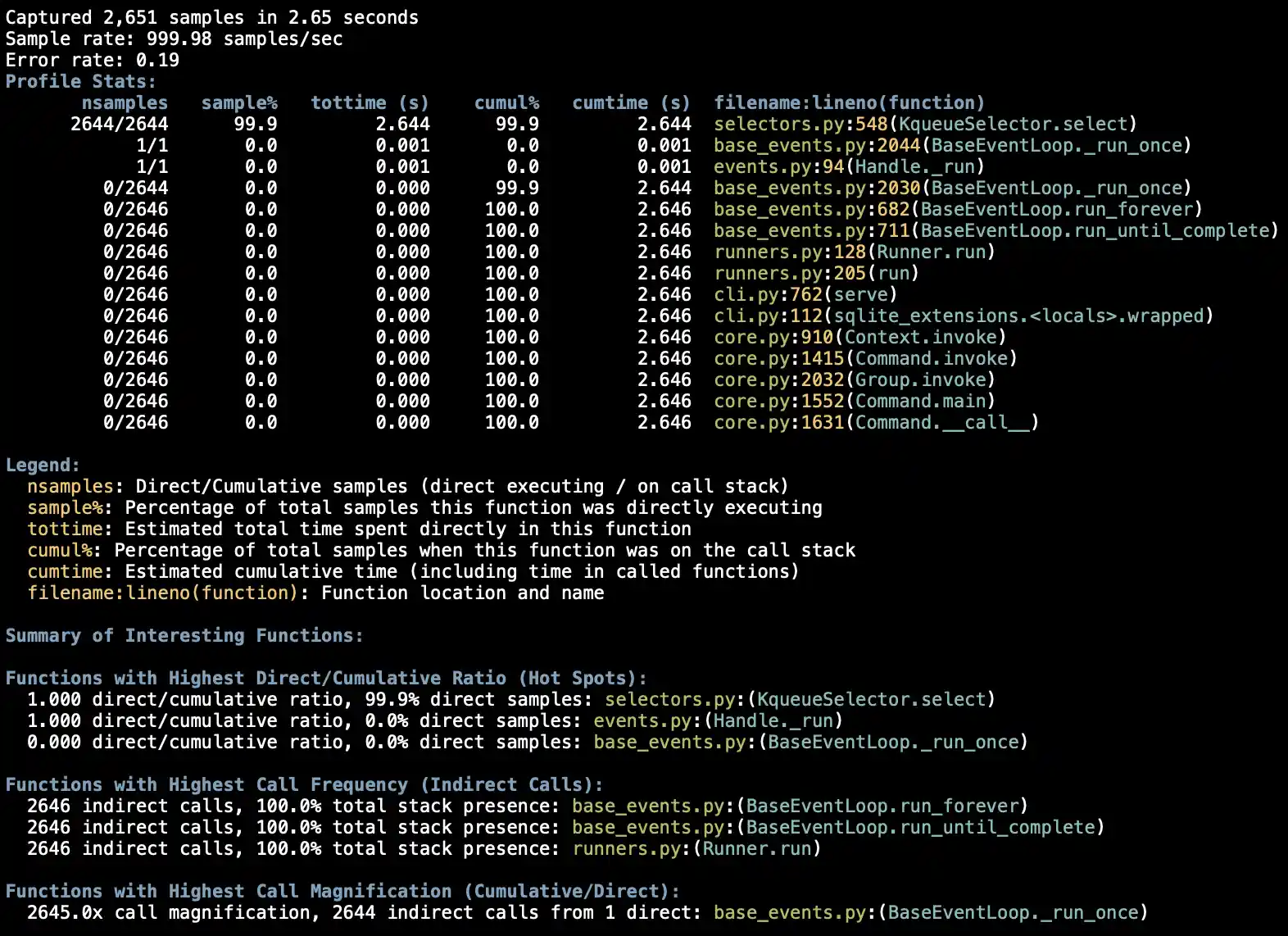
Third is a sampling profiler in the standard library. The existing tracing profiler has been renamed from cProfile to profiling.tracing, and it is joined by a new sampling profiler named Tachyon, importable as profiling.sampling. Sampling profilers work by periodically capturing stack traces from a running process and then computing which functions account for the most time. Because they do not require instrumenting the program first, overhead stays low and they can be pointed at systems already running in production. Outside tools such as py-spy have covered this ground before; the change is that the capability now ships with Python itself. A running process can be attached to by process ID, for example by invoking the profiling.sampling module with attach and a PID, then interacting with the program and interrupting to receive a report. Output options include flame graphs, heat maps, and a format viewable in the Firefox profiler interface.
On performance, expectations should be modest for this cycle. An independent investigation of 3.15 against the 3.15.0rc3 release found speed largely unchanged from 3.14, with one exception: the experimental JIT produced a 1.2x improvement over the standard 3.15 interpreter on a Fibonacci test, described as the first meaningful JIT gain observed. By contrast, exploration of 3.14 last year found significant improvements over 3.13 across many more categories. In practice that means the reasons to move to 3.15 are language and tooling features rather than raw throughput, with the JIT still experimental and narrow in the benchmarks described.
Upgrading with uv on macOS took a short sequence of commands: updating uv itself so it knows about the new release, installing the stable 3.15 build, and then pinning 3.15 globally so that uv run uses it unless a project pins something different. Individual tools installed with uv tool install can be reinstalled against the new interpreter in one step by passing the python version flag, after which the tool's own version endpoint can confirm which interpreter is in use.
The other half of the story is what becomes available by dropping 3.10. The 3.11 release notes list tomllib, an often-wanted addition now usable without a third-party dependency. For asyncio-heavy code, TaskGroup and timeout() arrive, along with several other features; TaskGroup in particular gives structured concurrency with coordinated cancellation. datetime.UTC becomes a simple alias for datetime.timezone.utc. SQLite support gets several upgrades: setlimit() and getlimit() expose SQLite runtime limits from Python, create_window_function() allows custom window functions defined as a class with step(), value(), inverse(), and finalize() methods, and blobopen() provides an efficient way to do partial reads and writes of large BLOB values in a row. It is also now possible to call set_authorizer(None) to remove a SQLite authorizer, replacing workarounds previously required in projects like Datasette. The typing system also picked up a broad set of improvements in 3.11.
The plan described is to land 3.11-based improvements across a group of open source projects over the following weeks, beginning with a Datasette pull request that removes the authorizer workaround. Cookiecutter templates for click apps, Datasette plugins, Python libraries, and LLM plugins have been updated to test against Python 3.11 through 3.15.
Why it matters: library and tool maintainers can now set their floor at 3.11 and delete compatibility shims, while projects that carry heavy optional dependencies have a language-level fix for slow CLI startup. Application teams get a bundled sampling profiler for diagnosing production processes, and teams pinning interpreters through uv or similar tools have a straightforward upgrade path. The performance picture suggests the JIT is one to watch rather than to depend on yet, since the gain described is experimental and limited to specific benchmarks.
Based on reporting from the original publisher. Visit the source for full context and later updates.
Publisher excerpt
Python 3.15 is here ! Here's the essential What's new in Python 3.15 guide, this year curated by 3.14 and 3.15 release manager Hugo van Kemenade. As someone who builds open source software that works in every supported Python version, I get to say goodbye to Python 3.10 and start embracing features from Python 3.11. First, some highlights from Python 3.15. Explicit lazy imports I'm most excited about Explicit lazy imports from PEP 810 . These let you import modules like so: lazy import json lazy from pathlib import