Responsible AI for agentic AI: A phased roadmap for platform and application teams
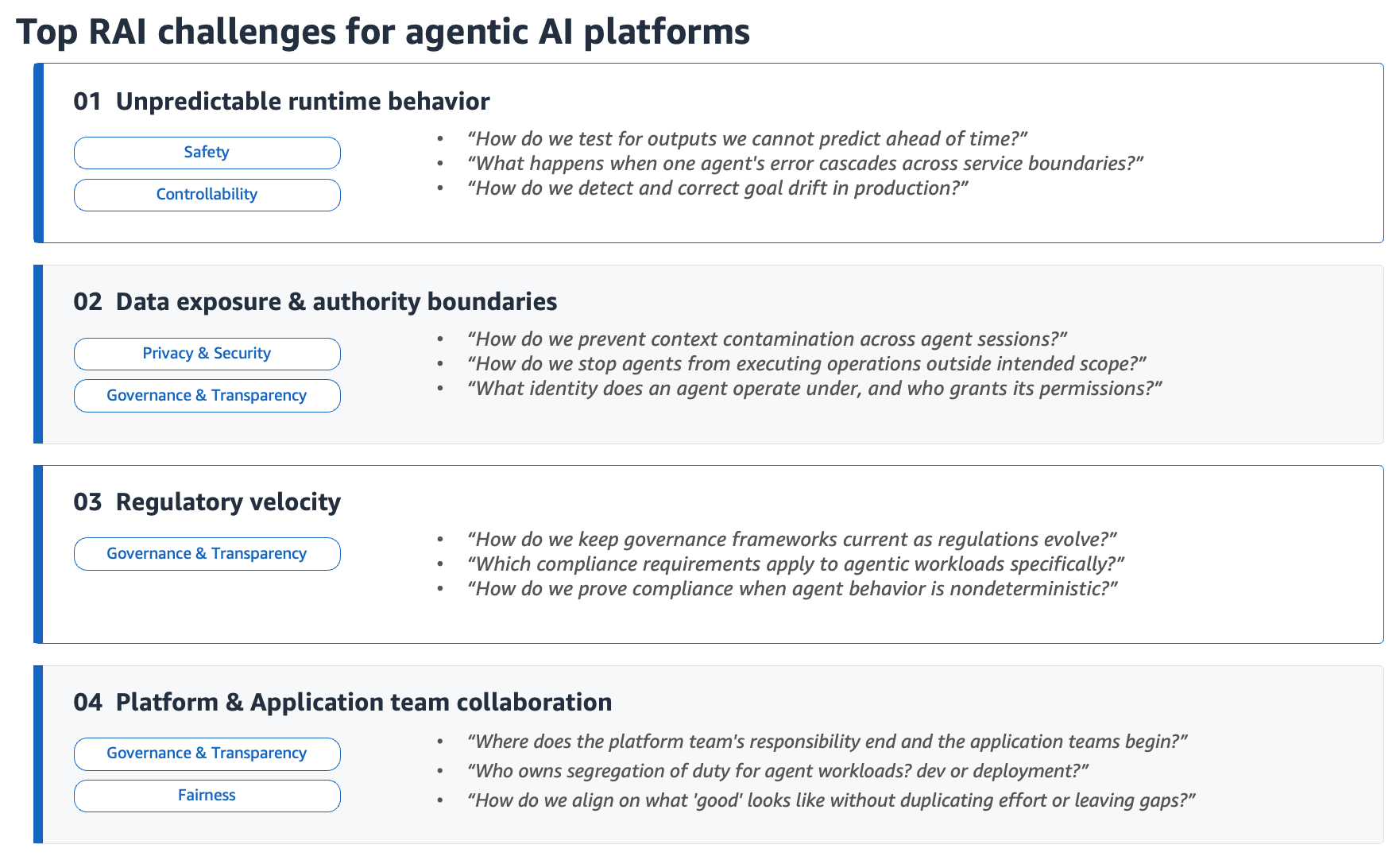
AWS's Machine Learning Blog published a roadmap for applying responsible AI practices to agentic AI platforms, aimed jointly at the platform team that runs the shared infrastructure and the application (or workstream) teams that build agents on top of it. The core deliverable is a Responsible AI Assessment Skill that maps the pillars of the AWS Responsible AI Lens to a three-phase maturity model, plus a scorecard teams use to assess their current posture and revisit as applications mature. The material is organized around a customizable 12-week implementation timeline. The post explicitly frames itself as guidance on which questions to ask at each phase rather than step-by-step implementation detail, and states that it is not legal or compliance advice.
The framing argument is that responsible AI has historically been model-centric, scoped to training, testing and inference, and applied to systems that could be tested against known inputs. Agents reason, call tools, compose those tools dynamically and operate over multiple steps, which widens both the surface and the depth of what governance has to cover. AWS lists the pillars in scope as security and privacy, veracity and robustness, fairness, safety, controllability, explainability, transparency and governance. It cites a Harvard Business Review observation from Wade and Wirtz that trust is becoming a competitive differentiator, and points to Robinhood's generative AI financial crimes agent on Amazon Bedrock, which the post says achieved a 20% efficiency gain while maintaining regulatory compliance.
The post enumerates four recurring problems from customer conversations. The first is unpredictable runtime behavior: nondeterministic outputs, goal drift, and cascading failures. It cites a German financial services company where multi-agent orchestration amplified one misclassification into policy violations across three downstream services. The second is data exposure and authority boundaries, addressed by scoping agents to intended tenants, data, systems and actions, isolating session context with data residency enforced at the access layer, and granting privileged access through least-privilege, task-bound permissions agents cannot modify themselves. The third is regulatory velocity from the EU AI Act, ISO 42001, NIST AI RMF and forthcoming legislation, which the post argues requires continuous evaluation on a defined cadence. The fourth is team collaboration: a UK media company flagged that segregation of duty between developer and deployment teams is undefined for agent workloads, and the post describes a failure mode where platform teams build guardrails application teams route around while application teams assume the platform handles responsibilities it does not.
Phase one, the governance foundation, concentrates on governance, security and privacy. Application teams classify each planned use case with a risk rubric; the platform team stands up the landing zone, monitoring, access control and onboarding governance. Concrete tasks include mapping data shared between agents, including organizational knowledge bases and per-agent context graphs, then setting access boundaries and read/write permissions; classifying data and implementing exfiltration protection with access control, logging, integrity checks and access monitoring; defining a risk rubric aligned to obligations such as EU AI Act tiers and assigning Low, Medium, High or Unacceptable levels with documented controls per level; vetting and cataloging approved models by capability, latency and cost; and a central registry where every agent, shared tool and skill carries an owner, risk tier and regulatory scope. The registry is the enforcement point for discoverability: a resource that isn't registered can't be discovered or managed.
Phase two is pilot deployment, covering safety, veracity and robustness, controllability, and security and privacy. The platform team supplies PII redaction filters for model input/output and tool calls plus a baseline rule set; application teams set content moderation thresholds per use case and route low-confidence responses to humans. Tool access is defined per agent with fallback behavior on policy violation. Grounding checks verify each response is supported by relevant retrieved data, and regulated use cases add automated reasoning for verifiable outputs, along with processes for curating knowledge sources and classifying out-of-domain requests. Human-in-the-loop approval acts as a circuit breaker for high-risk or on-behalf-of actions, with defined triggers such as confidence below threshold, a fired safety guardrail, or a high-stakes decision, and escalation events logged for audit. Observability spans session, trace and span levels, with structured traces for decisions, guardrail invocations and tool calls, and distributed tracing across multi-agent, multi-tool workflows so reasoning paths can be reconstructed. Tool-level authorization uses declarative policy languages with granular per-knowledge-source policies.
Phase three, evaluation and hardening, covers fairness, explainability, transparency, security and privacy. Fairness work includes checking model cards, restricting access to pre-approved models, running benchmarks such as CEB or HELM where no metrics exist, evaluating end-to-end routing and tool selection for equitable treatment, and regression pipelines for fairness drift. Transparency means machine-readable provenance labels on reusable outputs, mandatory disclosure of AI presence in user interactions, and audit trails detailed enough to reconstruct what an agent accessed, when and under which identity. Explainability covers assembling audit reports and on-demand plain-language explanations for users. Security work adds pre- and post-deployment evaluation pipelines with alerting on threshold breaches, red-teaming against agent-specific threats including prompt injection, tenant isolation under concurrent access, token exchange with misconfigured profiles and long-running async tasks, an incident response runbook for agent safety events, and deployment gates in CI/CD so nothing ships below its risk tier's release criteria. The post also lists review triggers, both standing cadences and events like a new model, tool, use case or customer segment, a regulatory change, or altered agent behavior.
A worked bank example ties the phases together: a multi-agent loan platform with intake, risk scoring, compliance and customer communication agents. Agents register at High risk; the intake agent's output is independently verified by the scoring agent rather than trusted outright; Automated Reasoning checks confirm denials conform to documented criteria; PII is redacted before customer communication; and results other than VALID, or scores within roughly 5 points of the threshold, escalate to a human credit specialist. AgentCore Evaluations run on each pipeline push and block deployment on regressions, and human review of denials moves to after-the-fact appeals review after 2,000 aligned decisions over 60 days, with AI use disclosed to customers and decisions traced via OpenTelemetry spans.
Why it matters: teams running agent platforms now have a citable division of labor, with shared guardrails owned centrally and per-use-case thresholds owned by application teams, which is useful when auditors ask who approved a given agent. The phased structure and registry requirement are a plausible template for showing EU AI Act and similar compliance work, though as inference, small teams may find the full 12-week, four-agent framing heavier than their risk profile warrants. The concrete practices worth adopting first are grounding checks, escalation triggers with logged conditions, and trace-level observability, since those directly address the cascading-failure and data-exposure problems described.
Based on reporting from the original publisher. Visit the source for full context and later updates.
Publisher excerpt
Enterprises adopting agentic AI at scale need platforms that embed responsible AI from the start. This post gives platform and application teams a three-phase roadmap (governance foundation, pilot deployment, and evaluation and hardening) that maps the AWS Responsible AI Lens pillars to each phase, with guidance on when to revisit each one.