All Systems Go: Global PC App Ecosystem Ready for NVIDIA RTX Spark
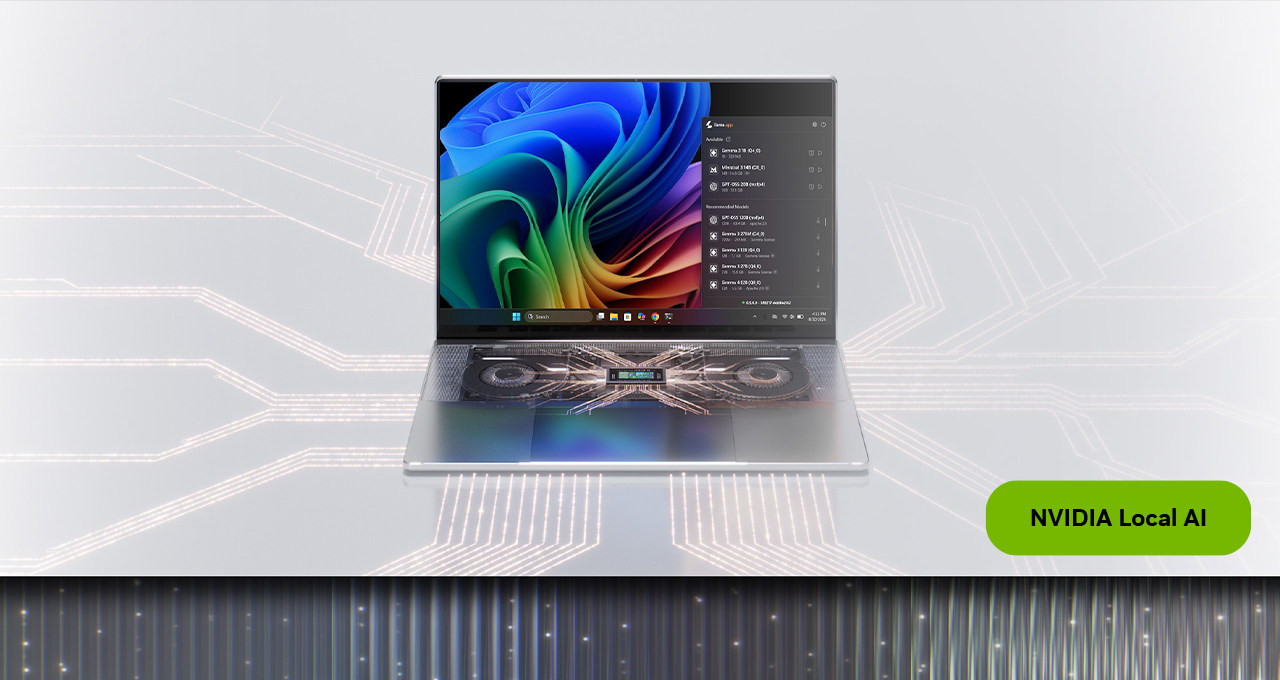
NVIDIA and Microsoft will put RTX Spark laptops on sale Friday, Oct. 16, and NVIDIA has lined up a broad set of software updates from itself and ecosystem partners timed to the launch. The chip is pitched as a combination of gaming PC, creative workstation and personal AI machine, with up to 128GB of unified memory and 1 petaflop of AI compute, running the full RTX and CUDA software stack. NVIDIA describes the machine as a platform for local AI agents, a framing that runs through nearly every piece of the announcement.
On the agent side, the company says first boot will show a Getting Started screen for choosing and installing an agent app. GitHub Copilot, Hermes, OpenClaw, Perplexity, Pi and WorkBuddy have all been updated to streamline RTX Spark setup, and each will recommend an optimized local model and settings configuration that installs in a few clicks. Security is handled through NVIDIA OpenShell and Microsoft Execution Containers (MXC), described as operating-system-level sandboxing for agents. OpenShell layers on convenience features including credential protection and security monitoring. Hermes Agent will integrate granular OpenShell controls and MXC by the end of the month, while OpenClaw and GitHub Copilot already support MXC.
NVIDIA Switchyard is an open-source model router library that lets agents send queries either to local models or to cloud LLMs, aiming to cut cloud usage while keeping results close to what a cloud-only setup would produce. Hermes plans to add Switchyard later in October, and Perplexity Computer and GitHub Copilot have integrated their own routing systems. NVIDIA is also publishing MCP servers for its own applications, including the NVIDIA App, Broadcast, PAIR, Omniverse, RTX Remix and a library of CUDA-X Skills, plus AI playbooks on Oct. 16 covering first-agent setup, a personal AI assistant for work, development configuration and a creative assistant.
The centerpiece model release is NVIDIA Nemotron 3.5 Bolt 74B-A9B 24GB on Thursday, Oct. 15. It is a mixture-of-experts model with 74 billion total parameters and 9 billion active, compressed into 24GB with 2-bit quantization and quantization-aware training intended to preserve quality. NVIDIA positions it to be faster than most popular dense models while smarter than most MoE models of comparable memory footprint. It will run at launch through llama.cpp, vLLM, Ollama, Unsloth and LM Studio, and be directly usable from Hermes and OpenClaw. As with other Nemotron releases, training data, weights and recipes are open source, so teams can fine-tune their own agents. In practice, a 24GB footprint is the interesting number: it puts a capable agent model inside the memory envelope of a single laptop GPU rather than a datacenter card, and the open release makes it a candidate for fine-tuning on proprietary workflows.
NVIDIA PAIR, the company's personal AI router, leaves beta today. It is free and open source, discovers compatible PCs on a local network, installs models and inference engines, and spreads workloads across those machines. The official release adds llama.cpp support, direct downloads from Hugging Face, customizable inference engine settings and RTX Spark support, and runs on Windows, Linux and macOS. NVIDIA says community contributors have added more than 10 features and fixes in the month since the initial release. That is a meaningful shift for small teams: aggregating idle laptops into a local inference pool is a cheaper alternative to cloud APIs for many workloads, though latency over a network and the need for compatible hardware will limit who benefits.
For creators, NVIDIA claims up to 2x performance gains in Adobe's top apps. Photoshop work focused on GPU-accelerated compositing, with improvements to the Remove Tool and effects like Light Leaks; Premiere targets playback, rendering, color grading and AI features such as Enhance Speech and Object Mask; Substance 3D Painter gets faster baking of high-resolution mesh maps and faster open, save and export of large projects. Those optimizations arrive in phases, with Photoshop and Premiere AI improvements in beta now and Substance updates later. NVIDIA Broadcast 2.3 ships now, running natively on RTX Spark, adding RTX Video Super Resolution and Frame Generation effects, Studio Voice profiles, and an Offline File Processor that applies effects to recorded files at higher quality since real-time constraints no longer apply. Broadcast also gains an MCP server so agents can adjust settings and process files. ComfyUI adds RTX Video Frame Generation and RTX Video HDR nodes plus EXR export; frame generation requires GeForce RTX 40 Series or newer. Blender 5.3, now in beta with RTX Spark support, will add DLSS Ray Reconstruction in November for a more interactive viewport.
Developer readiness is a stated priority. PyTorch, Python, CUDA and all CUDA libraries are available for RTX Spark, and NVIDIA cites several firsts for Windows on Arm: a PyTorch-CUDA build, a Python 3.15 build native by default, and a native Conda installer with more than 2,000 packages. NVIDIA says 97% of the top 15,000 Python wheels are ready and it will work with the community on the rest. A Windows Developer Config installs common developer tools, and Windows Subsystem for Linux provides the same packages used for cloud deployment. The open-source NVIDIA Skills repository teaches agents to use CUDA-X tools, which NVIDIA says lets people build accelerated apps without CUDA knowledge. Microsoft is adding llama.cpp as a Windows ML backend and making coding models such as MAI 1.1 Coding Flash available locally, while GitHub Copilot's HydraFusion router gains local model support to reduce token consumption. Llama.cpp now supports decision models — which NVIDIA describes as choosing the next action up to 200x faster than traditional agent reasoning loops — and is releasing Llama Windows, a Windows-native companion app that runs from the system tray with one-click access to Hugging Face Hub models.
Gaming coverage is broad: hundreds of titles at launch, including Cyberpunk 2077, Fortnite, Gears of War: E-Day, Hogwarts Legacy, Marvel Rivals, NBA 2K27 and World of Warcraft, with RTX features such as DLSS, Reflex, Remix, G-SYNC and ray tracing, plus anti-cheat support built with developers. DLSS 5 with 3D-Guided Neural Rendering arrives on launch day, and a new DLSS 5 model that NVIDIA says is 2x faster debuts in NBA 2K27 on Oct. 16 with up to 1.4x frame-rate gains, later reaching Hogwarts Legacy on Nov. 5 and Where Winds Meet in late November. DLSS 5 comes to RTX Remix on Oct. 23. Nemotron 3.5 Bolt E4B 4GB, the third-generation small language model for NVIDIA ACE game characters, releases Oct. 23 and will be testable in the SkyrimNET modding platform for Skyrim; it adds a conversational mode for concise, speech-ready replies and switchable reasoning. RTX Remix 1.6 on Oct. 23 brings ComfyUI Version 2, replacing REST API node wiring with an AI tools layout in the sidebar for generating PBR materials natively, plus batch processing and presets for non-technical modders.
Why it matters: This is less a chip launch than a bid to make local agents a default PC workflow. Developers evaluating on-device inference now have a concrete target — a 24GB, open-weight MoE model with first-class support in llama.cpp, vLLM, Ollama and LM Studio — and the MCP servers and routing tools suggest agent apps will treat local and cloud models as interchangeable backends. Product teams building creative or coding tools should watch whether the claimed 2x app gains and the Arm-native Python and PyTorch builds hold up outside beta, since that toolchain maturity, not raw compute, will likely decide how quickly Windows on Arm becomes a viable primary development machine. Inference from the stated facts: the heavy dependence on phased betas and late-October follow-ups means early buyers are effectively testing unfinished software.
Based on reporting from the original publisher. Visit the source for full context and later updates.
Publisher excerpt
NVIDIA RTX Spark is a new beginning for the PC — a reinvention combining the capabilities of a gaming PC, a creative studio and a personal AI supercomputer into a single superchip. With up to 128GB of unified memory and 1 petaflop of AI compute, RTX Spark delivers the full stack of NVIDIA RTX and […]