Putting a spotlight on AI, society, and humanity
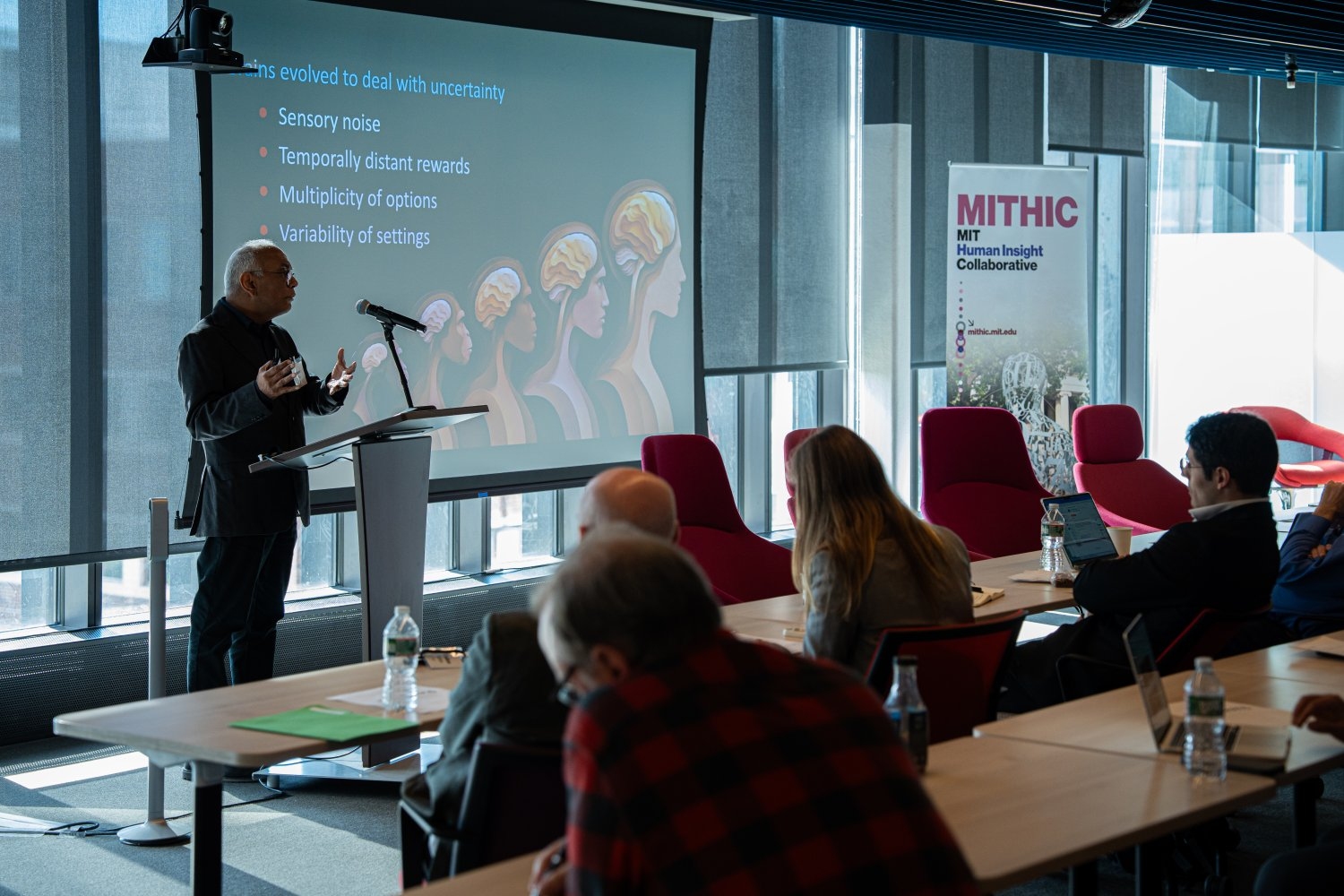
The MIT Human Insight Collaborative, known as MITHIC, has become the Institute's main vehicle for studying how artificial intelligence reshapes human life, according to an account of the initiative's first years of work. Launched in 2024 as a strategic initiative, MITHIC brings together scholars, artists, educators, and researchers and is now in its third year. It has supported 67 projects across 31 MIT units, committing $5.5 million in total funding. Roughly one-third of those projects center on AI, society, and humanity, a share faculty co-lead Heather Paxson says has grown steadily more important to the initiative.
Paxson, a professor of anthropology and associate dean of the School of Humanities, Arts, and Social Sciences (SHASS), frames the scope broadly. The concern is not only individual ethical choices or retraining displaced workers, she says, but how AI is reshaping sociality itself and the ways people relate to one another.
The backdrop is MIT's recent report on AI and education. Among its findings: MIT students are attending office hours less often and spending less time working through problem sets and with one another. The report warned that AI is eroding the "creative friction" that has long defined an MIT education, meaning the debates among students, professors, and teaching assistants that happen in class and out of it. Seth Mnookin, a science writing professor who heads Comparative Media Studies Program/Writing and co-leads MITHIC with Paxson, said the report's message was not that everyone should adapt to AI but that more fundamental questions need asking. He drew a parallel to 1941, when the Institute's newly trained scientists and engineers helped shape the World War II era, arguing that this time the most important questions cannot be answered by technologists alone.
Earlier this year an AI and Society Forum took place on campus, co-organized by MITHIC, SHASS, the Social and Ethical Responsibilities of Computing (SERC), and the MIT Generative AI Impact Consortium (MGAIC), with panels on jobs, democracy, and AI. MITHIC's SHASS+ Connectivity Fund pairs a SHASS scholar with a researcher elsewhere at MIT, and several of the resulting projects are worth watching.
One, conducted in the context of the 2026 U.S. midterm elections, studies how large language models have become intermediaries of democratic knowledge. Political scientists Adam Berinsky and Charles Stewart III and MIT Sloan assistant professor Chara Podimata have shown how voters in Alaska's midterms who did their pre-election research using Anthropic's Claude may have received incomplete information about candidates and their views. The work was recently featured in The New York Times. Podimata's point, as she put it to the Times, is that AI now mediates how people encounter political information while little is known about that information environment or how it varies by demographics, political identity, and geography.
A second project pairs Eric Klopfer of CMS/W with brain and cognitive sciences professor Pawan Sinha to measure AI's near- and long-term effects on cognition. They are testing two competing possibilities: that generative AI increases how much information the brain consumes while offloading cognitive work, or that it supports greater cognitive function when used as part of a creative process. The two recently convened experts for a campus event titled "AI and the Brain."
In arts and technology, music technology professor Anna Huang, who holds a shared position between the MIT Schwarzman College of Computing and the Department of Electrical Engineering and Computer Science, and Media Lab professor Joe Paradiso are examining AI's effect on creative process and live performance. Their project, "Live Musician-AI Improvisation, Tuning the Social Aesthetics in Human-AI Partnerships," asks what happens when human composers and contemporary machine learning systems improvise together. A collective of MIT musicians, ethnomusicologists, and engineers meets regularly to experiment with improvisation frameworks, including pausing to discuss how technology affects authorship, musical direction, and ensemble dynamics. Faculty plan to fold the takeaways into a future course or practicum on AI improvisation.
On the teaching side, anthropologist Graham Jones and computer science associate professor Arvind Satyanarayan used SHASS+ Connectivity funding to launch 6.S061/21A.S02, Humane User Experience Design. Students examine how AI systems are designed and confront what happens when AI agents enter socio-cultural relationships with people by mimicking human thought and speech. Jones said the word "humane" is deliberately double-edged, meaning both benevolent and humanlike, and that students are finding a real tension between building a system that serves people and one that seems human, since real people can develop dangerous dependencies.
Dwai Banerjee, associate professor of science, technology, and society, leads "Rebuilding Computing and Society at MIT," funded by MITHIC's Education Impact Fund. The project revived the Computing and Society HASS concentration launched in 2019, which had gone dormant with classes no longer offered and minimal student interest. It now draws on current classes across 11 SHASS units. Banerjee, the concentration's advisor, is working with lecturer and research affiliate Mariel Garcia-Montes and MIT senior Daniel Gonzalez, the latter developing a research and outreach program centering undergraduate voices.
Another Education Impact Fund project, led by Writing, Rhetoric, and Professional Communication lecturer Michael Trice, responds to a consistent SHASS faculty request for training to handle generative AI concerns in their classes. Trice is assembling faculty resources and running workshops and visiting lectures on generative AI and writing, including a talk this fall by John Gallagher of the University of Illinois presenting findings from a large-scale 2026 survey of undergraduate AI usage and writing at his institution.
MIT leadership has endorsed the effort. President Sally Kornbluth called this the most important time for collaboration between science and technology and the human-centered disciplines. SHASS dean and MITHIC co-chair Agustín Rayo said MIT is uniquely placed to generate the values, tools, and policies needed to shape AI as a force for good. Provost Anantha Chandrakasan, also a co-chair, told the SHASS 75th Anniversary Symposium that understanding ethical implications and societal impact is especially urgent given how fast AI is developing.
Next, MITHIC and SERC are planning a series of events pairing humanists or social scientists with colleagues in a single field, beginning with mathematics, to examine what AI changes about how that field produces knowledge and trains its next generation. As Mnookin put it, the question is not whether AI will change these fields but whether people understand what is at stake before it does.
For developers and product teams, the research points at concrete design risks. The Alaska finding suggests retrieval-augmented or chat-based political information can silently narrow what voters see, which argues for source transparency and coverage testing before shipping civic tools. The Humane User Experience Design course names a trade-off many teams will recognize: humanlike agents can build trust and dependency at the same time. The cognition work is an open empirical question rather than a settled verdict, so claims that AI either sharpens or dulls thinking should be treated as unproven. A likely inference is that evaluation practices will increasingly need to measure social and cognitive effects, not just task accuracy.
Why it matters: Universities are among the first institutions to see AI's effects on how people learn, deliberate, and create, and MITHIC's portfolio turns those observations into funded research that product teams can learn from. The Alaska voter study and the humane design course both suggest that how an AI system presents information and mimics people carries consequences beyond accuracy benchmarks. For developers building civic, educational, or companion-style products, the practical implication, as an inference from these projects, is that transparency about sourcing and deliberate limits on humanlike behavior deserve a place in the design process rather than a later patch.
Based on reporting from the original publisher. Visit the source for full context and later updates.
Publisher excerpt
Supported by the MIT Human Insight Collaborative, scholars are exploring how AI is impacting the human experience and reshaping higher education.