A game you cannot win unless you have a quantum computer
Google Quantum AI researchers ran a set of games and algorithms on the Willow superconducting processor that are designed so no classical strategy can win, and reported results above the classical bounds at every size they tried. The work, published in Science under the title "Quantum-classical separation in bounded-resource tasks arising from measurement contextuality," was described in a blog post by research scientists Shashwat Kumar and Rodrigo Cortiñas. The central claim is that a property called quantum contextuality can be demonstrated, quantified and used across systems reaching 105 qubits, not just the handful of particles used in earlier experiments.
Contextuality is the idea that the outcome of a measurement can depend on which other compatible measurements are performed alongside it, so outcomes cannot be treated as fixed values that exist before anyone looks. The team frames this against Einstein's question of whether the moon is there when nobody looks; for quantum systems, the answer is that pre-existing values cannot be assigned to everything one might measure. Entanglement is the usual headline ingredient of quantum computing, but the post argues that a growing body of theory points to contextuality as the deeper resource behind certain quantum advantages.
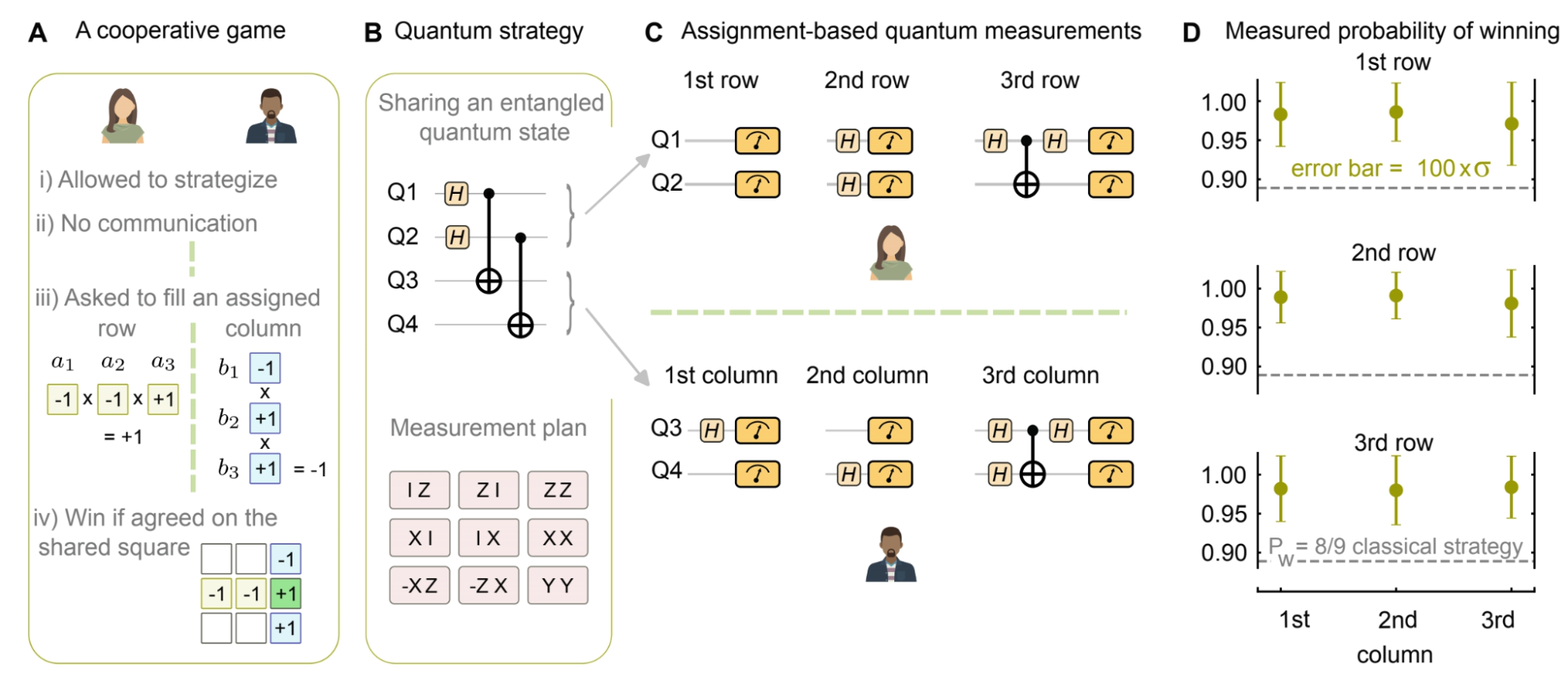
The demonstration uses the magic square game. Players Alice and Bob are given a row and a column of a 3x3 grid and must fill them with +1 or -1 so that every row multiplies to +1 and every column multiplies to -1, agreeing on the shared cell without communicating. No such grid exists, so any prearranged table wins at most eight of nine rounds, or 88.89%. On Willow, Alice and Bob each hold two qubits sharing two entangled Bell pairs and measure them with preset settings. Across all nine versions of the game, each played 100,000 times, the qubits won 98.30% of rounds (0.9830 ± 0.0001), a statistically significant gap over any pre-written table.
The team then quantified contextuality with a Bell-Kochen-Specker inequality, computing a number χ defined as the sum of the three row products minus the sum of the three column products. Predetermined outcomes force χ ≤ 4, since classical tables can only yield -4, 0 or 4, while quantum mechanics allows values up to 6. The test is state-independent, meaning it does not depend on how the qubits are prepared, which the researchers argue makes it a property of the machine rather than of a chosen input. Measuring it is demanding because every row and column must be measured on the same two qubits in sequence without disturbing them. The team used an extra ancilla qubit to capture each result, running 540 consecutive measurements repeated 1,000 times, and obtained χ = 5.590 ± 0.008. That is past the classical bound of 4 and about 7% from the quantum limit of 6.
Scaling was the harder question, since added qubits bring noise that can erase fragile quantum effects. In the GHZ parity game, N players share a single entangled GHZ state, each receives a one-bit question and answers with one bit without communicating, and they win if the parity of their answers matches a rule set by the questions. Random guessing succeeds half the time and the best classical plan reaches 75% for three players, declining toward 50% as players are added, while an ideal GHZ state wins every round. The team played with up to 71 players, one per qubit, and stayed above the classical bound throughout, though the margin narrowed as noise grew with each added qubit. They also verified genuine entanglement across 45 qubits.
The same physics underlies a separation between shallow quantum and classical circuits. A 2018 theorem showed that finding a hidden linear function can be solved by a constant-depth quantum circuit and that no constant-depth classical circuit can match it, with contextuality traced as the source of the advantage. Because a constant-depth circuit computes each output bit in a fixed number of steps, each classical output can only depend on a small neighborhood of the input. The algorithm had not been run at scale on real hardware before. The team encoded hidden-linear-function instances on grids of up to 105 qubits using the shallow recipe, with success probabilities above one-half; success falls from close to 1 down to about 0.6 at maximum processor size, still above the conjectured classical bound.
An unexpected byproduct is a benchmarking tool. These tasks require many qubits to agree exactly and simultaneously, which surfaced subtle coherent errors of the kind that rotate a quantum state slightly off target and that random-circuit benchmarks tend to average away. The physics sets a fixed ceiling: χ = 6, a win probability of 1, a perfect contextual fraction. The gap between a machine's result and that ceiling becomes an objective score that never shifts as hardware improves, unlike classical bars that get easier to clear.
In my reading, that benchmarking angle may prove as practically important as the headline result. Chemistry and materials simulations require structured algorithms with many interacting qubits, where small coherent errors can hide inside aggregate fidelity numbers; a benchmark keyed to a physics-imposed ceiling could expose them earlier. A likely trade-off is that these tests are specialized and costly to run, needing long sequences of measurements and careful calibration, so they are unlikely to replace broad random-circuit benchmarks outright. The reported margins also shrink as system size grows, which is the familiar pattern for near-term quantum hardware and suggests the advantage will need error correction to hold at larger scales.
Why it matters: Teams building or evaluating quantum processors gain a concrete, reproducible way to test hardware against a limit set by physics rather than by an adjustable classical baseline. For developers working on quantum algorithms, the results suggest contextuality is worth treating as a practical resource and a diagnostic, not only a philosophical curiosity, though whether the observed advantages translate into useful applications remains to be shown.
Based on reporting from the original publisher. Visit the source for full context and later updates.
Publisher excerpt
Quantum