Vercel Releases UI SDK for Agents to Compose UI from Reusable Behaviors
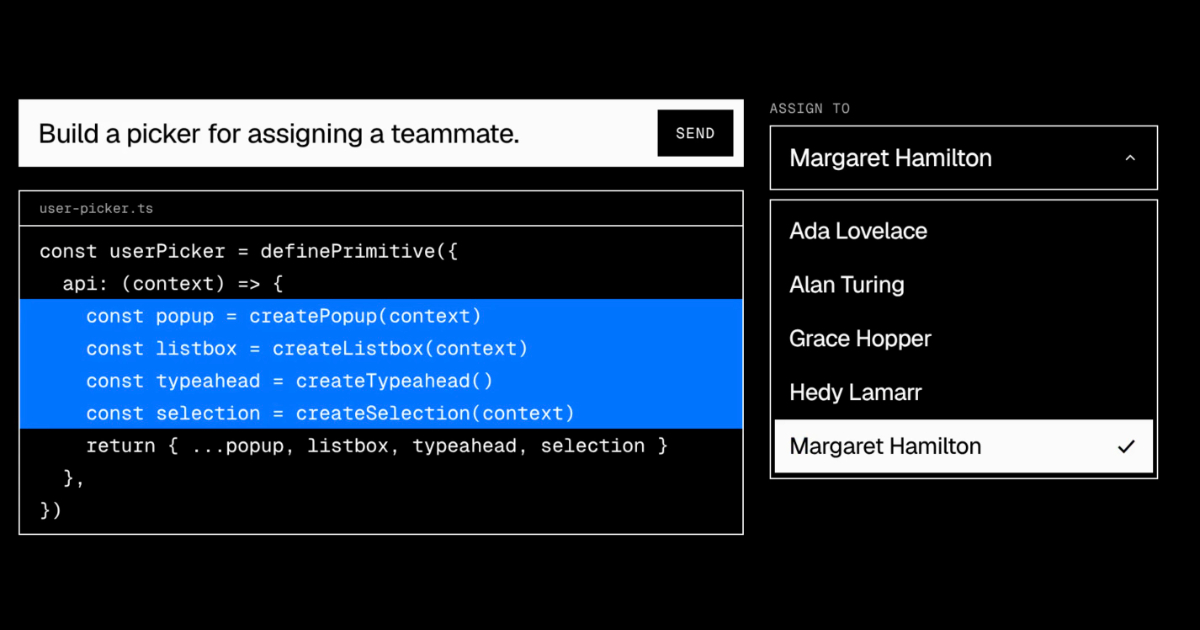
Vercel has published UI SDK, an open-source TypeScript library currently in beta, under the GitHub project vercel-labs/ui. The project was reported by InfoQ's Daniel Dominguez. Its organizing idea is that keyboard navigation, focus handling, selection, popups and drag and drop are treated as reusable behaviors rather than details hidden inside finished components.
The behaviors ship in the @ui-sdk/core package. Vercel says it has built more than 50 of them, among them createPopup, createSelection, createTypeahead, createRovingFocus, createReorder, createResize, createViewport, createListbox, createChange, createFocusRecovery and createVirtualizer. A developer, or in Vercel's framing more often an agent, composes these helpers inside definePrimitive, which declares a component's state, API and slots once. Framework adapters then render that same primitive through createParts in React, Vue, Svelte, Solid or as Web Components. The rendered parts are unstyled and expose attributes and CSS variables, so styling is left to the consuming app.
The same behaviors also power a starter library of more than 50 unstyled components, including a Color Picker, Token Input and Command, alongside Calendar, Tree and OTP Input. Part names are consistent across all five adapters, which means the same primitive description can target different frameworks without rewriting the rendering layer.
The agent story extends past authoring. A ui-sdk skill, installed with npx skills add vercel-labs/ui --skill ui-sdk, points an agent at the Markdown documentation shipped inside the installed packages, so the agent works from local docs rather than external references. At runtime, createAgent, imported from the matching framework package such as @ui-sdk/react/agent, exposes snapshot, act and query, letting an agent read component state and invoke actions through the component API instead of relying on screenshots. Apps can approve or refuse those steps, and change callbacks receive a source of "agent" and may cancel a change. A registerTools helper can expose the same methods to a browser's built-in agent through WebMCP, when the browser provides document.modelContext.
This places UI SDK in a crowded layer. Headless libraries such as Radix UI, Base UI, React Aria, Ark UI with its Zag.js state machines, and Headless UI already separate behavior from presentation, and shadcn/ui sits a level above those primitives as a component kit copied into a repository. UI SDK's differentiation, as described, is aiming lower, at composable behaviors shared across frameworks, and adding the agent bridge as a first-class feature. The changelog credits the teams behind Radix, Base UI, React Aria, shadcn/ui, Nuxt UI and Geist. Vercel has not said whether shadcn/ui will be rebuilt on UI SDK.
Early reaction has focused on the bridge. Rahim, a product engineer at Mux who built Vidstack, described the packaging as elegant after reading the source and singled out two details: createAgent giving an agent a snapshot, act and query tool to interact with actual components, and change callbacks knowing a modification came from the agent via details.source === "agent", with cancel available to reject it. A developer identified as Stefan asked how the idea differs from existing headless libraries and whether the intent is to think of UI as combinations of behaviors.
The practical details matter for anyone evaluating an upgrade. UI SDK is at 0.1.0-beta.1 under the Apache License 2.0 and is subject to Vercel's public beta terms, with APIs, documentation and behavior subject to change before general availability. Installation pairs @ui-sdk/core with a framework adapter, for example npm install @ui-sdk/react @ui-sdk/core, which requires React 19 or later. The Vue, Svelte and Solid adapters document peer ranges of Vue 3.5, Svelte 5.33, and Solid 2 from 2.0.0-rc.14. Setup guidance lives in the documentation.
The version constraints are worth reading carefully. The Solid requirement sits at a release candidate, and the React floor is a relatively recent major, so teams on older stacks may find adoption blocked until they upgrade. This suggests the library is aimed at greenfield or actively modernized frontends rather than legacy applications, at least while it remains in beta. The unstyled default also means the SDK is not a drop-in visual kit; teams get behavior and semantics and must supply their own design layer.
A likely trade-off of the agent bridge is the tension between automation and control. Letting an agent call actions directly avoids brittle screenshot-driven automation, but it also means the component API becomes a surface that agents can drive, which is why the approve-or-refuse step and the cancellation hook in change callbacks look central rather than incidental. Building agent-visible state and action methods into primitives could become a differentiator if browser-level agent interfaces such as WebMCP gain adoption, though that path depends on browsers exposing document.modelContext.
Why it matters: frontend teams choosing a headless library now have another option, one that standardizes behaviors across five frameworks and ships an explicit contract for agents to inspect and operate components. Developers experimenting with agent-driven interfaces can wire snapshot, act and query into existing primitives without abandoning their design system, provided their framework versions meet the beta's requirements. The main caveats, all inference from the stated facts, are beta churn, a young ecosystem around cross-framework primitives, and the need for teams to build their own visual layer on top.
Based on reporting from the original publisher. Visit the source for full context and later updates.
Publisher excerpt
Vercel has released UI SDK in beta, an Apache 2.0 TypeScript library of more than 50 UI behaviors in @ui-sdk/core, with adapters for React, Vue, Svelte, Solid, and Web Components, so agents can compose accessible components and operate them through a documented agent bridge. By Daniel Dominguez