Bringing the Spark to Europe: Local Intelligence Powers Next Wave of Agents
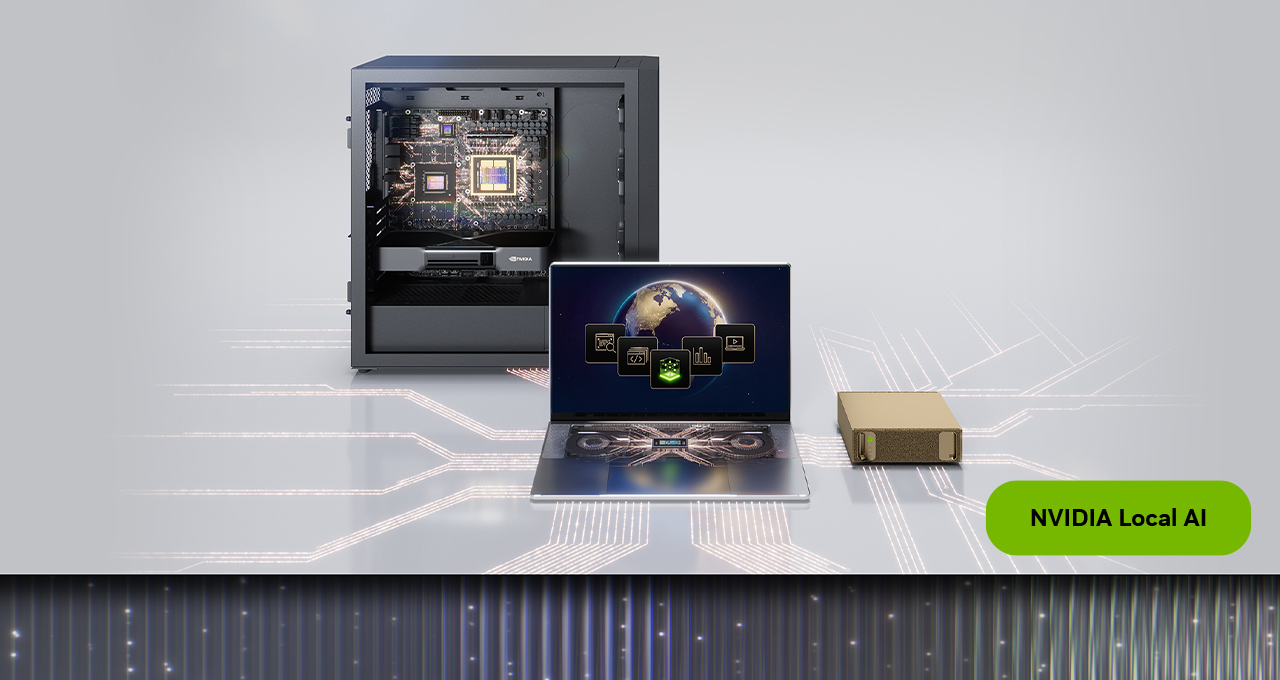
At GTC Berlin, NVIDIA presented its portfolio of hardware for running AI models locally rather than in the cloud, spanning Windows PCs, Linux developer desks and enterprise workstations, along with a set of software, model and integration announcements around them. The three tiers it named are RTX Spark, which launched on October 16 and powers personal agents on Windows PCs; DGX Spark, aimed at developers building and scaling Linux applications; and DGX Station, for enterprise teams running frontier workloads on Linux, with a Windows edition expected in December.
RTX Spark is the consumer-facing piece: NVIDIA says it runs personal agents, accelerated content creation and 1440p gaming at 100 frames per second, with up to 128GB of unified memory and one petaflop of AI compute. The company cited early reviews from CGMag, The Verge and PCMag describing the platform in positive terms around creation, future-facing design and portability. Laptops from ASUS, Dell, HP, Lenovo, Microsoft and MSI are available now, with Acer coming later. Many RTX Spark laptops ship with an unlocked bootloader, which NVIDIA frames as an aid to developers and enthusiasts who want to build and customize local agents.
A new desktop agent app, Underdog, is now available for RTX Spark. It is built for fully local, private AI and runs on the company's Husky model-specific inference engine, so models execute entirely on the device and user data does not leave the PC. In the GTC keynote, NVIDIA founder and CEO Jensen Huang demonstrated agents on RTX Spark training Hugging Face's Microduck robot using Isaac Lab, Hermes Agent and Nemotron 3.5 Bolt 74B.
On the developer side, DGX Spark 64GB systems begin rolling out from partners on Friday, October 23. NVIDIA lists Nemotron 3.5 Bolt 74B 24GB, Qwen3.8 27B and Gemma 4 26B-A4B among the models these systems can run. Capacity scales by linking machines through built-in ConnectX-7 networking and NVIDIA Sync Cluster Assistant; clusters of up to eight units are now supported in manual configuration, producing 1TB of unified memory. According to NVIDIA, that is enough to run frontier-class models such as GLM 5.3, and the setup suits small teams sharing one cluster as a backend while each developer runs concurrent sessions against the same model. Advanced coding models named for this tier include Qwen 3.8 Flash Next, DeepSeek v4 Flash 0731 and GLM 5.3 Flash. DGX Spark hardware is sold by Acer, ASUS, Dell, GIGABYTE, HP, Lenovo, MSI and NVIDIA.
NVIDIA Sync is gaining a Model Launcher later this month. It downloads a model and container matched to the machine's configuration and wires the model to OpenCode, loading DGX Spark Skills for troubleshooting, device maintenance and documentation access. The October DGX Spark software update adds a Wi-Fi Assistant for switching networks while the system runs in appliance mode, and refreshes those Skills.
DGX Station is the high end: 748GB of coherent memory and up to 20 petaflops of AI performance, positioned to run models like GLM 5.3 and serve more than 30 users at speeds NVIDIA compares to cloud models. Sync now supports DGX Station for connecting two Linux systems. Seven new management integrations — Absolute Security, Splunk by Cisco, Fleet Device Management, Microsoft Intune, Perforce Puppet, Progress Software Chef and Tanium — let IT teams fold the machines into existing setup, management and compliance processes. The Windows version, due in December from system partners, combines RTX PRO GPUs with agents whose LLMs run on GB300 systems in one machine, and will support manufacturing software from nTop, Dassault Systèmes, Keysight, MathWorks, Rockwell Automation, Siemens, Synopsys, Unity and Altera, plus on-premises agents via Hermes Agent, Perplexity or Aible. DGX Station systems ship now from ASUS, Dell, GIGABYTE, HP, MSI, Supermicro and Exxact; Windows units are expected from ASUS, Dell, GIGABYTE, HP, MSI and Supermicro later this year.
For robotics, NVIDIA released three open source reference workflows bringing GPT-6 Astra, Isaac Lab, Isaac Lab-Arena and Cosmos to DGX Station, for refining GR00T 1.7 models with reinforcement learning, training dexterous manipulation and post-training Cosmos world models for synthetic data. NVIDIA Cloud Functions is entering early access on Linux DGX Station: teams register local model endpoints in a shared catalog and reach them through a single OpenAI-compatible entry point, swapping the model behind an endpoint without changing application code. This is effectively a private inference service on a desk — convenient, though the shared-catalog model means access control and endpoint governance become the team's responsibility.
Recursive Superintelligence released Recursive Flint, a local coding LLM: a 40-billion-parameter mixture-of-experts model with 2.5 billion active parameters, evaluated on agentic coding benchmarks including SWE-Bench Pro v2, Terminal-Bench 2.1 and SWE-bench verified. NVIDIA says Recursive's Eureka Machine automated research pipeline produced specialized kernels that raised generation speed on RTX Spark by 55% without changing weights. Open weights are on Hugging Face under Apache 2.0, runnable on RTX Spark, DGX Spark, GeForce RTX and RTX PRO GPUs, with post-training via NeMo AutoModel and NeMo RL.
Model support widened with day-zero backing for Nemotron Bolt E4B 4B (releasing October 23), GLM, DeepSeek, Qwen, MiniMax, Liquid AI's LFM2.5-24B-A2B and Black Forest Labs' FLUX.3 Klein, a 5.6-billion-parameter image model that runs on GeForce RTX cards with as little as 8GB of VRAM and makes a 1-megapixel image in about four seconds on an RTX 5090. A new checkpoint collection is quantized for RAM efficiency, starting with Qwen3.8-Flash-Next-FP4-Local on one DGX Spark 128GB or RTX PRO 6000 and GLM-5.3-Flash-FP4-Local across two systems.
Inference engines got attention too: llama.cpp gains speculative decoding with MTP for Qwen 3.8 Flash Next, up to 1.4x faster on RTX PRO 6000 Blackwell; vLLM gains faster speculative decoding and FlashInfer prefill kernels for Qwen linear-attention layers, up to 1.3x faster with Qwen3.8 27B on DGX Spark and up to 1.2x throughput for GLM 5.3 Flash on DGX Station.
Why it matters: teams weighing on-premises AI now get a clearer ladder — consumer laptops, a clusterable Linux desktop, and a workstation with enterprise management hooks — plus an open Apache 2.0 coding model and tuned checkpoints. For developers, the practical questions are memory sizing and cluster topology once models exceed a single device; the inference gains matter most where they shorten agentic loops. Product teams in manufacturing and robotics, in my reading, are the clearest near-term beneficiaries of the Windows and workflow announcements.
Based on reporting from the original publisher. Visit the source for full context and later updates.
Publisher excerpt
At GTC Berlin, NVIDIA is showcasing its full lineup of local AI hardware. RTX Spark, which launched last week, powers personal agents on Windows PCs; DGX Spark supports developers building and scaling applications on Linux; and DGX Station serves enterprise teams running frontier workloads on Linux, with a Windows version arriving in December. Announcements include: […]