[AINews] OpenAI’s Patch the Planet program is 1 of 2 parties to discover PHP2Shell vulnerabilities in core PHP affecting 70% of the web, using GPT-5.6 Sol; coordinated response over 2 months
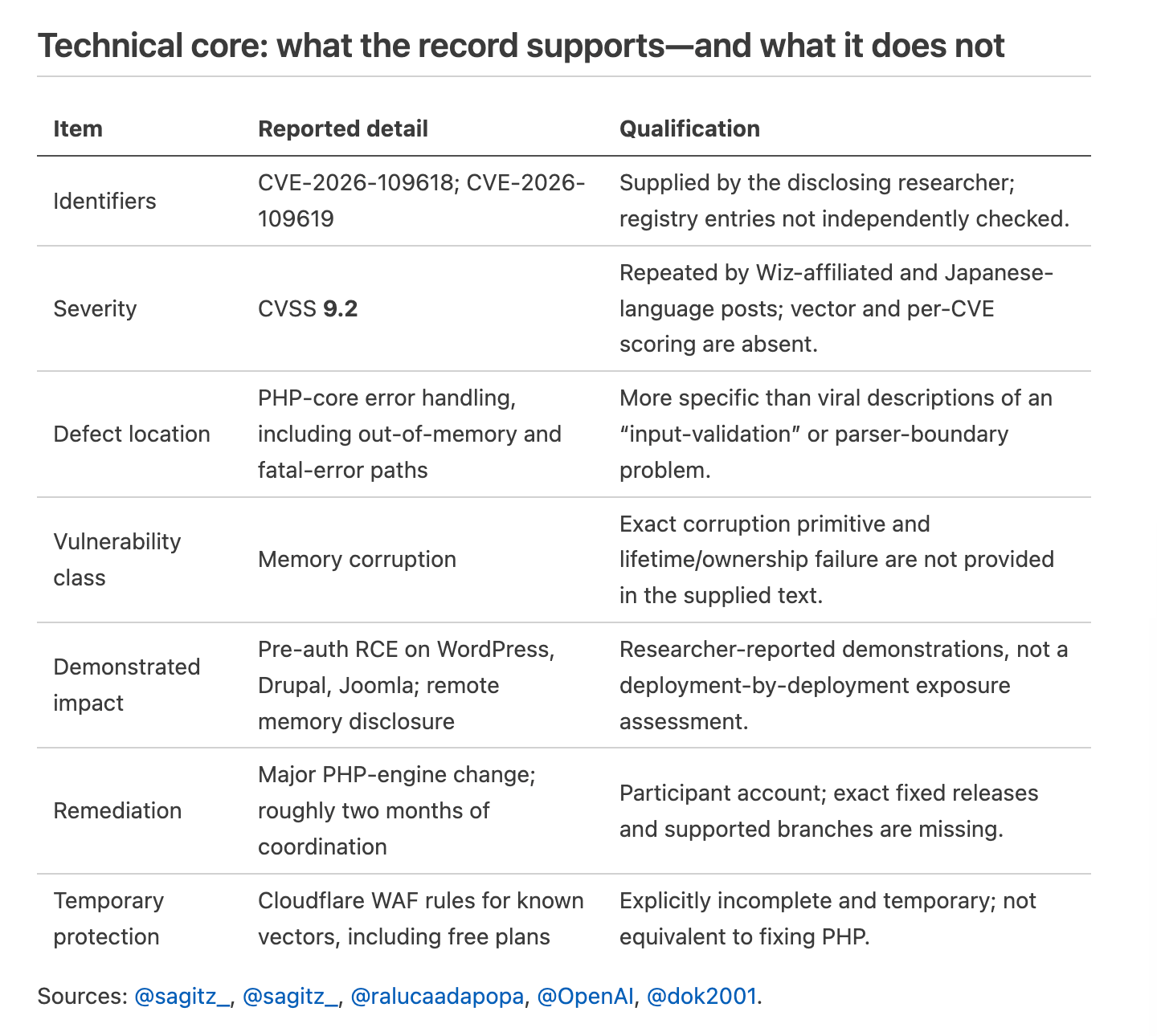
PHP2Shell is the name researchers gave to two memory-corruption vulnerabilities in the PHP engine itself, tracked as CVE-2026-109618 and CVE-2026-109619, disclosed on October 21, 2026 after approximately two months of private coordination. The flaws sit in PHP's internal handling of out-of-memory conditions and fatal errors, not in a WordPress plugin or an application's authentication layer. The researchers report demonstrations of full remote code execution and Heartbleed-style memory disclosure, with pre-authentication RCE shown against WordPress, Drupal and Joomla.
Two independent discovery teams are credited. OpenAI says Ryan Austin, a researcher at the security firm Calif, found the bugs in August 2026 as part of the OpenAI Patch the Planet project using GPT-5.6 Sol. Secondary reporting says Wiz, recently acquired into Google Cloud, independently found the same flaws; a Wiz-affiliated account credits Gemini 4 Argon with discovery, exploit-chain development, detector creation and patch validation, alongside Wiz's own Atlas tool. OpenAI links the work to Daybreak, the cyber model and product line for which it had announced a $1B subsidy for frontline defenders shortly before.
The distinction between the program names is worth keeping straight: Patch the Planet is described as the remediation initiative, Daybreak is the model access that researchers credit with enabling the security work. They are different roles in the same effort, not two names for one thing.
On the fix side, OpenAI describes a patch that required a major change to the PHP engine, coordinated among maintainers, researchers, security providers and governments, with confidential advance notice to governments and outside agencies. A participating researcher confirms work with the PHP Foundation to support and harden the patch. Before the scheduled release, Cloudflare deployed WAF mitigations covering known exploit vectors for all customers including the free tier, and its CTO said the rules were being updated as early attacks appeared while calling them a stopgap and directing operators to patch at 14:00 UTC — matching warnings in Japanese-language posts of a 23:00 JST release on October 21.
An NSA account advised preparing for an immediate update and taking systems offline where timely mitigation was not possible. OpenAI later said every PHP site can upgrade safely, and published a repository containing a Codex skill to guide operators through checking whether their sites were affected. Secondary reporting says details leaked before the patch landed.
A widely circulated compilation attributed to Censys put roughly 1.5 million servers on unfixed versions and listed reported shutdowns at Dutch institutions, government sites in Europe, Wikipedia, Archive.org, Asana and GOG, plus an early-morning warning from Japan's prime minister. Those individual figures and outages are not corroborated in the primary record, and it is not established whether any given shutdown was precaution, a patching interruption, an unrelated failure or a compromise. SemiAnalysis separately reports the Japanese prime minister urging operators to patch immediately or disconnect, set against an existing breach wave in Japan — 18 companies disclosing incidents since September 25, including exposures of about 6.6 million Times Car accounts, 11.18 million Burger King Japan app records and potentially 22.5 million Sourcenext records. Nothing in that account ties those earlier breaches to PHP2Shell.
The affirmative case for AI-assisted discovery rests on working exploit chains, engineered patches, detectors and patch validation rather than benchmark scores alone. OpenAI frames the episode as a "Defender's Window" — advanced models finding a flaw before attackers and buying defenders time — though its wording is "to our knowledge," which is not proof that no attacker already knew. Google also advertises Wiz testing in which Gemini 4 Argon found more than twice as many vulnerabilities as baseline models, but that promotional post does not expose the dataset, baselines, budgets or false-positive accounting, so it is not an independent comparison of PHP2Shell discovery.
My reading is that the disclosure doubles as positioning for every vendor involved: OpenAI, Google via Wiz, and Cloudflare all get a credible security story out of it, and the severity debate — whether this ranks with log4shell or Heartbleed — is genuinely open. What is less ambiguous is the operational shape of the response: pre-release filtering, a synchronized patch window, government warnings and a coordinated upstream fix.
For operators, the practical sequence is to get the authoritative PHP and distribution advisories, inventory every exposed runtime — managed hosting, containers, appliances, background workers, legacy apps — install authenticated fixed packages, confirm the running build, and investigate signs of exploitation separately from patching. Updating closes the hole; it does not show that credentials or data were untouched. WAF rules reduce immediate exposure but tempt false confidence, since proxied coverage, alternate ingress paths and origin exposure all need checking. The conditional shutdown guidance applies when immediate updating is infeasible, not to the internet at large.
One recurring proposal — using the RCE to auto-patch servers — is an idea floated on social media, not an authorized remedy; unsolicited exploitation carries outage, evidence-destruction and legal risk regardless of any speculative pardon. There is also a supply-chain tension in the fix: constant updating exposes users to compromised packages, while delay leaves known holes open. Sarah Guo is reported citing CVEs rising from roughly 4,000 to 15,000 per month since April and asking about formal verification and safer distributions; those counts are unverified and disclosure volume is not a measure of successful exploitation.
Why it matters: anyone running PHP — which the headline figure puts at 70% of the web — faces a core-runtime flaw that plugins cannot fix, so upgrades and version verification land on platform and infrastructure teams rather than application developers. It is also the clearest public test so far of frontier models finding serious bugs before attackers, which likely accelerates both defense budgets and the debate over who gets vetted access to the strongest cyber models. The next year should bring more disclosures of this kind, and teams that cannot inventory their PHP runtimes quickly will feel it first.
Based on reporting from the original publisher. Visit the source for full context and later updates.
Publisher excerpt
The Big Hardening begins