Europe’s Industrial Leaders Reinvent Engineering and Manufacturing With NVIDIA
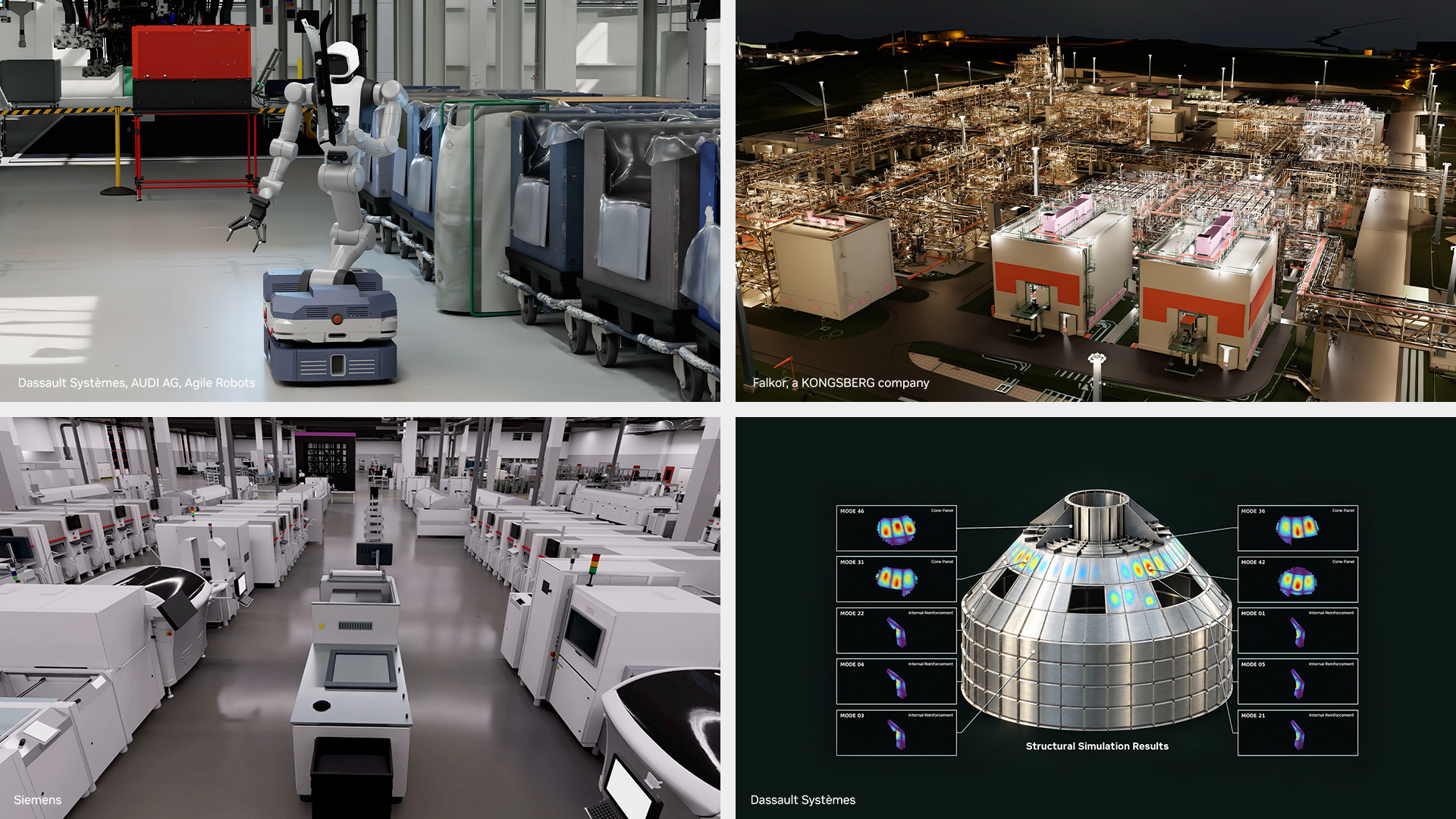
At GTC Berlin, NVIDIA outlined how European industrial companies are using its CUDA-X and Omniverse libraries alongside the Cosmos and Nemotron open models across engineering and manufacturing. The most concrete deliverable for developers is the Factory Operations Blueprint, or FOX, which is now in early access on GitHub. FOX is a starting path for building two kinds of industrial agent: an always-on factory manager that coordinates work across machines, and specialist agents aimed at tasks such as visual inspection, root cause analysis, report generation and fleet management.
These agents can attach to frontier models, including Cosmos and Nemotron, and to foundational knowledge sources spanning computer-aided design, product lifecycle management, simulation software, and both IT and operational technology systems. According to NVIDIA, agents built on FOX can monitor factory operations in real time, correlate visual findings with machine logs when investigating a problem, and coordinate the response. Cosmos in-context learning lets the agents adapt from examples and documentation rather than requiring fine-tuning, which matters because fine-tuning a model on a specific production line is slow and hard to maintain.
Siemens is the most detailed customer example. It is integrating FOX-built agents into Intelligence Center X, its agentic enterprise system, to identify root causes and coordinate factory operations, with NVIDIA estimating cost savings of 20%. Siemens' Process Preparation X agents use Cosmos Data Factory tools and skills to generate defect images for circuit-board inspection. At Siemens' Erlangen electronics factory, that approach cut calibration time for inspection processes by 40%.
On the simulation side, NVIDIA is releasing cuDSS for general availability at the event. cuDSS is a CUDA library for sparse direct solvers, the numerical workhorse behind structural stress, fluid flow, electromagnetic field and semiconductor device simulations. Making it generally available lowers the barrier for simulation vendors and engineering teams to adopt GPU acceleration without building their own solver stack. Mercedes-Benz runs Siemens' Simcenter STAR-CCM+ on NVIDIA GPUs to compare vehicle designs via faster aerodynamic simulation, and in its factories uses Cosmos 3 with the Metropolis VSS blueprint to build agents for vehicle inspection and windshield assembly verification that detect deviations. Cadence is benchmarking automotive fluid-dynamics workloads on NVIDIA GPUs, and Autodesk is bringing PhysicsNeMo and Warp into NavPack, integrated with Alias, for simulation-trained AI that helps designers such as Bentley's predict vehicle performance.
Semiconductor work yields some of the sharper numbers. imec and Infineon are accelerating simulation with Synopsys software on NVIDIA accelerated computing: benchmarks of S-Litho on imec's model show up to 40x speedup, and Infineon reports a 12x speedup in 3D breakdown simulation for next-generation power devices using Sentaurus Device with CUDA libraries. Elsewhere, Leonardo is working with Neural Concept on AI-driven aircraft design using Omniverse libraries to combine geometry and aerodynamic results; Dassault Systèmes' LEO and AURA Virtual Companions, powered by Nemotron and orchestrating CATIA and SIMULIA AI agents with CUDA-X-accelerated SIMULIA solvers, let carmakers virtually test vehicle doors before building prototypes. UniversalAGI and Saab use Latent Interaction Field Transformer physics models with Warp to evaluate thousands of wave conditions and headings in real time instead of days, so vessels can anticipate dangerous motion and pick safer routes. PhysicsX is working with GB1, Britain's America's Cup team, on yacht design with Omniverse visualization of hull geometry and pressure fields; Fermioniq's Sofia agent translates natural-language requests into Warp-based simulation solvers for Deltares and Dutch ministries modelling river flow; and Mistral plans to use CUDA-X, Warp and Omniverse to accelerate physics simulation and generate training data for engineering models.
Omniverse and Isaac libraries underpin the digital-twin and robotics work. Audi uses a battery-production digital twin built with Omniverse libraries to test production concepts before equipment exists, and with Dassault Systèmes and Agile Robots simulates mobile humanoid robots and logistics in DELMIA virtual twins. Schaeffler is integrating digital twins of its humanoid actuators with Isaac simulation frameworks so robotics partners can evaluate components in simulation and cut physical testing. At Volkswagen Sachsen's Transparent Factory, Wandelbots uses NOVA with Isaac Sim, built on Omniverse and OpenUSD, to validate assembly workflows digitally before preparing applications for physical robots. Falkor, a KONGSBERG company, is integrating agents and Omniverse libraries into its platform; on Microsoft Azure NCv6 virtual machines powered by NVIDIA RTX PRO 6000 Blackwell Server Edition GPUs, agents with spatial intelligence combine engineering data, operating information and 3D equipment geometry to inspect and maintain facilities in process and energy industries. Schneider Electric and AVEVA are building an AI factory digital twin for Nscale with Omniverse libraries so engineers can compare power, cooling and equipment configurations before physical changes.
My reading is that the through-line is a shared stack: CUDA-X for fast solvers, Omniverse and OpenUSD for geometry and twins, Isaac for robots, and Cosmos and Nemotron for perception and reasoning, with FOX providing an application skeleton on top. For developers, the practical question is how much of FOX is reusable plumbing versus NVIDIA-specific glue, and early access on GitHub should make that inspectable. A likely trade-off is dependence on NVIDIA hardware and model families, and the headline speedups are vendor and workload specific, so teams should benchmark their own solvers before assuming the gains transfer.
Why it matters: Manufacturing and engineering teams evaluating industrial agents now have a concrete reference implementation to study rather than a slide deck, and the Siemens figures give a first public yardstick for what root-cause and inspection agents may return. Developers building factory software should expect integration points around CAD, PLM, simulation and OT/IT systems, and should treat the quoted speedups as targets to verify on their own workloads.
Based on reporting from the original publisher. Visit the source for full context and later updates.
Publisher excerpt
To increase productivity, accelerate innovation and create new opportunities for economic growth, Europe’s industrial leaders are tapping NVIDIA CUDA-X and Omniverse libraries, as well as NVIDIA Cosmos and Nemotron open models, across the engineering and manufacturing lifecycle. Bringing those capabilities together on the factory floor, the NVIDIA Factory Operations Blueprint (FOX) is now available in […]