Trump declares robot imports a national security threat
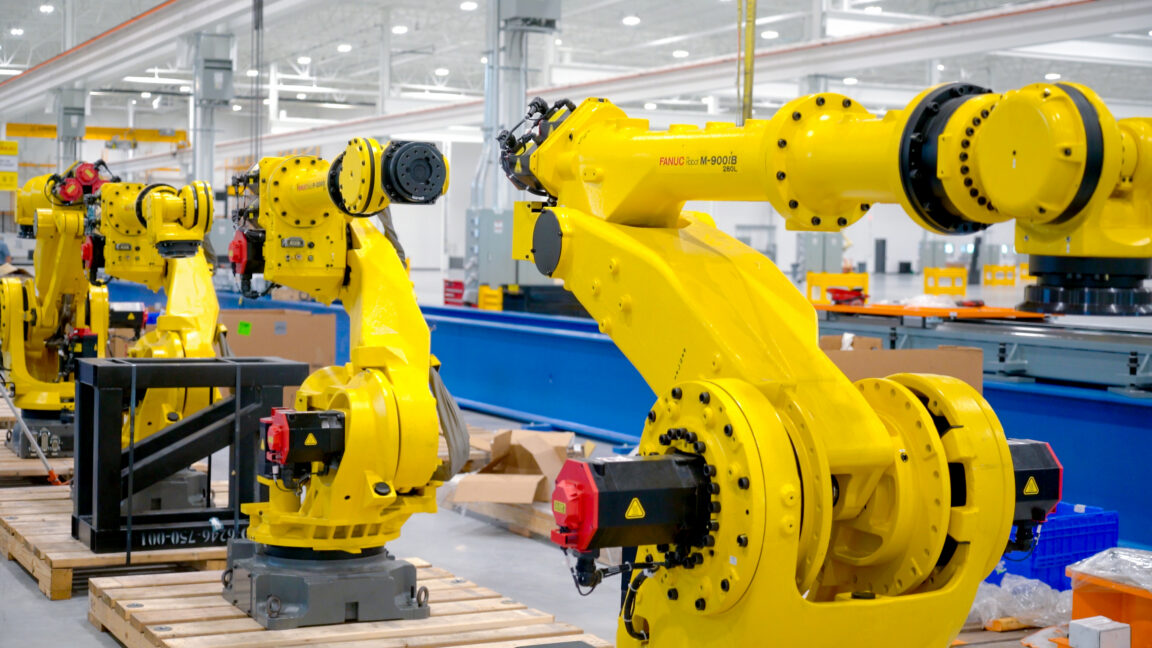
President Donald Trump issued a presidential proclamation on October 28 declaring that imports of foreign-made factory robots constitute a national security threat. The directive orders new negotiations with US trading partners over imports of robotics, industrial machinery and their components, and leaves open the option of new tariffs on such imports down the line. The move sharpens government scrutiny of a category of equipment that underpins manufacturing at some of the largest American industrial companies.
Those companies include Detroit automakers General Motors and Ford, electric vehicle manufacturer Tesla, and aerospace and defense contractors Boeing and Lockheed Martin. All rely heavily on industrial robots in their manufacturing operations, so any change in the cost or availability of imported machines would land directly on their production lines.
The proclamation frames industrial robots and machinery as essential to building US military weapon systems and describes them as a driving force behind every critical infrastructure sector in the US economy. It cites an investigation under Commerce Secretary Howard Lutnick that found US imports of such robots pose risks to the US industrial base and threaten long-term US competitiveness in a sector increasingly vital to national security. The investigation also reportedly identified unique security and safety risks, including what the proclamation describes as significant cybersecurity vulnerabilities that could have severe consequences for the United States.
That cybersecurity framing echoes the reasoning the Federal Communications Commission under Trump used when it banned new models of foreign-made robots in July 2026, covering consumer and service machines such as robotic vacuums, four-legged robot dogs and humanoid robots. That FCC action carved out industrial robot arms and other fixed or stationary robots of the kind common in automotive factories and logistics warehouses. The new proclamation reaches precisely the equipment the earlier measure exempted, so it expands the scope of scrutiny from consumer and mobile robots to the heavy machinery inside plants.
The timeline is explicit: the US and its trading partners are directed to adjust imports of robotics, industrial machinery and components, with new agreements expected within 180 days of the proclamation's date. If no agreements are reached by then, the proclamation warns the president may take additional action, including tariffs, duties, quotas and fees on those imports.
Any such charges would be paid by the US companies bringing the robots in. That would likely raise the cost of US manufacturing at a moment when the country is the second-largest market for industrial robot use; the International Federation of Robotics reported nearly 38,500 new US installations in 2025.
Sourcing is concentrated. Major US automotive and aerospace companies typically buy large robotic arms from the so-called big four makers, FANUC, ABB, Yaskawa and KUKA, which are headquartered in Japan, Switzerland and Germany respectively. No US company currently offers comparable heavy-duty hardware for large industrial robotic arms, though the foreign makers have been expanding their US engineering and assembly facilities. Even Amazon, which has deployed more robots than perhaps any other company, still uses foreign-made machines such as FANUC arms from Japan alongside its own in-house robot production and specialized arms. The proclamation itself acknowledges that US robotics companies do not produce enough industrial robots to meet national security needs and that the country relies on foreign imports for most types of robotics and industrial machinery and for their components.
In practice, the measure is a negotiating lever rather than an immediate restriction. A tariff or quota would raise the landed cost of imported arms without banning them, which for a factory already running foreign equipment mostly means higher prices on replacements and expansions rather than a forced change of vendor. A likely trade-off is that protection for a domestic robotics industry that the proclamation concedes is not yet large enough to supply national security demand would arrive before domestic alternatives exist at heavy-duty scale, pushing costs onto the importers in the interim. The mention of cybersecurity vulnerabilities also hints that future conditions could extend beyond price, for example to software and connectivity requirements on imported machines.
The Intel example is instructive: the article notes that major US companies can still obtain waivers from the Trump administration to keep using foreign-made robots even where a nominal ban applies, suggesting enforcement may be negotiated case by case rather than applied uniformly.
Why it matters: Manufacturers, logistics operators and any product team specifying robotic hardware now face a 180-day window in which sourcing decisions could be reshaped by trade deals or, failing those, by tariffs, quotas and fees. Because no US supplier offers comparable large industrial arms, buyers have limited near-term substitutes, and procurement and finance teams should model higher imported-equipment costs and possible waiver processes. Developers building on robot platforms should also watch whether the cybersecurity rationale hardens into software or connectivity requirements, though that remains an inference rather than a stated policy.
Based on reporting from the original publisher. Visit the source for full context and later updates.
Publisher excerpt
President orders trade talks on foreign-made factory robots, threatens tariffs.