Introducing managed cluster extensions for observability and user management in Amazon SageMaker HyperPod Slurm
Amazon SageMaker HyperPod now supports cluster extensions, software packages that AWS manages and that customers install, configure, update and remove through APIs or the Amazon SageMaker AI console. The launch, described as arriving in November 2026, starts with two extensions: observability, which gathers node, GPU, Elastic Fabric Adapter, Slurm job and Slurm cluster metrics and ships them to Amazon CloudWatch or Amazon Managed Service for Prometheus, and user management, which creates users and groups with matching IDs across nodes, controls SSH and sudo access per node type, registers users with Slurm accounting and can connect a cluster to Active Directory, such as AWS Directory Service for Microsoft Active Directory.
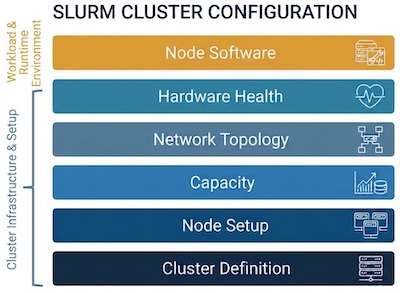
The new mechanism targets the sixth layer of a Slurm cluster's configuration: the software running on nodes. HyperPod already manages five other layers declaratively, introduced earlier in 2026. API-driven Slurm configuration lets administrators define node roles, partitions and Amazon FSx for Lustre and OpenZFS mounts inside CreateCluster and UpdateCluster calls, and attach an external accounting database. AMI-based configuration replaces routine setup scripts with images carrying Slurm, Docker, Enroot, Pyxis and home directories. Continuous provisioning retries capacity requests in the background, works alongside AMI-based configuration, supports minimum capacity through MinInstanceCount, and tracks scaling requests. Automatic topology management keeps the network layout current as nodes scale or are replaced, and on Slurm 25.11 or later supports tree or block topology per partition. Deep health checks stress GPUs and test NCCL connectivity, either on demand or as nodes are provisioned, holding checked nodes in Slurm maintenance reservations so jobs stay off them.
The software layer behaves differently because it keeps changing for the life of the cluster. Lifecycle scripts, the previous primary mechanism, run only at provisioning time, so every change means editing a script and replacing or re-running across nodes. Errors surface only when the script executes on a node, and nothing reports what is actually installed, which lets nodes drift. Extensions aim to fix that by validating settings against the extension version's schema during the API call, so a misspelled setting is rejected before reaching any node, and merging partial updates into stored settings.
Operationally, HyperPod records the desired version and settings, and a node agent applies the package on every node, including nodes added by scale-up or replacement, which receive the same state a few minutes after they start. Nodes install only role-relevant components, for example GPU exporters on GPU nodes and Slurm cluster metrics on the controller. Health probes report back, and node-specific problems such as a port or user ID already in use appear in the Health field of DescribeClusterExtension, grouped by cause with a code, a message and an affected-node count. HyperPod retries internal failures itself; for other failures an operator fixes the cause and calls UpdateClusterExtension with no changes to retry. Status reads Creating or Updating during rollout, Active when every node runs the requested version and settings with no problems, and Degraded when some nodes failed. Each extension gets its own ARN, so separate teams can own observability and user management.
The six cluster extension APIs cover installing, updating, describing, listing and deleting an extension and listing upgradable versions. The console's Extensions tab on a cluster's details page shows status, version and ARN, and hosts installation. The observability extension adds controls for metric store and a button to open a dashboard in Grafana; its Amazon Managed Grafana add-on includes prebuilt Clusters and Jobs dashboards covering cluster health, GPU and GPU memory totals, vCPUs, memory, FSx for Lustre capacity, Slurm node states and job queues, plus drill-down into EFA networking, GPU errors and host metrics. User management shows user and group counts and a Manage users control.
Adoption has prerequisites. Clusters must run the November 2, 2026 HyperPod AMI or later with continuous provisioning enabled. Because extensions run software as root on every node, CreateClusterExtension, UpdateClusterExtension and DeleteClusterExtension should be treated as administrator permissions; AWS recommends against granting them to the cluster execution role, since anyone who can sign in to nodes could use its credentials. The execution role still needs access to CloudWatch or aps:RemoteWrite for observability, and secretsmanager:GetSecretValue plus kms:Decrypt on a customer managed key for Active Directory secrets read by user management, which also needs shared storage such as FSx for Lustre for home directories.
Migration from scripts happens one capability at a time, with scripts and extensions running side by side. The steps are: call UpdateClusterSoftware to move to the November 2026 AMI or later; disable the capability in lifecycle scripts and upload them to S3 so new nodes skip it; during a maintenance window stop and remove the script-installed agents fleet-wide, the only manual cluster-wide step; then call CreateClusterExtension. Leftover conflicts such as an occupied port are named at install and surfaced under Health, and user management preserves existing usernames and IDs. Each component should have a single owner, since managing the same exporter, user or service through both a script and an extension can cause install or runtime conflicts. Custom AMIs and lifecycle scripts remain the recommended path for organization-specific software such as security agents, license servers and pipeline storage layouts; direct SSH access to every node, including the controller, remains available. In practice, this division suggests extensions suit commodity, frequently updated agents while scripts suit bespoke tooling.
Why it matters: Platform teams running shared Slurm clusters for foundation model work get drift detection and schema-checked rollout for monitoring and identity agents without replacing nodes. Developers gain an API surface that fits version-controlled infrastructure pipelines and per-extension ownership. The trade-off is the AMI floor, the manual removal step during migration and the broad root-level IAM permissions, which security-conscious teams will want to scope carefully; this is an inference from the stated permission guidance.
Based on reporting from the original publisher. Visit the source for full context and later updates.
Publisher excerpt
Amazon SageMaker HyperPod now offers managed cluster extensions for observability and user management, bringing declarative, API- and console-driven configuration to the software running on Slurm cluster nodes. This post explains how the extensions work and follows a platform team through a quarter of running a shared Slurm cluster with them.