How Standard Bank Group automates AI risk assessment for generative AI
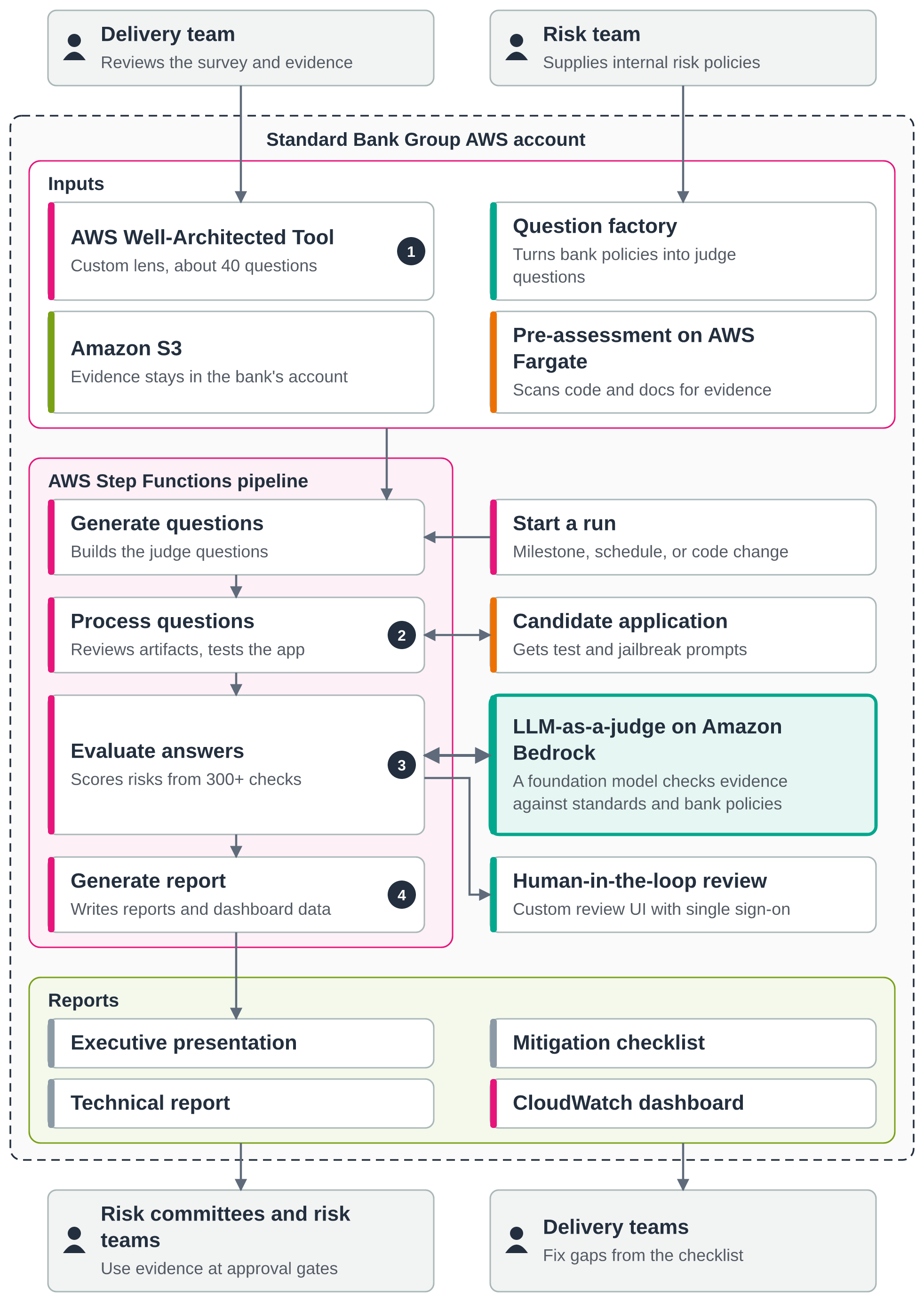
Standard Bank Group, working with AWS Professional Services, has deployed an automated assessment that scores each generative AI use case against international AI standards and the bank's own policies. The system runs entirely inside Standard Bank Group's AWS account and is now live in production, evaluating use cases before they go live. The bank reports that the assessment turned a traditionally manual two-week review into a comprehensive risk report generated in approximately two hours, demonstrated across six assessments, and delivered a 14% improvement in use-case risk scores after remediation. Jörg Fischer, Group Chief Information and AI Officer at Standard Bank Group, framed the work as embedding automated risk management into the bank's AI journey while keeping banking-grade controls; Duncan Macdonald, the bank's CTO, said the assessment helps product teams demonstrate enterprise-grade, best-practice-aligned builds.
The approach deliberately builds on governance the bank already had. Standard Bank Group already ran a model risk practice covering concerns such as explainability and fairness, plus a change risk process that assesses each new use case by risk tier before launch. The goal was to automate evidence gathering and testing, then feed results into those existing approval gates. The risk committee still reviews and approves; what changes is that its decisions now rest on evidence collected the same way for every use case.
The pipeline keeps documents, code and test results in an Amazon S3 bucket inside the bank's own account. The AWS Well-Architected Tool handles intake through a custom lens, AWS Step Functions orchestrates the workflow, and a foundation model on Amazon Bedrock evaluates the evidence using an LLM-as-a-judge technique, where a large language model checks evidence against defined criteria. Access to the model is controlled through AWS Identity and Access Management. According to the post, Amazon Bedrock does not share the bank's prompts or model outputs with model providers and does not use them to train models. Because Bedrock exposes many foundation models through a single API, the team can switch to a newer judge model by changing a configuration setting rather than rebuilding the pipeline.
Each assessment runs in four steps. In the first, a pre-assessment agent on AWS Fargate scans the use case's code repository and documentation and pre-populates the roughly 40-question Well-Architected custom lens, mapping relevant files to each question and attaching evidence links. Delivery teams review and correct those answers and supply evidence the agent could not find. In the second step the pipeline examines four kinds of evidence: system documentation, policy documents, source code and the system prompt, and live calls to the application. For documents and code it checks whether each artifact contains what its mapped control requires — an incident procedure, for instance, must describe how incidents are reported. For live testing it calls the application through its AWS Lambda function or API, using questions from the delivery team plus a built-in set of jailbreak attempts and off-topic prompts the application is expected to decline. It also sends the same prompt repeatedly in original and reworded forms and uses an embedding model on Amazon Bedrock to check that answers stay consistent in meaning, comparing against expected answers where the team supplies them. Every response is stored in Amazon S3 for review.
The third step is the judge evaluation. The Bedrock model is used as-is, with no fine-tuning, and returns yes or no on whether specific evidence appears in artifacts or responses. Every check maps to a control drawn from an international standard or framework for AI management, AI risk or AI security, and the bank added judge questions from its own standards, taking the total past 300. Checks span eight AWS responsible AI dimensions: veracity and robustness, privacy and security, transparency, fairness, safety, controllability, governance, and explainability. Each risk gets a likelihood score based on the share of required evidence the model could not find, plus a severity level the bank's risk team can adjust, producing a rating from Very low to Critical. Each missing piece of evidence maps to a specific mitigation and to the clause of the standard or policy it came from, so a risk officer can trace findings back to source for a regulator.
The design puts guardrails around the judge itself. All model interactions pass through Amazon Bedrock Guardrails, screening for harmful content and attempts to manipulate the model and applying the same safeguards the bank uses across its AWS accounts. Instead of open-ended opinions, the pipeline asks narrow yes-or-no questions worded to match a specific control, and a fixed, inspectable formula converts answers into scores. Each evaluation runs multiple times to measure consistency, inconsistent findings are flagged in the review interface, and every judgment is stored alongside its evidence for reviewers and auditors.
Outputs come in four forms: an executive presentation, a mitigation checklist, a detailed technical report, and an Amazon CloudWatch dashboard tracking scores across use cases over time. Before a gate decision, reviewers confirm findings in a custom review interface with single sign-on, where they can add a use case, review questions, amend answers with a business justification, and rewrite output. The post is explicit that the tool produces evidence against controls but does not certify compliance with any regulation, and that the bank remains responsible for its regulatory determinations.
A question factory extends the checks beyond external standards by generating judge questions from internal documents. Because those checks derive from policy language, a policy change becomes a test change applied automatically to later assessments, with little manual rework. The assessment fits the use case lifecycle in three stages: optional during proof of concept, giving teams an early view of gaps; mandatory at build, with the approval gate drawing on its results as formal evidence; and, once live workloads are connected, scheduled reruns or reruns triggered by code or configuration changes. Teams already trigger assessments themselves through a central workflow running from intake to evaluation.
For a developer or platform team reading this, the architecture is the transferable part: a document-and-code evidence collector, live black-box probing with adversarial prompts, a judge model constrained to binary answers, a deterministic scoring formula, and an audit trail tying each finding to a control clause. This suggests why such systems favor yes-or-no judging — it is cheaper to validate and easier to defend to auditors than a prose verdict. A likely trade-off is rigidity: controls written for documents and prompts may miss emergent behavior in agentic or fine-tuned systems, and repeat runs only measure consistency, not correctness. The bank's ownership of accounts and data, plus the model-agnostic API, also means the judge layer can age without a rewrite.
Why it matters: Any organization shipping generative AI into a regulated environment faces the same bottleneck — each new use case needs an approval decision, and manual review does not scale with how often prompts, models and data change. The reported two-week-to-two-hour compression and 14% post-remediation score improvement, if they hold beyond six assessments, would let risk teams shift from evidence gathering to judgment calls. For product teams, the practical lesson is to encode policy as executable checks early and run them during development rather than at the gate; my inference is that tooling of this kind will increasingly be expected by auditors, not merely welcomed.
Based on reporting from the original publisher. Visit the source for full context and later updates.
Publisher excerpt
Standard Bank Group automated the evidence behind its generative AI approval gates. Working with AWS Professional Services, the bank built an assessment in its own AWS account that scores each use case against international AI standards and its own policies using LLM-as-a-judge on Amazon Bedrock, giving risk committees consistent, traceable evidence.