Researchers use AI to design proteins that cut up other proteins
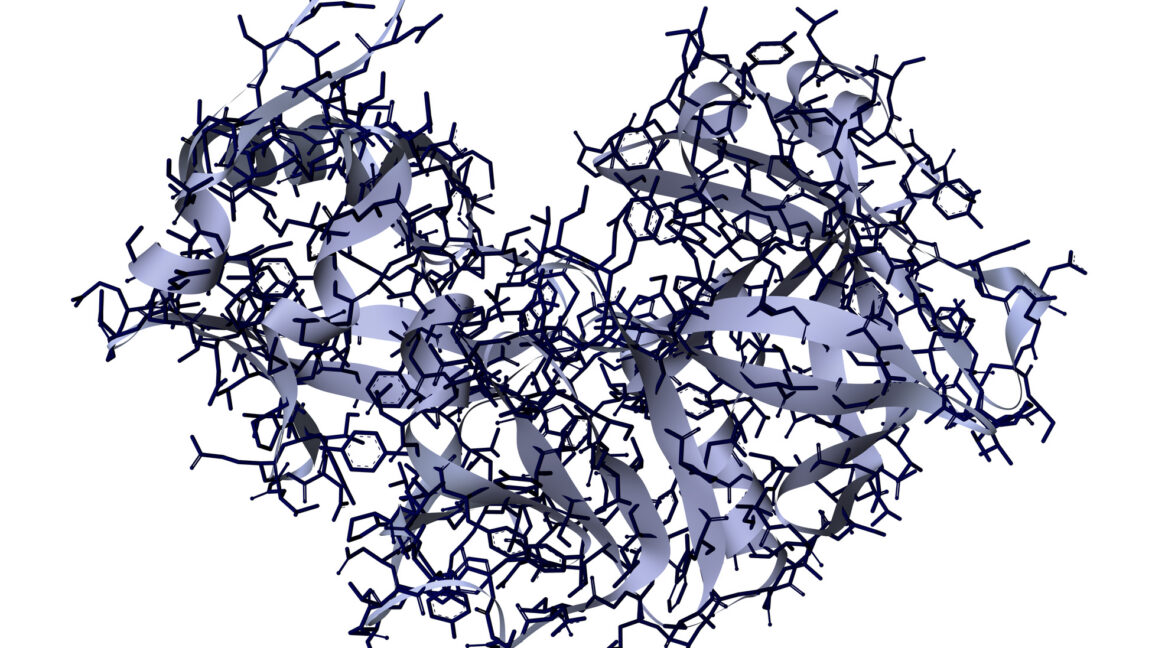
Researchers primarily from David Baker's lab at the University of Washington have used AI-based protein design tools to build proteases—enzymes that cut other proteins—by keeping only the catalytic core of two natural proteases and designing the rest of the protein from scratch. The work is described in two papers published in Nature. The resulting enzymes could be tuned to cleave specific target proteins, and the team demonstrated zinc-based designs that cut proteins associated with neurological diseases, including Alzheimer's and frontotemporal dementia.
Proteins are chains of amino acids joined by peptide bonds. Those bonds are extremely stable on their own—estimated to have a half-life of several hundred years in water. Organisms get around this with proteases, enzymes that catalyze bond breakage and have diversified into countless specialized forms.
The research relied on two catalytic mechanisms. A zinc protease uses a zinc atom's positive charge to coordinate the peptide bond, key enzyme residues, and a water molecule, with the protease partially pulling a proton off the water to activate it. A cysteine protease instead uses a cysteine residue to attack the peptide bond, forming a temporary enzyme-protein intermediate that a water molecule later breaks apart. Both mechanisms require a handful of specific amino acids held in close proximity and the correct orientation, and the rest of the protease helps determine which proteins get cut—some are promiscuous, others highly selective, such as the protease that activates insulin.
Designing a protease was viewed as a hard challenge: peptide bonds are stable enough that no reaction happens without an effective catalyst, and catalysis demands a very precise arrangement of residues. It was not obvious the lab's design tools were up to it.
Both projects started from an existing enzyme with a known structure and known catalytic residues: a zinc protease from a crayfish digestive system and a cysteine protease from yeast. RFdiffusion2 generated a protein backbone under constraints—it had to bring the catalytic residues together and accommodate the intended target sequence near the catalytic center. ProteinMPNN then populated the backbone with amino acids, choosing each for compatibility with the planned fold, with formation of the catalytic site, and, in nearby regions, with binding the target. The team repeated this dozens of times, generating 12 backbones with 69 amino-acid sets for the cysteine protease and 135 designs for the zinc project. AlphaFold3 was used to predict structures, and nothing closely resembling the designs was found in existing databases.
Testing used a single long protein containing the protease, its target sequence and a fluorescent protein, with cleavage freeing the fluorescent tag. For the cysteine protease, 13 designs worked—a 19 percent success rate—though all were considerably less active than the yeast enzyme used as a model. The zinc work was trickier: designs that omitted the participating water molecule had a low success rate, with only 14 of 89 showing weak activity, and modeling showed water often blocked the reaction site. Adding a water molecule in the right place as a design constraint raised the success rate sharply, with 35 of 38 showing some activity, still well below the starting enzyme. One design was more active but not specific about where it cut.
To improve activity, the researchers identified residues near the active site that were not directly involved in catalysis and swapped in every alternative amino acid not predicted to disrupt the structure. The best cysteine variant accelerated cleavage by a factor of 10^9 while staying highly specific for the intended target. A second-generation zinc protease incorporating some random mutations was 30 times more active than the design it was based on and accelerated cleavage by a factor of 10^10.
For the disease demonstration, the team designed zinc proteases targeting proteins associated with Alzheimer's and frontotemporal dementia. Modifying an existing design for a new sequence did not work well, so they restarted the process and found a design that could cut the intended target inside cells. The researchers suggest this points toward possibly influencing the course of some genetic diseases by targeting malformed proteins.
Therapeutic use faces substantial hurdles, which the work itself highlights. Proteins are often difficult to deliver to the site where they are needed and can trigger an immune response. A target inside a cell rather than on the exterior would likely require the target cells to produce the protease, meaning delivery of the gene encoding it.
The results also expose limits of current design tools. As used, the tools successfully met the physical constraints they were given: designs folded so catalytic residues landed in roughly the right place and latched onto specific target sequences. But there is no way to specify a desired catalytic activity directly, so many designs missed the subtle details that make evolved enzymes such good catalysts. In short, the tools are strong on structure and not necessarily on activity—and while structure is essential for function, it is not everything. Introducing random mutation still produced subtle structural adjustments that yielded considerably more active enzymes. The software is only a few years old, and both its developers and users may find ways to incorporate constraints beyond physical location.
Why it matters: This work shows that AI protein design can, in principle, repurpose a catalytic core into a programmable cutter aimed at a chosen protein, with the zinc designs already cleaving disease-linked targets in cells. For developers and product teams in biotech, the practical takeaway is that current tools are reliable for structure and targeting but not for specifying catalytic efficiency; expect the design-then-mutate loop to remain central, and note that delivery, immunogenicity and intracellular targeting remain the gating problems before any therapy is plausible.
Based on reporting from the original publisher. Visit the source for full context and later updates.
Publisher excerpt
AI design tools make proteins that break bonds that are stable for hundreds of years.