Quickly, There’s No Time
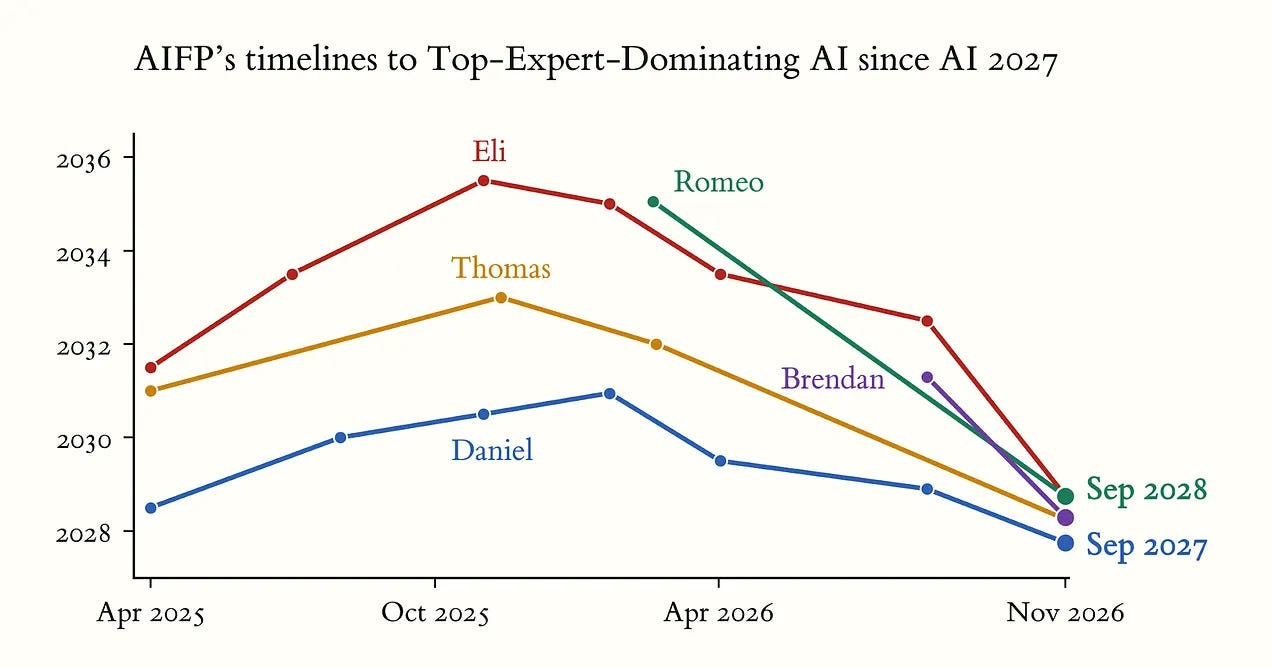
The AI Futures Project, the team behind the AI 2027 scenario, has sharply shortened its timelines in response to a new METR report, and the revision has pulled several prominent forecasters along with it. The group now expects a Superhuman AI Researcher (SAR) to arrive at some point in 2027, assuming no substantial deliberate slowdown, down from a previous median of about 2030. It also puts a 35 to 65 percent chance on a Top-Expert-Dominating AI (TED-AI) — systems that could automate all white-collar work — arriving before 2028. In parallel, Paul Christiano, a member of OpenAI's board, has described a material risk of AI takeover within 6 to 12 months and called in his personal capacity for companies to pause development until security and alignment are in much better shape.
The trigger is METR's estimate that Anthropic is now making AI progress about twice as fast as its historical rate, with a plausible range of 1.3x to 3x. METR further guessed that perhaps roughly 80 percent of the current acceleration is attributable to AI itself. Eli Lifland and Daniel Kokotajlo both frame the consequence the same way: if that estimate holds, the AI-driven acceleration implied is about five months ahead of the original AI 2027 scenario. Kokotajlo said the underlying benchmark trends had been expected to slow, if anything, and instead accelerated in ways he had assigned only around a 4 percent chance of happening.
The researchers' core argument is about where automation bites first. AI research resembles mathematics in that progress can be measured against verifiable proxies, so it is a domain where narrow systems can plausibly match or beat the best humans well before they can do most jobs. The mechanism they describe is recursive: once AI systems do the research that produces better AI systems, progress compounds. One bottleneck they single out is research taste — the judgment about which ideas are worth pursuing. Humans are still needed, on this account, because they generate the better ideas; if that advantage erodes, the rest is expected to follow quickly. The AI Futures Project cautions that the output of such systems could become increasingly misaligned across successive development cycles.
A recurring ambiguity in these discussions is what, precisely, any given date refers to. SAR, TED-AI, a broader superintelligence, a point of no return where human decisions can no longer change the outcome, and outright takeover are distinct milestones whose timelines differ. The author's own reading, offered here as interpretation rather than reported fact, is that recursive self-improvement is better treated as a period than an instant — there is no single moment when it switches on, but there is a useful threshold at which progress clearly feeds on itself and humans are functionally out of the loop. Distinguishing these targets matters for anyone building plans on top of them.
Other forecasters moved too. Dwarkesh Patel now gives a median year of 2028 for human-level automated AI researchers, with a 25 percent chance it arrives after 2032. He describes his view shifting substantially over roughly three months, from expecting at least the better part of a decade to thinking AIs as good as the best humans at AI research are only a couple of years away, and possibly a couple of months. His argument runs through domains with verifiable rewards: current systems are jagged, worse than humans in most areas but often competitive in math and similar fields. He suggests a narrow system concentrating a jump as large as the one from GPT-3 to GPT-6 into a single year, starting from a stronger base, could produce AIs that rapidly surpass the best humans in every field. He puts roughly a 50 percent chance on a "spark" instead — a large jump that stalls rather than compounding indefinitely.
Christiano's numbers represent a large revision from September, when he cited a 4 percent chance of loss of control within one year and 15 percent within three years. He is on OpenAI's safety and security committee, co-invented RLHF at OpenAI between 2017 and 2021, and headed safety at the US government's AI agency from 2024 to 2026. He warns that even with realistic policy responses the risk stays exceptionally high, and that a build-it-as-fast-and-easily-as-possible approach implies more like a coin flip over three years. His recommended response is an industry-wide pause followed by an international agreement.
The author's own position is more measured than the most aggressive updates. He calls the direction correct and argues a substantial chance of superintelligence in 2027 should be taken seriously, while putting the probability of an SAR that year under 50 percent — not far under. He says he would be surprised but not shocked if, absent any slowdown, something close to an SAR still had not appeared by the end of 2028. He also warns against treating 2027 as a baseline rather than a possibility, noting that predicting an exponential is noisy: small changes in acceleration rates translate into large differences in timing, so plans should survive both faster and slower outcomes. Collective action by labs or governments to pace or pause the frontier would push dates out.
On the question of what could stop the trend, the author is skeptical of arguments that AIs will require some missing ingredient and therefore stall. Moore's Law and similar trends persisted, in his account, because of continual innovation and step changes rather than because of extrapolation alone. The author also argues that optimizing hard for a single measurable number is a poor route to alignment, calling AI research largely verifiable "to about the worst possible extent" — useful for speed, corrosive at the limit.
Why it matters: Forecasters whose models shape funding, safety staffing and policy have moved their central estimates forward by years within a single news cycle. For developers and product teams, this suggests planning assumptions about how much time exists for alignment, evaluation and governance work may need revisiting, though the probability spreads — an SAR in 2027 with substantial but sub-50 percent odds, TED-AI with a 35 to 65 percent chance before 2028 — argue for robustness rather than a single date. A likely trade-off is that teams building on these estimates will be pushed toward security and oversight work earlier, at some cost to velocity. Whether the acceleration holds or stalls is, by the sources' own admission, uncertain.
Based on reporting from the original publisher. Visit the source for full context and later updates.
Publisher excerpt
In response to the METR report, many people have been reevaluating their timelines.