Autonomous treasury agents: How Trovata built an AI-native solution on Amazon Bedrock and AgentCore
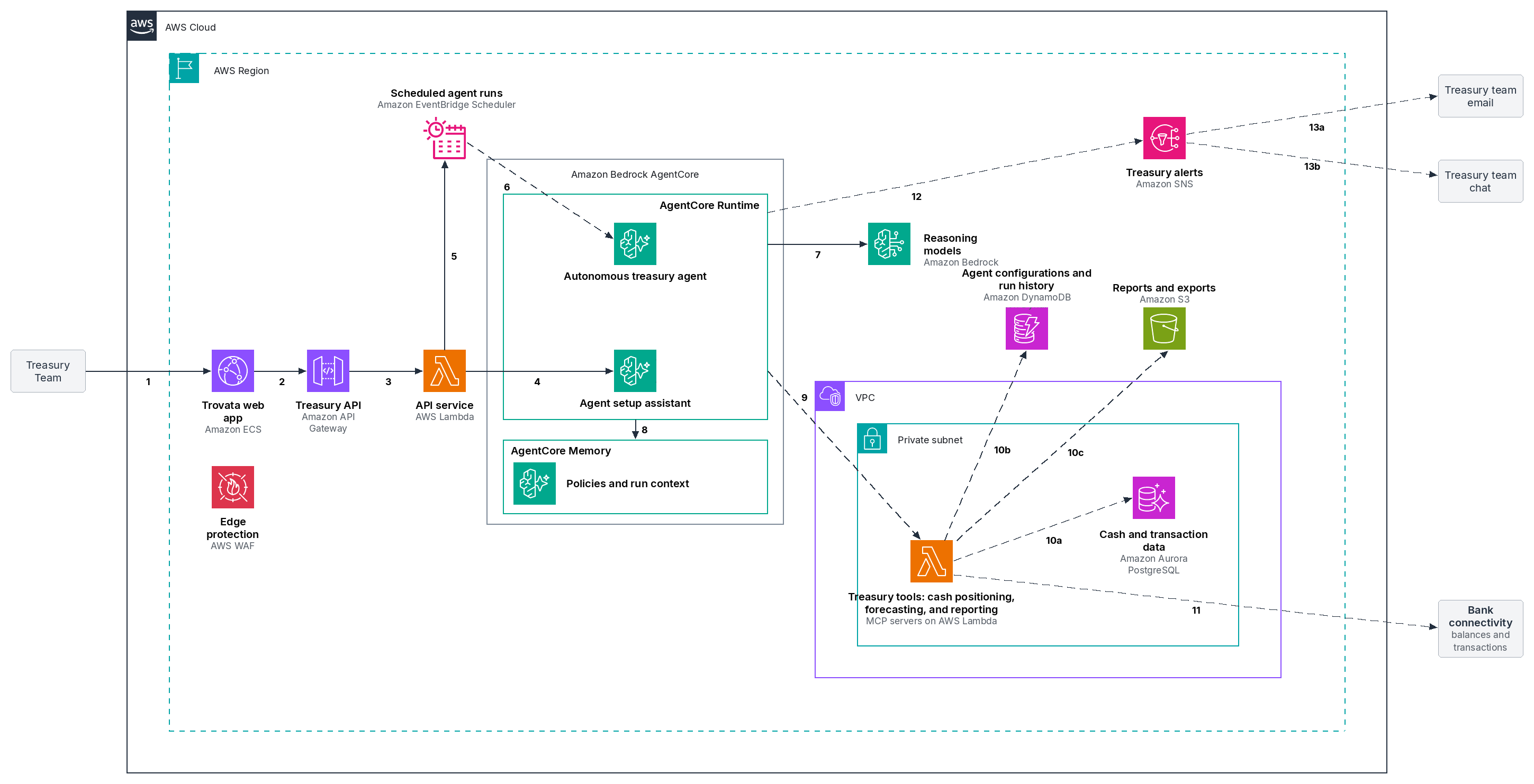
Trovata, a cash and liquidity management platform with direct connections to more than 10,000 banks, has extended its AI offering from generated insights to autonomous treasury agents running on Amazon Bedrock and Amazon Bedrock AgentCore. AWS published the architecture account on its Machine Learning Blog, co-authored by Trovata CTO Joseph Drambarean and AWS startup solutions architect Kushal Mangtani. Trovata first shipped generative AI for treasury in 2023; the latest update moves the product toward persistent agentic workflows, which the company says are now live in production.
The problem the agents target is familiar to anyone who has worked in corporate finance. Treasury data sits across many separate bank portals, so aggregation and reconciliation happen by hand. Reporting lives in spreadsheets, and older treasury management systems (TMS) are not cloud-native, which makes real-time cash visibility hard. Trovata frames this as a three-pressure problem: fragmented banking data, skilled staff spending hours or days on manual reporting, and legacy TMS software that cannot scale.
The reported results are specific. Trovata cites more than $1M in annualized cost savings, over 5 hours per day saved per accounting team, a 77 percent reduction in annual TMS costs, and treasury reporting compressed from hours or days to under a minute across hundreds of accounts. It also reports connectivity to 100+ enterprise customers and 2,000+ business customers on a single system.
The stack splits into three layers. Amazon Bedrock supplies LLM inference for natural language understanding and generation. Amazon Bedrock AgentCore handles agent orchestration, multi-step workflows and RBAC security. Serverless AWS infrastructure provides the real-time execution that keeps reporting under a minute. In practice, AgentCore is AWS's runtime layer for agents: it packages the orchestration, identity and isolation concerns that teams would otherwise assemble themselves, which is the part of the announcement most relevant to other software vendors building vertical agents.
Four user-facing components sit on top. Trovata AI Chat lets users query multi-bank data in plain English, for example asking for yesterday's net cash position across all accounts. AI Insights handles automated anomaly detection, variance explanation and trend analysis. AI Agents run on schedules, triggers or rules to monitor activity, explain variance, detect anomalies and deliver updates without human intervention. An Agent Builder-Configurator console lets teams define and scope agents. Enterprise RBAC keeps agents inside the same permission boundaries as human users.
The access design deserves attention. Agents retrieve data only through Trovata's own verified API layer, never touching databases directly, and run in an isolated AgentCore environment. AI queries and agent actions are logged for compliance review, and the whole capability can be delivered inside bank-branded applications, so banks can offer AI-powered treasury tools without building the AI themselves. For financial services, that audit trail and permission model are the difference between a demo and something a treasury department can sign off on.
Stated use cases cover cash forecasting with scenario modeling across multiple banks, natural language querying, real-time anomaly detection for unusual transactions or balance changes that may signal errors, fraud or operational issues, AI-drafted reconciliation summaries across hundreds of accounts, and ongoing agentic monitoring. Trovata's AI Agents Playbook publishes ten agent patterns taken from real customer deployments, and the company estimates most treasury teams have 5 to 15 workflows ready for agents today.
My reading is that the bank-branded model is the commercially interesting piece. Selling agents to a bank, which then resells them under its own name to corporate clients, turns Trovata into an infrastructure supplier and gives the bank a way to compete without an in-house AI program. That is a common pattern for vertical SaaS and mirrors how payments and fraud tooling were distributed. The trade-off is dependency: banks gain speed but cede control of the model layer, and their clients end up trusting two vendors' governance rather than one.
The architecture also leaves open questions the announcement does not settle. How variance explanations are validated, how much an agent can do before a human approves, and how model changes are rolled out to bank-branded tenants are all unresolved from the outside. The agents operate within RBAC boundaries, which limits blast radius but does not by itself guarantee correct outputs. Financial agents that explain variance still need a reviewer, and the under-a-minute reporting figure measures latency, not accuracy.
Trovata says it plans to expand its agent patterns, deepen ERP integrations and extend global bank connectivity. It is also listed on AWS Marketplace.
Why it matters: Treasury and finance teams get a concrete template for replacing spreadsheet reporting with governed autonomous workflows, and the reported savings figures give buyers something to benchmark against. For developers and product teams building vertical SaaS, Trovata's split of duties, with Bedrock for inference, AgentCore for orchestration and RBAC, the vendor's verified API for data access and audit logging throughout, is a reusable pattern for enterprise agents in regulated industries. The caution is inference on my part: as agents move from reporting to acting, permission boundaries and human review will matter more than the language model itself.
Based on reporting from the original publisher. Visit the source for full context and later updates.
Publisher excerpt
Learn how Trovata built autonomous treasury agents on Amazon Bedrock and Amazon Bedrock AgentCore, using an RBAC-secured architecture for bank-branded AI deployment and agentic workflows that move corporate treasury from manual operations to real-time decision-making at enterprise scale.