Meta’s Muse Spark Open now available in Amazon SageMaker JumpStart
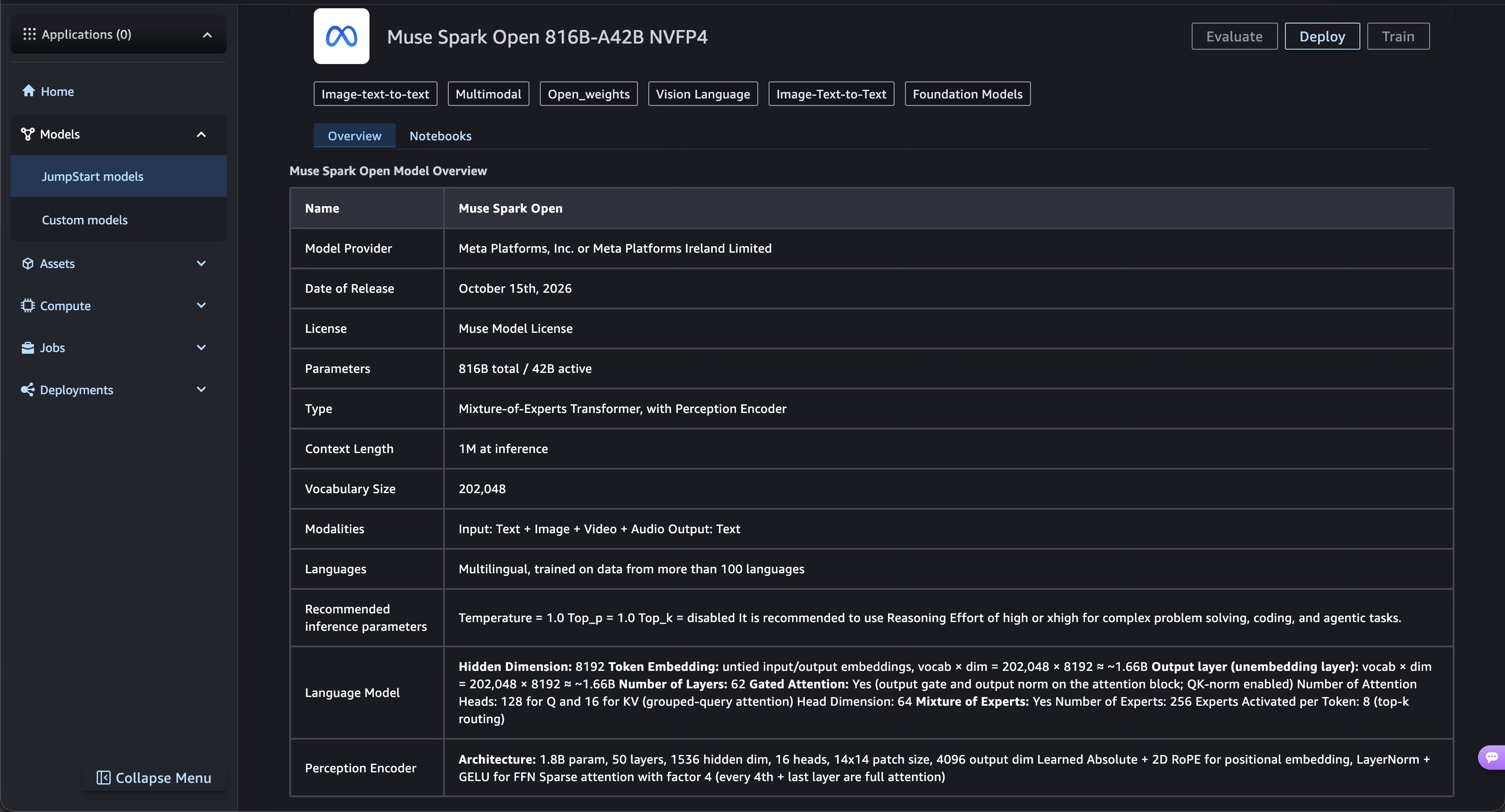
Meta's Muse Spark Open is now listed in Amazon SageMaker JumpStart, the model hub inside Amazon SageMaker AI, AWS said in a post on its Machine Learning Blog. The open-weight, coding-optimized model can be deployed to a real-time SageMaker AI endpoint in a customer's own AWS account without the customer managing serving infrastructure. At launch it is offered in two variants: a BF16 build named Muse-Spark-Open-816B-A42B and an NVFP4 quantized build named Muse-Spark-Open-816B-A42B-NVFP4.
The model uses a mixture-of-experts architecture with 816 billion total parameters, of which 42 billion are active per token. That split is the reason a network this large is practical to serve: capacity lives in the full parameter set, while the compute spent on any single token is closer to that of a much smaller dense model. Muse Spark Open is a reasoning model that accepts text, images, documents, audio and audio-video as input and returns text. Meta describes it as trained for agentic coding work, with emphasis on first-attempt accuracy, tool calling and understanding large codebases. Weights are released under the Muse Model License, which includes the Muse Spark Usage Policy.
The headline specification is a context window of 1 million tokens. Meta trained the model on patterns from real repositories, including code generation, debugging and multi-file refactors, and says the window is wide enough to hold an entire project together with its dependencies, legacy code and thousands of files, so a task does not have to be split into smaller pieces to fit. Meta also positions the model as agentic by design: it plans, acts, observes the result and corrects itself over long horizons rather than issuing isolated tool calls. Because it is a reasoning model, the SageMaker AI endpoint returns the model's reasoning alongside the final answer, so a developer can follow what an agent is doing and why. Meta trained it to browse the web, coordinate subagents for parallelizable work, and operate computers across desktop, mobile and browser environments. Those are model capabilities; on SageMaker AI, the surrounding application or agent framework supplies the tools, browser and computer-use environment the model calls. Beyond code, Meta reports the model reasons across images, documents, audio and video.
Serving is shaped by two properties. Sparse activation keeps per-token compute low, but an endpoint still needs enough GPU memory to hold all 816 billion parameters, so instance selection is largely a memory decision. Separately, the NVFP4 variant stores weights in NVIDIA's 4-bit floating point format, which needs roughly a quarter of the memory of BF16 weights. On SageMaker AI that decides the supported instance: NVFP4 maps to ml.p5e.48xlarge and BF16 to ml.p6-b300.48xlarge. AWS recommends treating NVFP4 as the first variant to try when sizing for cost, while validating quality against your own workloads. My read is that this is the standard quantization trade-off: a 4-bit format buys a smaller, cheaper instance, and the open question for any team is whether the quality delta is acceptable on their specific repository and task mix. Both hosting instances are multi-GPU, and an endpoint bills for as long as it runs, whether or not it serves traffic.
Deployment paths are SageMaker Studio and the SageMaker Python SDK. In Studio, you open JumpStart, search for Muse Spark Open, pick the BF16 or NVFP4 model detail card and choose Deploy. Because the model is gated, Studio presents the end-user license agreement, which must be accepted before continuing; you then set an endpoint name, choose the instance type supported for that variant, set the initial instance count to 1, and can optionally attach a VPC and an AWS KMS key or enable network isolation. AWS says provisioning typically takes 15 to 20 minutes while the instance is allocated and weights are loaded, after which the endpoint status becomes InService. Prerequisites include an AWS account with permission to create SageMaker AI models and endpoints, an IAM execution role (the walkthrough uses AmazonSageMakerFullAccess, with a note to scope permissions down for production), and a service quota for the chosen endpoint instance type.
The SDK path requires Python 3.10 or later and SageMaker Python SDK v3. JumpStart identifies the variants by model ID: meta-vlm-muse-spark-open-816b-a42b for BF16 and meta-vlm-muse-spark-open-816b-a42b-nvfp4 for NVFP4. Deployment goes through JumpStartConfig, ModelBuilder and a Compute object naming the instance type; because the model is gated, the config must set accept_eula=True, and a model_version field pins a specific version. Running in a SageMaker Studio notebook uses the domain's execution role, while any other credentialed Python environment needs the role passed explicitly via role_arn.
Inference uses an OpenAI-compatible chat payload with a messages list and returns a chat completion. The answer lands in message.content, the model's reasoning in message.reasoning_content, and usage.reasoning_tokens reports how many tokens the reasoning consumed. AWS cautions that because this is a reasoning model, max_tokens must leave room for both the reasoning trace and the final answer. Streaming is supported by adding stream: true and calling invoke_with_response_stream instead of invoke. Cleanup means deleting the model, endpoint and endpoint configuration via the SDK, or removing the endpoint from the Inference endpoints list in the SageMaker AI console, which stops charges.
Availability at launch is limited to US East (N. Virginia) and US East (Ohio); other Regions can be checked from JumpStart. The endpoint runs in the customer's account, so source code and prompts are processed on infrastructure the customer configures and controls, with options for VPC attachment, KMS encryption of the storage volume, container network isolation, chosen instance type and scaling limits, and a pinned model version that only changes on redeploy. The post suggests three broad use cases: coding assistants over private repositories, long-running coding agents that plan a change, edit across files, run tests in a customer-owned sandbox and correct course, and multimodal engineering workflows that turn screenshots, design documents or a recorded bug report with audio and video into a reproduction plan or draft fix.
Why it matters: teams that want a frontier-scale open-weight coding model inside their own AWS account can now get one through a managed deployment path, with the NVFP4 build lowering the instance class needed versus BF16. The practical work is evaluation rather than setup: benchmark both variants on your own repositories before committing to a production instance, budget for long-lived multi-GPU endpoints, and check that your target Region is among the two where the model is live at launch. Because the weights are open and the endpoint is customer-controlled, prompts and source code stay on infrastructure your organization configures.
Based on reporting from the original publisher. Visit the source for full context and later updates.
Publisher excerpt
Muse Spark Open, Meta's coding-optimized open-weight model, is now available in Amazon SageMaker JumpStart. Deploy it to a SageMaker AI endpoint in your own AWS account using SageMaker Studio or the SageMaker Python SDK, and run your first inference request.