QCon AI New York 2026 Program Committee Picks: Agent Identity, Context Costs, and Open-Source Infere
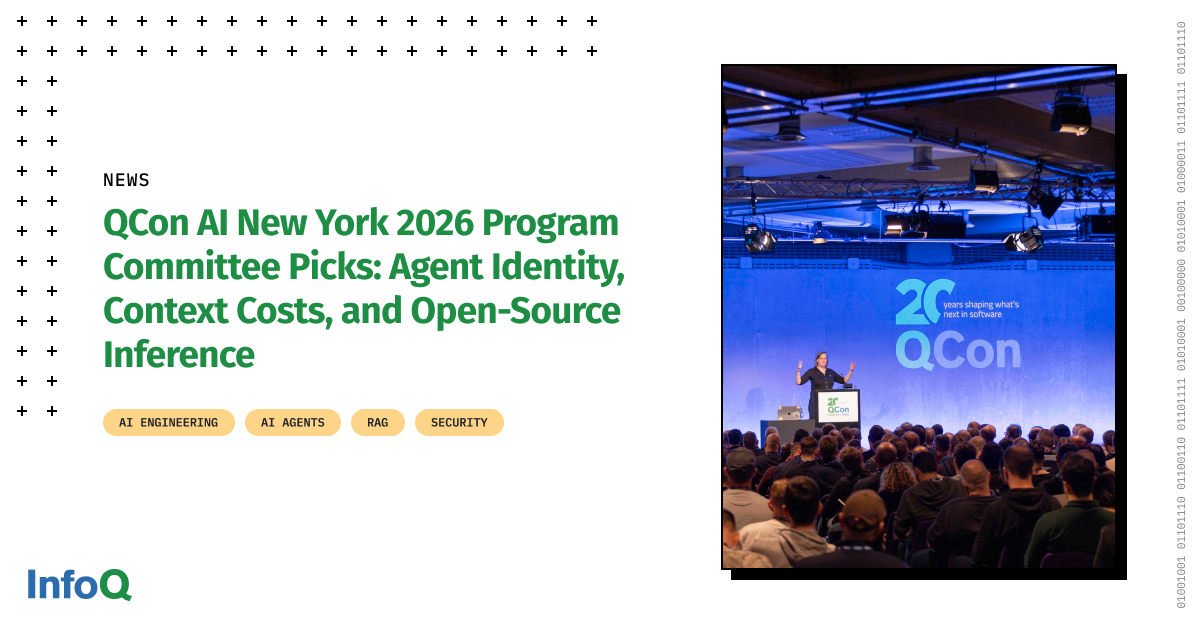
QCon AI New York 2026 will be held December 15–16 at the Westin Jersey City Newport, a single PATH stop from Lower Manhattan, and the conference's program committee has published six sessions its members are looking forward to. Conference chair Hien Luu, an AI/ML leader, advisor, speaker and author, shared the picks with committee members Wes Reisz, Technical Principal at Thoughtworks and creator of The InfoQ Podcast, and Faye Zhang, Staff Engineer at Google working on autonomous agents for Gemini Enterprise. The two-day event is aimed at senior software engineers, architects and engineering leaders working on production AI.
Reisz's first selection is a keynote, When Software Becomes a User: Identity and Authorization for Agents in Production, by Nancy Wang, CTO at 1Password. The premise is that conventional identity and authorization models degrade as agents take on more autonomous work. Wang's talk examines delegated authority, credential management and how agent interactions are secured, including how authority is delegated across subagent chains and how an agent can reach the credentials it needs without exposing secrets in its context. Reisz said these are foundational capabilities for agentic delivery. For developers, this maps onto a familiar but unresolved problem: an agent acting for a user needs a scoped, revocable grant rather than a copy of the user's own long-lived token, and multi-step agent pipelines make the chain of who authorized what harder to audit.
His second pick is Make Each Token Count: Compression, Caching, and Retrieval for Production LLM Context, from Tejas Chopra, CEO and co-founder of Headroom Labs. Chopra will cover learned prompt compression, prefix-cache-aware context alignment, and combined compress-cache-retrieve pipelines. The session also addresses failure modes that affect tool calling and agent trajectories. Reisz framed token costs and latency as real production constraints and predicted token compression will become a standard capability in agentic systems. The trade-off worth watching is fidelity: compressing context saves tokens and latency, but lossy compression near a tool-call boundary can change what an agent decides to do, which is presumably why failure modes get explicit treatment.
Luu selected The Future of the Engineering Org by Peter Bell, founder and CTO of Gather.dev. Bell draws on conversations with engineering leaders at organizations including Anthropic, OpenAI, Shopify and Coinbase to examine how engineering structures and practices shift around coding agents. The session covers team size and rituals, hiring and how engineers are assessed, changes in engineering leadership, and what happens to junior developers. This is a people-and-process session rather than a tooling one, but the questions it raises are practical for anyone deciding how to staff around coding agents.
Luu's second choice is Open Source Agentic Inference: Unlocking the Harness with vLLM, by Francisco Javier Arceo, Forward Deployed Engineer at Baseten and a maintainer of the vLLM Agentic API project. Arceo follows a coding task end to end, from the harness through model generation, tool execution and continuation, using Agentic API, vLLM and llm-d. The session looks at where tools run, who owns context, and how serving infrastructure supports these workloads. It also examines how repeated inference and context growth drive cost, and argues that cost per completed task matters more than token price in isolation. That framing is a useful corrective: an agent that loops, retries or re-sends a growing context can be far more expensive per finished job than its per-token rate suggests, so serving-layer choices feed directly into unit economics.
Zhang described her two picks as sitting at the intersection of frontier research and production engineering. The first is Navigating Agentic Standards: What to Build On Now and What to Watch, by Kevin Kelley, Technical Lead for Standards at Anthropic. The session organizes the standards landscape around questions of which agent is acting, on whose behalf, and how it reaches tools and other agents, and it separates what has shipped from work still open. Zhang highlighted how standards such as MCP, A2A and OAuth can establish interoperable agent identity, delegated authorization and trust boundaries without introducing new security vulnerabilities. For teams choosing a stack now, that shipped-versus-pending distinction is the practical part.
Her second selection is a keynote, Audio Processing with Large Language Models, by Tara Sainath, Distinguished Research Scientist at Google DeepMind and lead of the Gemini audio area. Zhang pointed to the questions LLMs raise for speech and audio modeling: unified multilingual representations, end-to-end versus cascaded architectures, and the latency-quality trade-offs needed for real-time conversational intelligence. Sainath will discuss research and product developments at Google across speech recognition, generation, translation and dialogue. The cascaded-versus-end-to-end contrast is a long-running one in speech engineering: a pipeline of separate recognition, language and synthesis models is easier to debug stage by stage, while a unified model can preserve paralinguistic and multilingual cues but is harder to inspect.
Pricing: a two-day pass is $1,705 at the early-bird rate until November 10, rising to $1,790 afterward. The conference site also offers a program overview and a "convince your manager" approval email template for teams drawing on remaining 2026 learning and development budgets.
Why it matters: the committee's picks sketch the open problems teams hit when agents move into production — delegated identity, context and inference cost, and which agent standards to build on — rather than model benchmarks. Developers and platform teams attending, or tracking the sessions, get a concentrated view of where practitioner attention is heading in December, though the value depends on how concrete the production detail is. My inference is that the cost-per-completed-task framing and the standards "build now versus watch" split are the most directly reusable ideas for teams making architecture decisions in the next quarter.
Based on reporting from the original publisher. Visit the source for full context and later updates.
Publisher excerpt
Who authorizes an agent’s actions, and how should teams manage growing context costs? The QCon AI New York 2026 program committee shares six session picks that tackle these questions, alongside open-source inference, agent standards, and audio AI. By Artenisa Chatziou