Evaluating multi-agent systems for explainability and helpfulness with Amazon Bedrock AgentCore
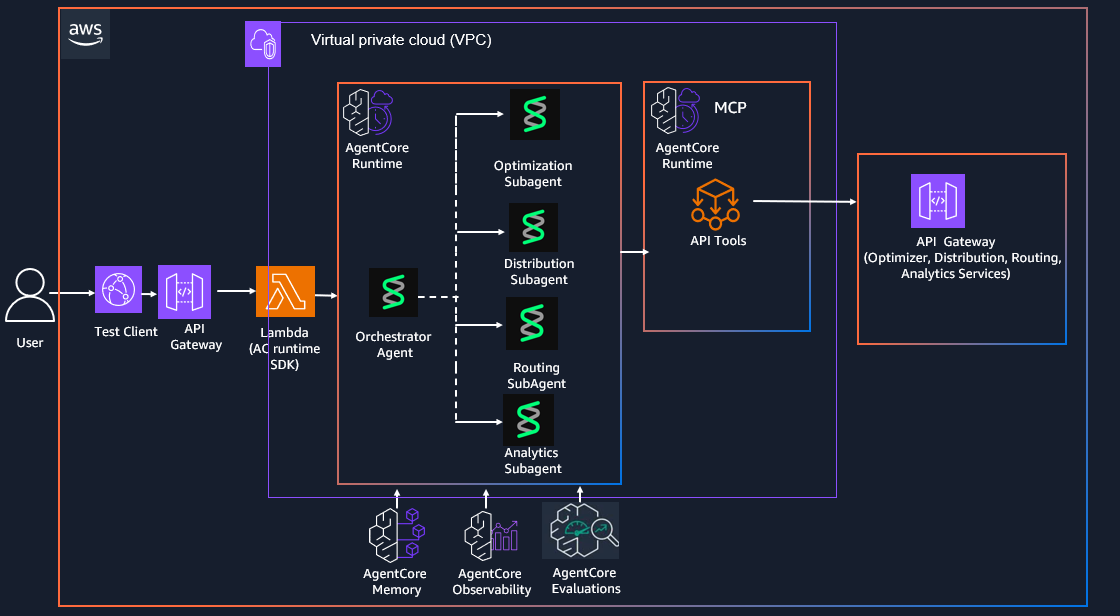
AWS published a walkthrough for building and evaluating a multi-agent supply chain decisioning system using Strands Agents SDK, Amazon Bedrock AgentCore MCP Server, and Amazon Bedrock AgentCore Evaluations. Amazon Bedrock AgentCore is described as a platform to build, connect, and optimize agents at scale with any framework or model, and AgentCore Evaluations as a fully managed capability for assessing agent performance across development and production.
The reference solution models a fictitious multinational retailer, AnyCompany Retail, that experiences inventory imbalances and must balance delivery speed, carrier capacity, and cost. The system uses an orchestrator agent plus four specialized sub-agents: optimization, distribution, routing, and analytics. Each runs on AgentCore runtime with AgentCore memory and AgentCore Observability enabled. The optimization agent calls MCP tools backed by mock Amazon API Gateway REST interfaces; the distribution agent calls recommendation APIs; the routing agent calls logistics APIs; and the analytics agent answers diagnostics questions. Foundation models on Amazon Bedrock drive the agent loop.
The evaluation framework has three layers. Built-in evaluators cover Helpfulness plus an agent-specific check such as Tool Selection Accuracy for the orchestrator, Response Relevance for optimization and distribution, Instruction Following for routing, and Faithfulness for analytics. Custom evaluators encode domain rules including constraint satisfaction, data grounding, route feasibility, SQL correctness, and plan coherence. Six cross-cutting explainability evaluators assess decision rationale quality, evidence attribution, constraint reasoning, trade-off explanation, tool-use explainability, and assumption disclosure. A recommendation can pass custom evaluators but fail explainability, the post states, letting teams distinguish reasoning articulation from decision logic.
AgentCore Evaluations supports on-demand mode for development benchmarking, regression testing, and CI/CD gates, and online mode for continuous production monitoring and alerts. The post says the same custom evaluators can be repurposed via an OnlineEvaluationConfig object referencing evaluator ARNs and specifying a sampling rate, for example 1–10% of production traces. Amazon Bedrock Guardrails provides content filtering, denied topic detection, and grounding validation that complement the evaluation framework; evaluations assess quality after execution while Guardrails enforce safety constraints during execution.
The solution is available from a GitHub repo with single-step Terraform deployment. Prerequisites include AWS CLI, AWS SAM CLI v1.100.0+, Docker v20.x+, Node.js v18.x+, and Python v3.11+. A test client runs 20 sample queries across four sessions; evaluations run asynchronously and save results as markdown files in S3. Cleanup uses terraform destroy.
Source: AWS Machine Learning Blog.
Based on reporting from the original publisher. Visit the source for full context and later updates.
Publisher excerpt
Multi-agent systems need deeper guarantees than fluent responses: they must select the right tools, respect constraints, and explain their decisions. Learn how to build a Strands-based multi-agent supply chain decisioning system and evaluate it with Amazon Bedrock AgentCore Evaluations using built-in, custom, and explainability evaluators.