NVIDIA Cloud Partners Scale Across Europe — Sovereign, Open and Built for Safe AI Agents
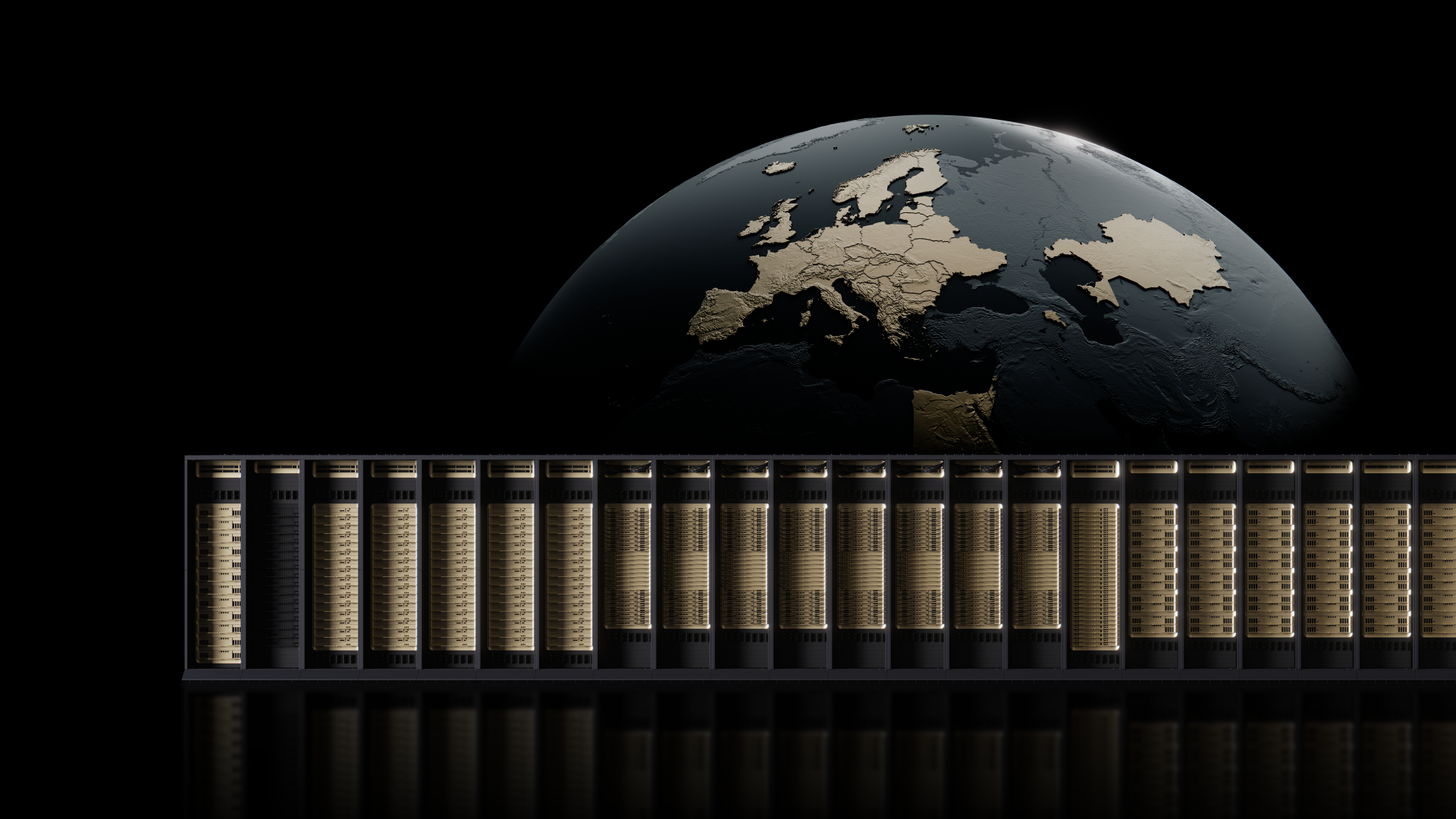
NVIDIA used its European partner announcements to describe a two-part push: cloud capacity in Europe, the Nordics, Africa and Central Asia built around its DSX AI Factory stack, and a new OpenShell Reference Architecture for constraining AI agents, announced at GTC Berlin. The participating providers span a wide group, among them Nscale, Crusoe, Nebius, Mistral, Baseten, Fireworks, Verda, Aleria, Cassava Technologies, Firebird, G42, Radiant, SWI Compute and Vultr.
On the infrastructure side, the theme NVIDIA frames as sovereign computing is siting compute near the data, talent and industry that will use it. Regional clouds combine Vera Rubin, BlueField and Spectrum-X Ethernet networking. Nscale is the most numerically specific: it says that using the DSX Platform to coordinate power allocation with workload requirements, DSX MaxLPS enabled 37% more GPUs and nearly 50% higher aggregate inference throughput inside the same provisioned power budget.
That result is worth reading carefully. As AI factories scale, power rather than floor space becomes the binding constraint, so squeezing more accelerators into an existing power envelope is effectively a capacity multiplier without new grid connections. The figures are Nscale's own tests on GB300 NVL72 systems for DSX MaxLPS specifically; they describe aggregate inference throughput, not per-GPU performance, which fits the idea that the software is rebalancing allocation rather than making individual chips faster.
Nscale also plans to deploy Vera Rubin for frontier-model training and production workloads, expanding across five European markets. Crusoe is developing Spark, liquid-cooled modular AI factories designed for Vera Rubin, to place capacity closer to users for low-latency inference; its EMEA customers include Base44, Gradium, LTX and Wonderful.
Nebius is pursuing inference and physical AI in parallel. For production inference it has adopted NVIDIA Groq 3 LPX, integrated with Vera Rubin NVL72 over Spectrum-X Ethernet on Nebius Token Factory, aimed at faster token generation for latency-sensitive applications and agents through managed serverless and dedicated endpoints and familiar APIs. On the robotics side it offers a Physical AI Workbench, used by Rhoda AI, RoboForce and Sereact, and has put three NVIDIA retail agent blueprints into early access covering inventory, store operations and fine-tuning. Nebius is also expanding its Physical AI Living Lab and serving as a computer supplier in Germany for SPRIND's Next Frontier Challenge.
The clearest example of fine-tuning an open model for a narrow job comes from Baseten and CodeRabbit. A specialized code-review routing model built on Nemotron 3.5 Lightning, trained with supervised fine-tuning and reinforcement learning, raised routing agreement from 75.8% to 80.7% while cutting estimated inference costs by 50% on the evaluated workload. This suggests small task-specific models can beat general ones on cost and consistency for routing-style decisions, though the numbers cover one workload and are estimates.
Fireworks and Era4 are partnering to bring open models to enterprises in the U.K. and Europe, pairing Fireworks' training and inference platform with direct liquid-cooled capacity on Blackwell Ultra GPUs at Era4's Chesterfield site, aimed at financial services, insurance and life sciences. Mistral is expanding its NVIDIA accelerated computing footprint, with Vera Rubin infrastructure planned for delivery in 2027. It trained Mistral Large 4, its latest frontier multimodal model spanning coding, agentic workflows and multimodal understanding, on 3,800 Grace Blackwell GPUs in Mistral-operated European data centers. Verda plans Vera Rubin deployment and already runs Nemotron and Cosmos in production, using the open source Dynamo framework for inference optimization.
The safety piece addresses a problem any team wiring a model to tools and business systems hits: an agent needs enough access to be useful and not more. The OpenShell Reference Architecture, built on OpenShell secure runtime software, splits enforcement across three layers. Vera Rubin NVL72 handles model inference; Vera CPUs run OpenShell for agent harnesses and tool use; BlueField-4 DPUs run NVIDIA Sentry for enforcement in silicon. In practice that split means policy is applied below the operating system, where a misbehaving agent process cannot simply route around it.
A long list of providers is backing the architecture, including Aleria, Baseten, Cassava, CoreWeave, Crusoe, DigitalOcean, Firebird, Fireworks, Firmus, G42, GMI Cloud, IREN, Lambda, Lightning AI, Nebius, Nscale, Radiant, Verda and Vultr. A likely trade-off is operational complexity: running agent harnesses on CPUs and inference on GPUs, with a separate DPU enforcement plane, is more moving parts than a single-node setup, and the benefits depend on partners actually wiring it into their managed offerings.
Why it matters: developers building in Europe now have more regional options for training and inference on open models, with Vera Rubin coming online across several providers and 2027 delivery planned at Mistral. Teams deploying agents should watch OpenShell's adoption, since a shared enforcement model could reduce how much access control they must build themselves. For anyone optimizing cost per token under fixed power, the DSX MaxLPS claims are worth benchmarking on their own workloads.
Based on reporting from the original publisher. Visit the source for full context and later updates.
Publisher excerpt
Demand from AI-natives is pulling the European AI cloud ecosystem forward faster than ever. Developers need compute closer to their data, open models they can customize and serve at scale, and full-stack infrastructure that is secure by design. NVIDIA Cloud Partners across Europe, the Nordics, Africa, and Central Asia are expanding regional compute capacity for […]