Battle Drones - a vibe coded RTS with audio-based multiplayer
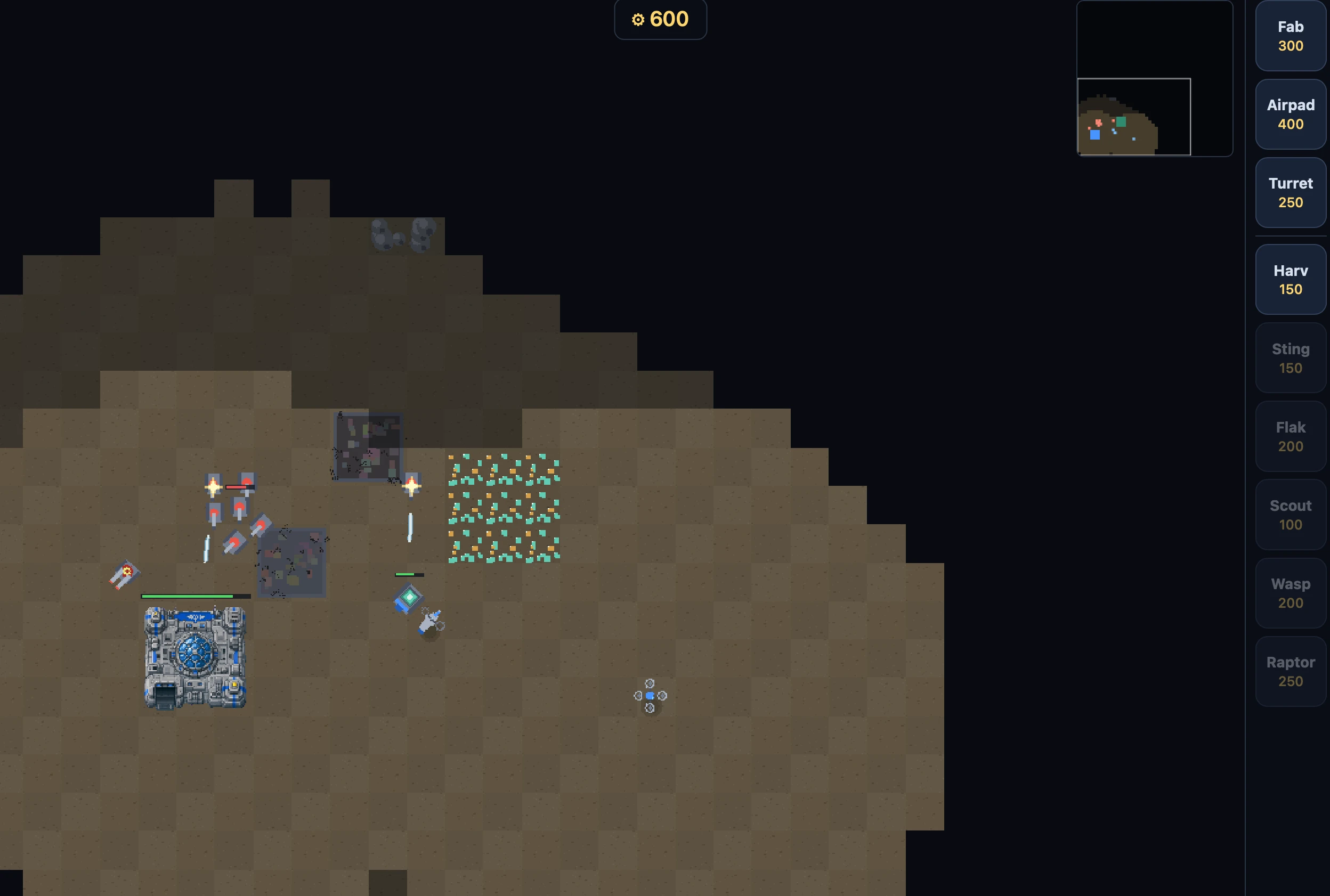
Simon Willison has published Battle Drones, a browser-based real-time strategy game in the mold of the 1995 Command & Conquer, playable on both mobile and desktop. The project reached its twelfth major iteration, built up through 321 commits made mostly by coding agents, primarily Claude Code. Willison describes it as heavily vibe coded: he has reviewed almost none of the code, and it is written in TypeScript, a language he has barely used himself. He has, however, playtested it extensively across the iterations. A video demo shows it running in a desktop browser.
The feature list is substantial. There are 9 building types, 7 ground vehicles, 6 aerial vehicles and 3 infantry units, all rendered as 3D models that can be browsed as a gallery. The game has fog of war, and different weapons are required to hit aerial versus ground targets. It ships with six maps across five biomes (temperate, desert, arctic, volcanic and tropical), plus a random map generator. Game modes include Skirmish, red versus blue on a rotationally symmetrical map, and Last Stand, where one player holds out against waves of enemies. Area-effect weapons include Barrage, EMP, Drop Pod and Sky Hammer, and crate drops grant bonus resources. The in-game music responds to events, intensifying as fighting breaks out. Several AI personalities are available, named Balanced, Rush, Air Swarm, Boom, Skyforce and Ironclad, and an AI-versus-AI mode lets you watch them play each other. There are also mutators that add rules or twists, a Daily Op challenge, ranks and achievements called Medals, and an Agent versus Agent mode in which two LLMs play against each other. A giant mech called the Goliath, with laser eyes, arm cannons and the ability to establish a new base, rounds out the roster.
The headline experiment is the multiplayer mode, which extends an earlier project called Chirp Pong: two nearby phones communicate by exchanging audio messages to synchronize game state. That means no network pairing, no server matchmaking, just microphones and speakers within range of each other. Willison notes an update adding online multiplayer as well, and remarks that the audio multiplayer induced headaches. For developers, the audio channel is an unusual transport choice. Synchronizing a real-time strategy game normally demands low, predictable latency; sound played through speakers and captured by a microphone introduces propagation delay, echo and ambient noise. A likely trade-off is that the design leans on loose synchronization, periodic state exchange or deterministic replay rather than fast tick-by-tick updates, and the short range is a feature as much as a limit. That reading is inference from the described setup rather than something the project documents.
The development history is as interesting as the game. The first prototype, started in July, was prompted as a mobile-friendly Command & Conquer-style RTS about two armies of drones, flying and ground-based, fighting over territory and resources. Assets came from the OpenAI image generation API, with an API key passed through an environment variable. The early versions used the Phaser 2D framework, something Willison only noticed several iterations later. Version 2 added sprites for all vehicles and the AI-versus-AI mode; version 3, built with Claude Opus 5.5 in October, added five new maps with generated terrain tiles and reworked sprites.
The turning point was version 4. Willison had been arguing that coding agents can build something that looks like a game but cannot make one genuinely compelling to play, so he gave the model a fair chance with a blunt prompt on his phone: make it a lot more fun. Running in an Ultracode mode, where Claude Code orchestrates many subagents through a JavaScript script called a dynamic workflow, the job ran overnight. The results, according to the release notes Claude wrote itself, included opening choices (Blitz, Industry or Air Wing), call-down powers, objectives and salvage from uplink relays, supply drops and wrecks, adaptive music, unit voices, an announcer, saved squads, an eight-mission campaign, heroes, seven mutators and a Daily Op. Balance shifted measurably: in 1,200 AI-versus-AI test matches on Normal, games still undecided after 25 minutes fell from 14% to 0.9%, and the share of wins by a side that had been 800 or more scrap behind rose from 24% to 46%. A large part of the elapsed time went into more than a thousand simulated playtest sessions whose results fed rebalancing and new units.
Version 5 ported the whole game to three.js with 3D models for buildings, vehicles and terrain, again over an overnight run; the models are constructed in TypeScript code rather than authored as art assets. Version 6 added visual polish, and version 7 added robot infantry (troopers, rocket squads, snipers) and a troop-carrying aircraft called the Condor. Version 8, the Archipelago map, came from Willison's longest prompt yet: limited harvester resources but more uplinks, placed on islands unreachable by land vehicles or infantry and unclaimable by air vehicles, so the only route is flying infantry in by Condor. Each army starts with a Condor and a squad, and a free Condor with a squad arrives if a player has none. The two headquarters sit on separate landmasses joined by two bridges in different places. Version 9 refined that map.
Version 10 added the Goliath, brainstormed as a mobile base that accepts harvested scrap, supports nearby construction even after moving, and produces infantry. It carries an eye laser, arm cannons, shoulder-mounted mortars and machine guns, and takes damage in stages that knock out weapons in sequence.
Why it matters: this is a concrete data point for teams weighing agent-driven development. A single developer produced a multi-mode 3D RTS with automated balance testing and an unconventional audio networking layer, while reviewing almost none of the code, which suggests the bottleneck shifts from writing code to specifying, playtesting and iterating. The audio-based multiplayer is a reminder that local, proximity-style communication can be a design primitive rather than a fallback, though latency and noise remain real constraints. For product teams, the more transferable lesson is the loop of blunt prompts plus simulated playtests producing measurable balance gains; whether that generalizes beyond games is, in my reading, still open.
Based on reporting from the original publisher. Visit the source for full context and later updates.
Publisher excerpt
My latest vibe coded game experiment is a Command & Conquer style RTS (Real Time Strategy) game called Battle Drones ( play it here ). Unlike my previous experiments , this one is actually fun to play . I'm somewhat embarrassed to admit that I got there by telling Claude to "Make it a LOT more fun". It also supports multiplayer between nearby devices using audio to synchronize game state! Here's what I've built so far, and some of the things I learned along the way. Battle Drones How I built this v1: the initial pr