[AINews] Anthropic files for $2T IPO in 2 weeks: 1400% growth rate, 48% of revenue through cloud partners, 85% margin, $1B op profit in Q2, $134B cash in bank and $10B lifetime burn
Anthropic publicly filed its S-1 on Monday at roughly 9am ET, moving toward a Nasdaq listing under the ticker "ANT." The document lays out a company that has crossed into operating profitability while carrying compute commitments reaching deep into the next decade. Reports from The Information, Fox Business and Bloomberg had signaled the timing, with the IPO itself expected around Nov 9.
Revenue scaled steeply. The company booked $41M in 2023 and $16.3B in H1 2026, about 14x year over year. Q2 alone came in at $11.6B, up 1,368% year over year. Q2 operating profit was $974M, and H1 operating cash flow was positive $3.9B. The headline $80.7B H1 net loss is largely an accounting artifact: it includes $81.1B of non-cash charges tied to financial instruments.
Gross margin swung hard along the way. Per Jamin Ball's reading of the filing, margin was 37% in 2023, negative 95% in 2024, 40% in 2025, 12% in H1 2025 and 85% in H1 2026. Free-cash-flow margin over the last six months was 21%, and the company burned under $10B in total to reach more than $16B in quarterly revenue. Ball also cited a widely reported $16.8B Q3 figure that is not in the S-1.
Capital efficiency is the eye-catching part. Anthropic has raised $141.1B in aggregate and holds $112.4B in cash plus $19.3B in short-term investments. SemiAnalysis put implied lifetime burn at about $9.7B and called it likely the most efficient scaling of a business in the history of capitalism. Derived cash and burn numbers do not agree across accounts: Austen Allred puts burn at $9.4B and cash around $132B, while Ball cites $134B today. Allred also claims $6.7B of positive cumulative free cash flow from 2023 to June 2026 and $575M per month currently, which sits awkwardly beside a roughly $9B lifetime burn. This suggests readers should treat derived cash-flow figures cautiously until the audited statements are clearer.
How the $141B breaks down matters for anyone modeling dilution. About $128.6B came from preferred stock proceeds. $11.3B was convertible notes from Amazon and Google issued in 2023-2025, of which about $5B has converted. The remaining $6.2B of principal carries a $108.6B fair-value liability because it converts at $2-5 per share against a roughly $59 Series H price. In practice those convertibles are closer to about 1.8B shares than to debt, and that mark-to-market is what drives most of the GAAP loss. Smaller pieces: about $0.6B of SAFEs and common stock and $0.7B from pre-2023 rounds.
Cloud distribution is a major channel. 48% of H1 2026 revenue, about $7.8B, flowed through Bedrock, Vertex and Azure Marketplace, up from 11% in 2023. Marketplace fees sit in sales, marketing and partnerships rather than cost of revenue, so they never touch the 85% headline gross margin. Channel-partner fees rose about $2.7B year over year. The reading offered by Bensign is that hyperscalers get paid twice, once for compute and again for distribution.
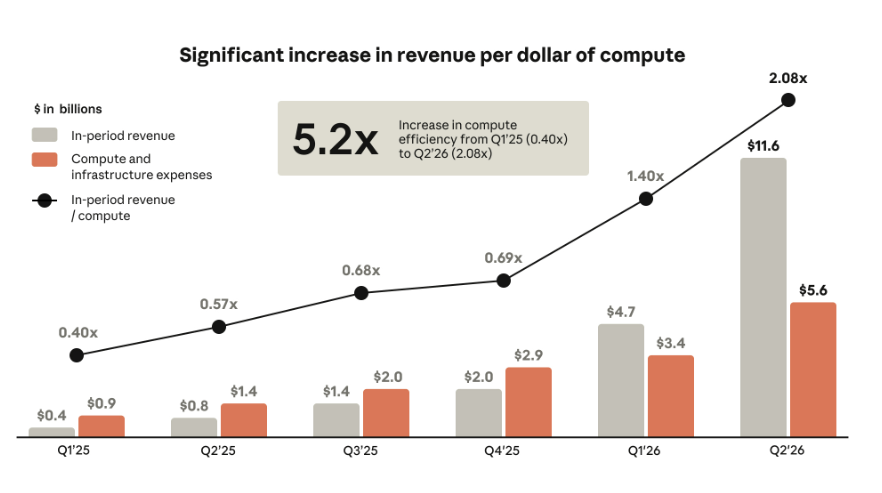
On compute economics, Aymeric Roucher derives $2.08 of revenue per $1 of compute, implying under a year of payback. Internal Claude usage passed monthly personnel costs excluding stock pay in April, and at list prices that usage grew more than 250x between January and September 2026. State of AI data cited in the coverage says Claude led 27% of Anthropic's R&D, and the filing states that over 90% of September codebase contributions were written by Claude.
Commitments are large and long. Non-cancelable obligations run into the next decade and include up to $120.5B for NVIDIA-powered compute through SpaceXAI under agreements extending into 2029. The filing also discloses a recent delay to pre-training of a new frontier model. One reader framed that as rational, arguing that training a 10T model on 100T tokens is partly wasteful and that Vera Rubin hardware will be pricier, while still expecting IPO capital to accelerate development.
Governance and float are unusual. The lockup is a staggered drip lasting more than a year rather than the customary 180-day cliff, and some holders can sell on day one, which should smooth the float. Five percent of shares go into a Public Benefit Fund, with the board able to add up to 2% more each time the company's value rises 50%. Founders have pledged 80% of their equity. Sarah Guo's first-pass read flags limited shareholder influence, a mismatch between consumption-based revenue and long-term compute obligations, heavy emphasis on bio and novel discovery, and roughly 20 pages of case studies starting near page 220.
The filing's narrative pitch is "virtual collaborators" rather than agents, aimed at a knowledge-worker population estimated to exceed one billion in 2028. Anthropic describes systems that carry the access rights, connections and context organizations grant them, navigate internal tools and execute multi-step workflows requiring sustained reasoning. The document also claims AI matching or exceeding leading human experts across most professional and scientific disciplines within a few years, autonomy lasting days or weeks with control of lab equipment and robots, and an early-stage, unvalidated molecular-machine discovery that could become a gene-editing tool. Compute is framed as the binding constraint for the foreseeable future. Dario Amodei's reply to critics was that Mythos-class models were held back from February to June.
One notable gap flagged by Elie Bakouch is any mention of in-house chip development. Risk factors say competitors may be better positioned to vertically integrate, including through proprietary chip design, and that Anthropic depends on third-party design houses for certain custom accelerator platforms. That sits in tension with a claim the day before from Dylan Patel that Anthropic has begun developing its own chip; Bakouch notes a chip team could still exist. Altimeter said it will participate majorly in the IPO on top of its existing stake.
Skeptical readings center on circularity: much revenue flows through Amazon and Google, which are simultaneously investors, suppliers and competitors, leaving unclear how much revenue is AI companies buying AI. Others note that a falling token price index in the filing mostly reflects model mix rather than price cuts, and that relative margins by model are not disclosed.
Why it matters: developers and product teams should expect Anthropic's commercial posture to be shaped by public-market scrutiny, with cloud marketplaces as the dominant distribution path and enterprise contracts increasingly framed around multi-step collaborative work rather than chat. The disclosed pre-training delay and enormous forward compute commitments suggest capacity, not demand, is the constraint that will govern model availability and pricing, which is inference from the filing's own framing. For teams building on Claude through Bedrock, Vertex or Azure, the channel economics above all else are worth watching.
Based on reporting from the original publisher. Visit the source for full context and later updates.
Publisher excerpt
The S-1, the numbers, and the reactions.