How IskayPet unified corporate knowledge with Amazon Bedrock Managed Knowledge Bases
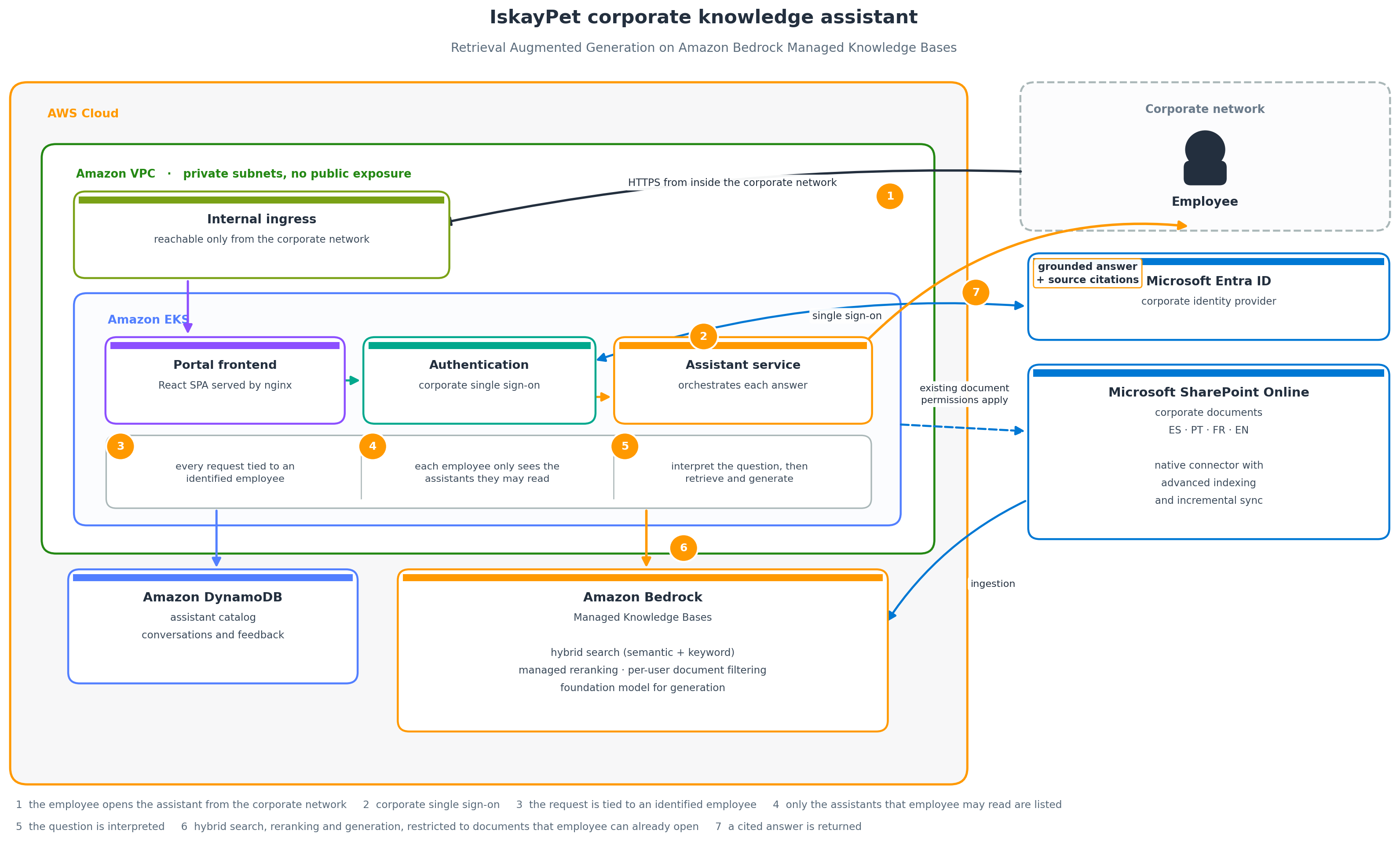
IskayPet, an Iberian pet care company operating more than 330 stores in Spain, Portugal and France under the Kiwoko, Tiendanimal, Kivet, Clinicanimal and Animalis brands, has put a corporate knowledge assistant into production on Amazon Bedrock Managed Knowledge Bases. The company, which has more than 4,500 employees and 7 million customers, described the deployment in a post on the AWS Machine Learning Blog. The assistant answers employee questions spanning retail operations, veterinary care, people and onboarding, and procurement, in Spanish, Portuguese, French and English, with no retrieval infrastructure for the company to run itself.
Before the build, office staff answered everyday operational questions — a return policy, a veterinary protocol, an onboarding step — by searching hundreds of Microsoft SharePoint documents by hand. With three countries and four languages, the company says searches took real time and answers were often outdated or wrong. The stated requirements were natural-language answers grounded in company documents, support for four languages in one system, routing of each question to the right body of knowledge without cross-contamination, the ability to add areas and countries without re-architecting, source citations, and reuse of the existing SharePoint repositories rather than a migration.
The assistant follows a standard retrieval-augmented generation flow, commonly called RAG. An employee types a question into a chat interface. The application calls the knowledge base tied to that assistant and passes the employee's identity, so document-level permissions are applied during retrieval. The knowledge base runs hybrid search — combining semantic matching with keyword (BM25) search — reranks the returned passages, and hands back the most relevant ones with source references. A foundation model then writes an answer grounded in those passages. The prompt requires citations and instructs the model to say when the answer is not present in the retrieved content. Employees see the answer with its source documents and can leave thumbs-up or thumbs-down feedback, which feeds the evaluation set.
On ingestion, the team avoided migrating content by using the native SharePoint connector. Under the data source's advanced settings they enabled the visual content indexing option, which extracts text from images embedded in PDF, DOCX and PPTX files as well as from standalone images. Figures and scanned material inside procedure documents therefore became searchable without a separate preprocessing pipeline. The connector syncs incrementally, picking up new and updated documents on each run.
The central architectural decision was how to organize knowledge across four languages, several business areas and three countries. IskayPet weighed a single shared knowledge base with country and area tags plus a per-query filter, which maximizes reuse of shared content but couples every domain into one index, against a dedicated knowledge base per assistant. It chose the latter. Each assistant points at specific SharePoint sites and can be narrowed further to particular document libraries or folders through inclusion paths, so it indexes only intended content rather than the whole corporate site. Adding a new area or country means adding an assistant and pointing it at the right content. The trade-off, as I read it, is that shared policy documents living in one place must be indexed into each assistant that needs them, which adds storage and sync overhead in exchange for clean isolation and independent tuning.
Access control reuses SharePoint permissions rather than rebuilding an authorization model, and the assistant grants nothing new — it only makes documents an employee could already open easier to query. It operates on two levels. First, an employee sees only the assistants whose underlying documentation they are entitled to read, whether through direct permission, group membership or folder access; if entitlement cannot be confirmed, the assistant is hidden. Second, the employee's identity is passed to the knowledge base, which returns passages only from documents that person may see. Because permissions are read from SharePoint on every check, revoking or granting access there is reflected without application changes. A consequence the post notes is that the same question can legitimately produce different answers for two employees with different permissions.
Retrieval and generation settings were tuned against an evaluation set. Chunking is handled by the managed service, so the team built no chunking pipeline. The assistant retrieves 25 passages, strips duplicates and fragments too short to add context, and injects up to 15 into the prompt. That count is described as the main cost lever, since it multiplies input tokens on every question. The generation prompt enforces a corporate tone, requires citations and tells the model to admit when retrieved content does not contain the answer. The team is adding Amazon Bedrock Guardrails to apply content filtering and responsible AI policies to generated answers, and is using native Bedrock RAG evaluation, drawing on real thumbs-up and thumbs-down feedback, to measure quality before and after changes.
Generation is deliberately decoupled from retrieval: because the knowledge base sits between the two, IskayPet can swap or upgrade the generation model without touching ingestion or retrieval. The company describes the generation model only as a cost-effective foundation model on Amazon Bedrock. The whole solution — the store-facing frontend, the AWS architecture and the deployment — was built with Kiro, the agentic development environment, running on Claude Haiku 4.5 on Amazon Bedrock. Kiro generated and iterated on UI code and helped design the architecture and provision knowledge base configuration, data sources, IAM roles and the application layer. IskayPet plans to evaluate new Bedrock models per use case as they appear.
On cost, multimodal parsing, embedding generation and reranking carry no additional charge, so ongoing spend comes mainly from index storage, retrieval API calls and generation-model tokens. Input tokens dominate in production because of the passages injected per prompt. The team is evaluating prompt caching for the stable portion of the prompt and batch inference for non-interactive workloads.
In roughly the first two months in production, IskayPet reports that time to find an operational answer dropped from 3–5 minutes to about 7 seconds, a reduction of around 95 percent in time spent searching for procedures and policies. The solution is expected to handle roughly 100,000 queries per month across all business areas and countries. One caveat worth noting is that these figures are self-reported by the company and cover a short window.
Why it matters: Teams weighing RAG for internal knowledge now have a detailed public reference for a managed approach — native SharePoint ingestion with permission-aware retrieval, one knowledge base per domain, and a tight cap on injected passages as the main cost control. Developers building similar assistants should note that the retrieval and access-control layer is largely handled by the platform, so the remaining engineering effort concentrates on scoping each assistant, prompt design and evaluation; in my reading, the main risks shift toward content hygiene in the source repositories and keeping evaluation sets current.
Based on reporting from the original publisher. Visit the source for full context and later updates.
Publisher excerpt
Learn how IskayPet, a leading pet care company in Iberia, built a multilingual corporate knowledge assistant on Amazon Bedrock Managed Knowledge Bases. The assistant answers employee questions across retail, veterinary, onboarding, and procurement in four languages and three countries, with no RAG infrastructure to manage.